

Commentary
Judy Dempsey
{
  "authors": [
    "Judy Dempsey"
  ],
  "type": "commentary",
  "blog": "Strategic Europe",
  "centerAffiliationAll": "",
  "centers": [
    "Carnegie Endowment for International Peace",
    "Carnegie Europe"
  ],
  "collections": [
    "Europe’s Eastern Neighborhood"
  ],
  "englishNewsletterAll": "",
  "nonEnglishNewsletterAll": "",
  "primaryCenter": "Carnegie Europe",
  "programAffiliation": "",
  "programs": [],
  "projects": [],
  "regions": [
    "Europe",
    "Eastern Europe",
    "Western Europe"
  ],
  "topics": [
    "EU",
    "Democracy"
  ]
}
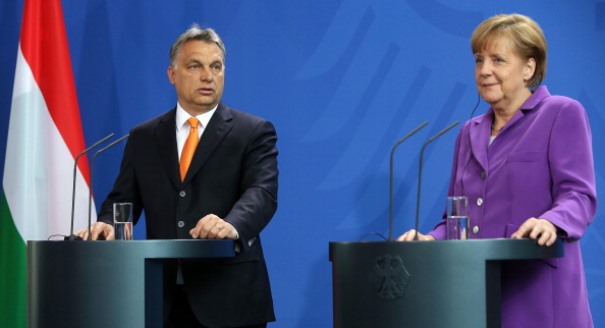
Source: Getty
The Hungarian prime minister is allowing corruption and patronage to damage his country’s political and economic system.
German Chancellor Angela Merkel, Europe’s most powerful leader, arrives in Hungary on February 2, her first visit to Budapest for five years. Merkel, no novice when it comes to judging how long she should stay in a country, will spend a mere five hours in the Hungarian capital.
During that time, she will visit a synagogue and meet university students. But the focal point of this short journey will naturally be her talks with Viktor Orbán. Hungary’s conservative prime minister has been in power since 2010. Fidesz, his party, won a two-thirds parliamentary majority then and again in 2014.
Such majorities have given Orbán a green light to change Hungary’s constitution and the chance to stamp his own special imprint on the country’s political and economic system. The effects have been for the worse.
Fidesz officials used to say such policies were simply aimed at dismantling the old Communist system that was based on corruption, patronage, and a lack of transparency. Now it is harder for the government to maintain that line, as its stance is difficult to distinguish from that it claims to oppose.
The United States has pulled no punches over Orbán’s style of governing. Washington recently blacklisted several Hungarian officials from entering the United States because of their involvement in corruption.
The EU, in contrast, is floundering over how to deal with Hungary. This is despite the fact that between 2014 and 2020, Hungary will receive €25.4 billion ($28.7 billion) in EU investment and structural funds. The EU’s antifraud agency, known as OLAF, is already investigating several cases of corruption or abuse of funds.
Merkel herself has watched Orbán’s metamorphosis from dissident during the 1980s to fiercely anti-Russian politician during the 2000s to supporter of an “Eastern” way since 2010.
#Orban has metamorphosed from dissident to anti-Russian to Putin-friendly.Tweet This
Over the past few years, Orbán has forged close ties with Russian President Vladimir Putin, especially with regard to energy. At a time when the EU is pushing for greater diversification of energy sources and promoting renewables that should be in Hungary’s interests, Orbán, whose country is dependent on Russia for its energy, is doing the opposite.
In 2014, during a visit to Moscow, Orbán concluded a €10 billion ($11 billion) credit line from the Russian bank Vnesheconombank to finance the building of a second nuclear power plant. In early December, the Hungarian parliament passed a law classifying almost all the details of the agreement. Russia, ironically, published some of them.
On December 9, Rosatom, Russia’s nuclear energy company, signed the plant’s construction contract with Hungary. That was just a week after Putin scrapped plans to build the South Stream gas pipeline, which would have brought gas from Russia to Central Europe, with Hungary as a partner.
Orbán’s attitude toward the Ukraine crisis has also irked his Ukrainian and EU interlocutors. He has never blocked the sanctions imposed on Russia following its meddling in eastern Ukraine, but he has been highly critical of them.
Furthermore, at one stage Orbán demanded autonomy for the ethnic Hungarian minority in Ukraine’s western Transcarpathia region. The implications of Orbán’s calls, which came just months after Putin annexed the Crimean peninsula in March 2014, were not lost on Kiev.
What disappointed Kiev even more was Orbán’s decision in September 2014 to cut the reverse flow of gas eastward to (rather than westward from) Ukraine. Hungary turned the taps off just two days after Alexey Miller, Gazprom’s chief executive, visited Budapest. The Russian gas company had put enormous pressure on Slovakia, another country dependent on Russia for its energy, not to reverse the flow of gas either.
#Orban's attitude toward the #Ukraine crisis has irked his EU interlocutors.Tweet This
No doubt Merkel will quiz Orbán about the Ukraine crisis and his energy policy when the two leaders meet. But also on her agenda is Orbán’s dispute with Hungary’s RTL Klub, a highly successful commercial TV station whose parent company, RTL Group, is owned by German media corporation Bertelsmann.
Last year, Hungary introduced a progressive tax on advertising revenues. RTL Klub was saddled with the top rate. Why? According to Dirk Gerkens, the station’s chief executive, the government didn’t want any criticism of its policies, let alone competition. RTL Klub has already filed a complaint to the European Commission.
“They [Fidesz] consider our news to be opposition news,” Gerkens said. “But that’s not the case. Our news is independent. We are not going to talk about the guys in opposition that are basically doing nothing.”
Oliver Fahlbusch, head of corporate communications at RTL Group, told Carnegie Europe that the station would continue its independent news reporting. “RTL Hungary has roughly a 13.5 percent share of the total Hungarian advertising market, yet RTL paid approximately 80 percent of the total advertising tax collected in this first round of advance taxation in 2014,” he stated. “This shows that the tax in its current form is clearly directed against RTL,” he added.
As for Gerkens, he has been at the receiving end of threats of violence. He moved his family out of Hungary. He moved out of his apartment and into a hotel in Budapest and hired bodyguards. “It’s not Russia or Mexico,” he said. “But better safe than sorry.”

Nonresident Senior Fellow, Carnegie Europe
Judy Dempsey is a nonresident senior fellow at Carnegie Europe
Recent Work
Judy Dempsey
Judy Dempsey
Carnegie does not take institutional positions on public policy issues; the views represented herein are those of the author(s) and do not necessarily reflect the views of Carnegie, its staff, or its trustees.

The EU can impose sanctions but struggles to enforce them without the United States. With Washington increasingly disinterested in backing European interests, the bloc must now fend for itself.


Nicu Popescu, Tiago Antunes

Russia is testing the waters of NATO’s mutual defense clause. What do strikes in Romanian territorial waters mean for the alliance’s posture toward Moscow?

Dimitar Bechev

With its public finances in shambles, the far right polling at 35 percent ahead of the 2027 presidential election, and a growing protest movement, is France’s crisis a threat to the EU’s geopolitical awakening?

Rym Momtaz, ed.

Ahead of a tough winter for Ukraine, Donald Trump’s swing back toward Russia bodes ill. But instead of panicking, Kyiv’s European allies are focusing on action.
Rym Momtaz

While the EU and European governments are embracing the much-lauded middle-power moment, this entails three difficult conundrums.

Richard Youngs