

Commentary
Judy Dempsey
{
  "authors": [
    "Judy Dempsey"
  ],
  "type": "commentary",
  "blog": "Strategic Europe",
  "centerAffiliationAll": "",
  "centers": [
    "Carnegie Endowment for International Peace",
    "Carnegie Europe"
  ],
  "collections": [
    "Europe’s Eastern Neighborhood"
  ],
  "englishNewsletterAll": "",
  "nonEnglishNewsletterAll": "",
  "primaryCenter": "Carnegie Europe",
  "programAffiliation": "",
  "programs": [],
  "projects": [],
  "regions": [
    "Russia",
    "Europe",
    "Eastern Europe"
  ],
  "topics": [
    "Foreign Policy",
    "EU",
    "Civil Society"
  ]
}
Source: Getty
Boris Nemtsov’s assassination should encourage the EU and European governments to support civil society movements in Russia and Eastern Europe.
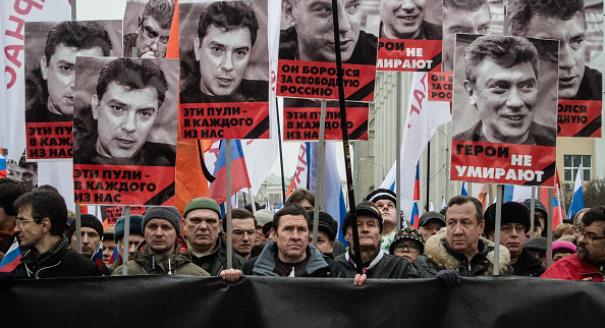
The thousands of Russians who turned out on March 1 to mourn the death of Boris Nemtsov defied those critics who believe that civil society hardly exists.
Many were holding big portraits of Nemtsov, a former Russian deputy prime minister who was gunned down on February 28. He had been a consistent critic of President Vladimir Putin. Some marchers carried homemade placards calling for an end to the propaganda and lies meted out by state-run television and media.
Their courage showed why the European Union, European governments, and foundations across Europe should support as much as possible Russia’s civil society, despite Putin’s attempts to muzzle any kind of independent thinking or actions.
That is why Euromaidan will need all the help it can get from the EU and European governments to complete Ukraine’s revolution and transformation. It is going to be a very long haul, but it is in the EU’s interests to have a democratic, stable, and prosperous Ukraine as its Eastern neighbor.
Russia is yet to have its own Euromaidan movement, despite some attempts a few years ago at building one. Nemtsov recognized the difficulties and the dangers in doing just that. Several critics and journalists who wanted to speak out against Putin’s Russia have been either killed or imprisoned.
Despite that, as an independent thinker and politician, Nemtsov spared no criticism of Putin’s domestic policies. He also had the nerve to speak out against the war in Ukraine. That was not easy to do given the wave of nationalism and the hatred of Ukraine’s leadership (and of the West) pumped out by the state media and the Kremlin. Indeed, Nemtsov was preparing to release a report challenging the Kremlin’s claims that Russia was not involved in eastern Ukraine.
European governments need to nurture #Russia's civil society.Tweet This
The critical reaction by the EU and most European leaders to Nemtsov’s assassination was swift. But now, European governments, including those who believe they can still do business with Putin, have a bigger task ahead of them: to nurture Russia’s civil society.
That task has become increasingly difficult. Philanthropists or foreign donors are deemed foreign agents. The latest casualty of the Kremlin’s efforts to suppress civil society is the Moscow School of Civic Awareness, formerly known as the Moscow School of Political Studies.
Over the past twenty years, the organization’s founder, Yelena Nemirovskaya, provided young and old Russians with a place in which to debate and learn. Guest speakers reveled in the hunger for ideas, for independent thinking. But now, the school has been forced to close its doors because of the way it was funded.
“What is secretive about an organization that posted every single word spoken by its lecturers in the public domain and disclosed every penny and kopek of its financing?” Konstantin Sonin, a columnist for Vedomosti, a business daily, and professor of economics at the Higher School of Economics in Moscow, wrote recently. “This type of education is not propaganda. It has no ulterior motives, no ‘hidden agenda’ and is always an engine of progress,” he added.
Progress, however, seems anathema to today’s Russia. Even Germany, once Russia’s greatest ally in Europe, now recognizes this. All the efforts by Germany’s Social Democrats to support the modernization of the Russian economy in the hope that such a step would eventually change the political system have backfired.
Yes, there are still any number of Russian sympathizers inside the Social Democratic Party who refuse to accept what Putin is doing to Russia. But something is changing among Germany’s political elites. Ursula von der Leyen, the German defense minister, recently said that the country’s security strategy had to be overhauled in response to Russia’s attempts to use “power politics and military force.”
In 2016, the ministry will publish a white book that will focus on the new threats facing Germany and how it should deal with them. In the meantime, the EU and European governments need to encourage civil society movements across Russia and Eastern Europe.
Is it that hard for European governments to puncture the #Kremlin's propaganda?Tweet This
Is it that difficult to introduce flexible visa arrangements for young people and to expand programs for students to study in EU countries? Is it that hard for European governments and foundations to puncture the propaganda financed by the Kremlin?
The one bit of good news this past weekend was the outcome of the general election in Estonia. The governing Reform Party managed to win the most seats in the country’s parliament. In doing so, it deprived the pro-Russian Center Party from clinching power. It also showed that it is possible to counter Russian propaganda through the ballot box and through a vibrant civil society.

Nonresident Senior Fellow, Carnegie Europe
Judy Dempsey is a nonresident senior fellow at Carnegie Europe
Recent Work
Judy Dempsey
Judy Dempsey
Carnegie does not take institutional positions on public policy issues; the views represented herein are those of the author(s) and do not necessarily reflect the views of Carnegie, its staff, or its trustees.

Ahead of a tough winter for Ukraine, Donald Trump’s swing back toward Russia bodes ill. But instead of panicking, Kyiv’s European allies are focusing on action.

Rym Momtaz

While the EU and European governments are embracing the much-lauded middle-power moment, this entails three difficult conundrums.

Richard Youngs

Much has been said of the changes Brussels is trying to make to the EU enlargement process. Here’s why gradual integration might—or might not—be the answer.

Dimitar Bechev

The European Commissioner for Trade is headed to China. But after President Xi’s bridge-building visit to Washington, can a more isolated EU overcome Beijing’s stranglehold on critical raw materials? Who will blink first?
Rym Momtaz, ed.

The domestic impacts of how long it is taking to end the war in Ukraine have pushed the French electorate to the political extremes and compromised the country’s diplomatic capacity.
Rym Momtaz