

Commentary
Judy Dempsey
{
  "authors": [
    "Judy Dempsey"
  ],
  "type": "commentary",
  "blog": "Strategic Europe",
  "centerAffiliationAll": "",
  "centers": [
    "Carnegie Endowment for International Peace",
    "Carnegie Europe"
  ],
  "collections": [
    "Europe’s Eastern Neighborhood"
  ],
  "englishNewsletterAll": "",
  "nonEnglishNewsletterAll": "",
  "primaryCenter": "Carnegie Europe",
  "programAffiliation": "",
  "programs": [],
  "projects": [],
  "regions": [
    "Russia",
    "Europe",
    "Eastern Europe",
    "Ukraine"
  ],
  "topics": [
    "Foreign Policy",
    "Democracy",
    "EU"
  ]
}
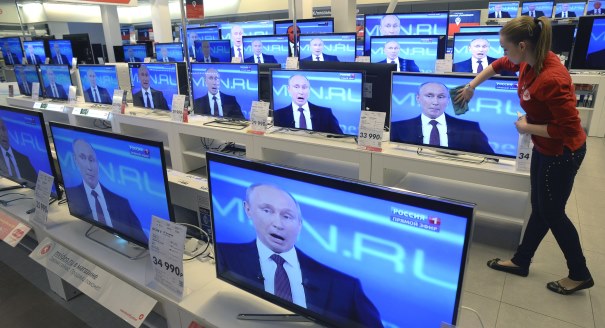
Source: Getty
The Kremlin’s clampdown on the media and sophisticated propaganda machine are giving the European Endowment for Democracy a new sense of focus.
The European Endowment for Democracy (EED), a brainchild of the Polish government, was established in October 2012 to support pro-democracy activists and organizations in Eastern Europe (but not in Russia).
What made the endowment different from other European foundations was its emphasis on speed and flexibility, its minimal bureaucracy, and its ability to adapt to changing realities.
In an interview with Carnegie Europe, Jerzy Pomianowski, the endowment’s executive director, explains how the war in Ukraine, Russia’s clampdown on the media, and the Kremlin’s sophisticated propaganda machine are giving the EED a new sense of focus. Central to that focus is the question of how to strengthen democracy beyond the EU’s neighborhood—including in Russia.
Jerzy Pomianowski: In December 2014, the board of the European Endowment for Democracy agreed to enlarge the organization’s geographic scope, to reach out to countries and societies beyond the EU neighborhood.
That includes Russia, countries in the Arab world aside from those already covered, and Central Asia. We are doing this organically, step by step.
Although we are now more aware of Russia’s influence in Eastern Europe, the situation of civil society in the countries of the EU’s Eastern Partnership hasn’t changed a lot in recent months. Russia’s state machinery is operating and meddling in those countries, through the media and through oligarchic corrupt economies. But this is not a new reality.
CE: What is the new reality?
JP: The new reality is that the political leadership in Europe finally realizes that there is an issue—not only with the role of Russian propaganda but also with the role of Russia itself in the region. We have a new level of awareness.
CE: What does this mean for EED’s role in Russia?
JP: There’s an open debate about what it means to be doing activities in Russia. Our partners have come to the conclusion that we cannot leave things as they are. And if we cannot leave things as they are, we have to ask what we can do to change the situation. The killing of Russian liberal politician Boris Nemtsov on February 27 is only adding urgency to this reflection. There are many Russians who share his views, and they deserve our solidarity.
CE: It’s increasingly difficult for Western foundations to operate in Russia. What can be done about that?
JP: I think that there is now a driving force for establishing new solutions. Traditional donors may find it increasingly difficult to operate in Russia. But flexible donor countries such as Norway and Sweden are doing work there in their own specific way. There are plenty of approaches that can be followed.
CE: What will be your modus operandi in Russia?
JP: We apply the same methodology that we apply in other hostile environments. We have to be very discrete. We have to be cautious not to expose our partners—the people we work with outside Russia but who provide support inside the country. There are many avenues we can pursue, but progress cannot be achieved overnight.
CE: Let’s turn to Ukraine. How has the crisis there changed your work in that country?
JP: Almost one third of our projects in Ukraine are focused on the media. One is European Pravda, a popular bilingual website that provides information in Russian and Ukrainian about developments on, for example, the EU-Ukraine Association Agreement. The project is about broadcasting information to Ukrainian society.
CE: So essentially, you are trying to give the view from the EU?
JP: Both from the EU and from inside Ukraine. Our ultimate goal is to bring about a plurality of debate, especially in the Russian-language media space. That is another part of our work in which we are strongly engaged.
CE: In other words, you are countering Russian propaganda?
JP: With the support of a grant from the Dutch government, we have launched a feasibility study on Russian-language media initiatives. This is about providing Russian-language alternatives to Russian state broadcasting for societies in the Eastern Partnership countries and beyond.
With a group of 90 experts and media representatives, we are closely analyzing many aspects: what kind of content is needed; what type of audiences can be reached; and what platforms can be used. We are looking at how to strengthen existing outlets that provide independent content in Russian. And we are assessing where there are potential synergies, for example through exchanges or joint production platforms. The feasibility study will include concrete recommendations for donors, including the EED.
The initial findings will be presented at the Eastern Partnership summit in Riga in May. The formal study will be finished by June. This is a joint reflection by those who are seriously considering a Russian-language audience.
CE: With such an emphasis on the Russian-language media, what about the EED providing an alternative to the media in Russia itself?
JP: Over the past ten years, the free media have been disappearing from the Russian landscape. The degradation of journalistic standards in the four main TV channels, which are Kremlin-driven, has been dramatic.
Years of domination by state propaganda mean that 100 million people on our continent are damaged on a daily basis by false ideas, by a strange set of values that do not reflect the society that they belong to.
Russian culture is a part of European civilization in a deep sense. There are millions of people like Nemtsov and others who were and are absolutely convinced of this. Unfortunately, there will soon be a whole generation of Russians who know only the machinery of social and intellectual engineering. They start to believe it. This is a long-term damaging and dangerous phenomenon.
Our work is about providing some alternative to Russian state media, so Russians can choose what information they receive, and then about putting this alternative into a form that is captured by a combination of news and entertainment. That is the challenge we are facing, debating, and trying to answer.
CE: With an initial budget of €14 million ($15 million), do you have enough funds to support your projects?
JP: There’s enough money for now. We are waiting for new contributions. Some are coming, some are not.
CE: Are all the big EU countries now on board with the endowment’s work?
JP: Germany is on board but with very modest support. The UK is absent but interested in participating in discussions.
CE: Who else is absent?
JP: Austria, Italy, Portugal, and France. New Europe is in.
CE: Actually, thirteen of the 28 EU member states do not support the EED. They include Greece, Cyprus, Slovenia, Croatia, Finland, Ireland, Malta, and Luxembourg.

Nonresident Senior Fellow, Carnegie Europe
Dempsey is a nonresident senior fellow at Carnegie Europe
Recent Work
Judy Dempsey
Judy Dempsey
Carnegie does not take institutional positions on public policy issues; the views represented herein are those of the author(s) and do not necessarily reflect the views of Carnegie, its staff, or its trustees.
French President Emmanuel Macron has unveiled his country’s new nuclear doctrine. Are the changes he has made enough to reassure France’s European partners in the current geopolitical context?

Rym Momtaz, ed.
European reactions to the war in Iran have lost sight of wider political dynamics. The EU must position itself for the next phase of the crisis without giving up on its principles.

Richard Youngs
Europe isn’t as weak in the new geopolitics of power as many would believe. But to leverage its assets and claim a sphere of influence, Brussels must stop undercutting itself.

Dimitar Bechev
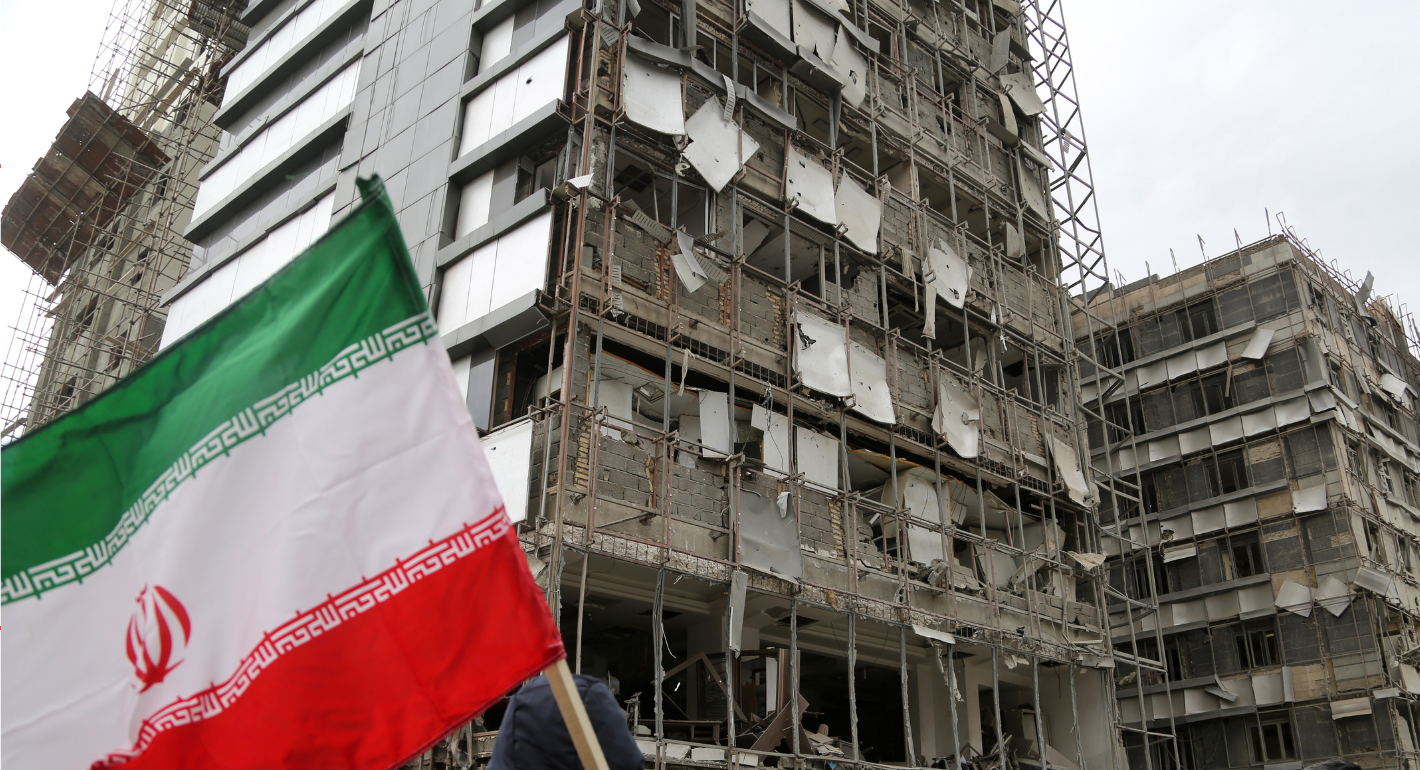
Europe’s reaction to the war in Iran has been disunited and meek, a far cry from its previously leading role in diplomacy with Tehran. To avoid being condemned to the sidelines while escalation continues, Brussels needs to stand up for international law.

Pierre Vimont
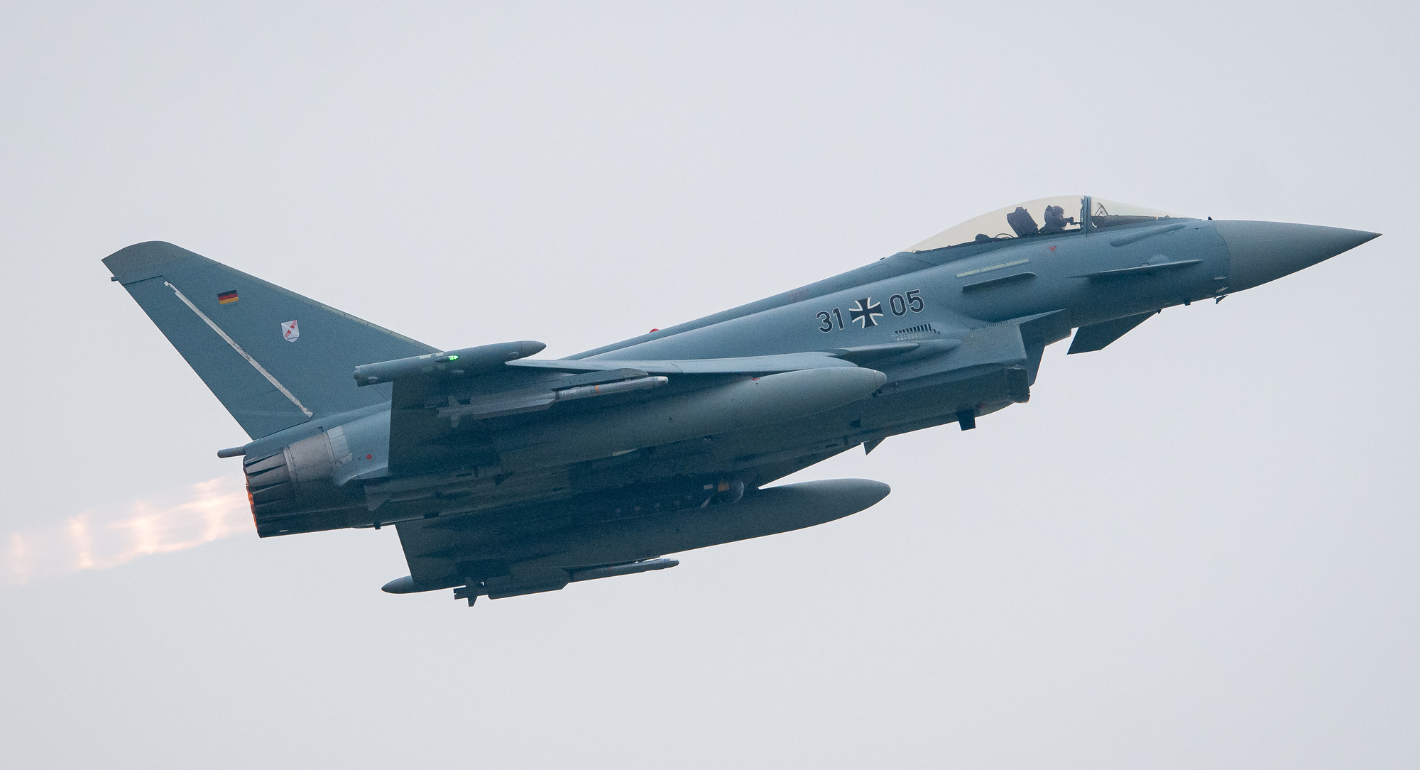
France and Germany’s failure to agree on the Future Combat Air System (FCAS) raises questions about European defense. Amid industrial rivalries and competing strategic cultures, what does the future of European military industrial projects look like?
Rym Momtaz, ed.