

Commentary
Judy Dempsey
{
  "authors": [
    "Judy Dempsey"
  ],
  "type": "commentary",
  "blog": "Strategic Europe",
  "centerAffiliationAll": "",
  "centers": [
    "Carnegie Endowment for International Peace",
    "Carnegie Europe"
  ],
  "collections": [
    "Europe’s Eastern Neighborhood"
  ],
  "englishNewsletterAll": "",
  "nonEnglishNewsletterAll": "",
  "primaryCenter": "Carnegie Europe",
  "programAffiliation": "",
  "programs": [],
  "projects": [],
  "regions": [
    "Europe",
    "Eastern Europe",
    "Ukraine"
  ],
  "topics": [
    "Economy",
    "EU"
  ]
}
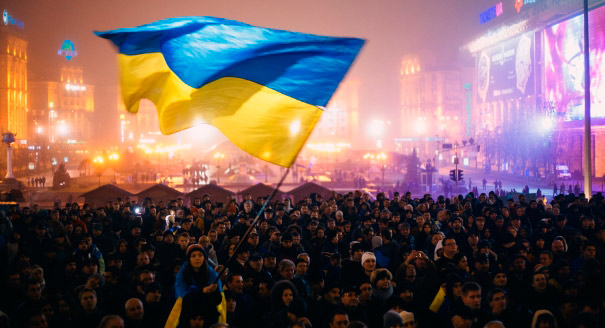
Source: Getty
A new report on how to rebuild Ukraine’s economy shows why Ukraine can’t follow Poland’s example. To ensure reforms succeed, Kiev must take on the oligarchs.
There have been any number of reports about the parlous state of Ukraine’s economy, and any number of working groups have been set up, each offering advice and advisers to the government in Kiev.
Even oligarchs such as Dmytro Firtash, who is steeped in corruption and has perpetuated Ukraine’s dysfunctional institutions, is trying to build his own so-called reform team from Vienna. This is despite the fact that the business activities of Firtash, an energy mogul, thrived under ousted president Viktor Yanukovych. He is under effective house arrest in Vienna awaiting extradition to the United States to face corruption charges over accusations of bribery.
It is also from the Austrian capital that the Vienna Institute for International Economic Studies, a research center long respected for its analysis of Europe’s Eastern neighbors, published a report on April 15 on what Ukraine and the EU have to do to reform Ukraine and stabilize its economy. The study paints a gloomy picture of a long and difficult road ahead.
And the report has no qualms in proposing that the Ukrainian government shift its spending priorities from the military to more socially oriented areas.
Above all, the EU could play a role by “design[ing] a Marshall Plan for Ukraine, which would include financial aid, institutional reform, and help to foster economic restructuring, trade, and investment,” states Peter Havlik, one of the authors of the study. Were that to happen, the architects of such a plan would have to adopt a hands-on approach to make up for all the lost potential of the country.
The research also makes clear there are few models that Ukraine can replicate. The report categorically rejects the notion that Poland’s shock therapy reforms of the early 1990s, which helped consolidate that country’s post-Communist transition, could be applied to the Ukraine of today.
It’s hard to believe that in 1991, Poland and Ukraine started their transformations from a roughly similar development level. According to the study, in 1991, Poland’s per capita gross domestic product (GDP) was €4,500 ($4,800), or 32 percent of the average of the EU’s 28 current members. Ukraine’s per capita GDP was €3,700 ($3,900), or 26 percent of the EU average.
By 2016—and this is such a stark contrast—Poland’s per capita GDP will have reached €21,000 ($22,000), or 70 percent of the EU average. Ukraine’s will have slumped to less than 23 percent of the EU average, standing at €6,200 ($6,600). This is despite the fact that Ukraine is endowed with fertile land and a wealth of commodities including iron, steel, and coal.
#Ukraine has failed to take off since it declared its independence in 1991.Tweet This
Yet Ukraine, which declared its independence in 1991, has failed to take off since then. Poland, in contrast, embarked on its shock therapy program (much criticized by the authors of the report for its high social costs) to radically make the break from a country with a central command economy to one with a market economy.
Ukraine dabbled in shock therapy too. The results were terrible: hyperinflation and a deep and protracted contraction of production. Poland went through that as well.
But there was an essential difference between the two countries. The state institutions in Poland were reformed, and there was a strong civil society to help make that transition. “[In Poland] there was a fairly consistent evolution of the state’s constitutional and legal framework, with a reasonably clear delineation of the powers of various state institutions,” the report states.
That never happened in Ukraine. “Ukraine’s track record of the past 25 years is that the responses to crises typically involved the change of persons in charge of policy—and not the change in policy itself,” according to the study.
This is a crucial point. Poland and Ukraine did transform into nations with market economies, with state assets in both countries diminishing. But by and large, Poland kept a distance between the politicians and business—not that this is ever easy in a democracy.
In Ukraine, however, “the state has been captured by the oligarchic interests,” the report states. “The conduct of the state’s economic policy has been directly controlled by the business ‘moguls’ whose fortunes derive, primarily, from shameless—and unpunished—looting of public assets, extortion of huge underserved subsides, etc.”
As if that’s not bad enough, the report argues convincingly that the Ukrainian ruling political class is indistinguishable from the country’s pretty narrow oligarchy. The oligarchs control the political parties (and therefore the legislature) and have their own paramilitary forces. The very same people also tend to be in charge of “economic reform,” the report states.
Moreover, the government seems unwilling to control private monopolies or capital flight. How can it when corruption is “rampant on all levels of public administration”? The report goes on the describe how “the ‘masses’—i.e. the underprivileged majority (including small business)—are at the mercy of a wilful and corrupt bureaucracy.”
The Viennese institute’s analysis pulls no punches about Ukraine’s prospects. Indeed, its tone is not particularly optimistic.
It is going to require an enormous EU commitment to turn #Ukraine around.Tweet This
It is going to require an enormous political and economic commitment from the EU to turn Ukraine around. And it is going to take a long, long time.
Just look how long it is taking EU members Bulgaria and Romania to turn the corner. Romania may finally be making that turn that because the Romanian public, young and old, became fed up of corruption, weak governance and rule of law, and intimidation by oligarchs. They elected Klaus Iohannis as president in November 2014 precisely to end the wasted years and begin afresh.
Ukraine is not yet there, not by a long shot. The power of the oligarchs is immense and entrenched, notwithstanding President Petro Poroshenko’s sacking on March 25 of Ihor Kolomoyskyi, an oligarch who was governor of the Dnipropetrovsk region.
But in comparison with the 1990s or the early 2000s, something fundamental has happened in Ukraine in recent years. There is now a civil society that is doing everything possible to keep justice, transparency, and the fight against corruption at the top of the political agenda.
Civil society is going to need all the help it can get from the EU. Without the rule of law and a vibrant civil society, sustainable political and economic reforms are not possible. And a failure to reform is in neither Ukraine’s nor Europe’s interests.

Nonresident Senior Fellow, Carnegie Europe
Dempsey is a nonresident senior fellow at Carnegie Europe
Recent Work
Judy Dempsey
Judy Dempsey
Carnegie does not take institutional positions on public policy issues; the views represented herein are those of the author(s) and do not necessarily reflect the views of Carnegie, its staff, or its trustees.
Hungarians head to the polls on April 12 for an election of national and European consequence. Three different outcomes are on the cards, each with their own implications for the EU.
Zsuzsanna Szelényi
The far right failed to win big in France’s municipal elections. But that’s not good news for the country’s left wing, which remained disunited while the broader right consolidated its momentum ahead of the 2027 presidential race.
Catherine Fieschi
Donald Trump has demanded that European allies send ships to the Strait of Hormuz while his war of choice in Iran rages on. He has constantly berated NATO while the alliance’s secretary-general has emphatically supported him.

Rym Momtaz, ed.
The EU is structurally incapable of reacting to today’s foreign policy crises. The union must fold the EEAS into the European Commission and create a security council better prepared to take action on the global stage.

Stefan Lehne
The war in Ukraine is costing Russia its leverage overseas. Across the South Caucasus and Middle East, this presents an opportunity for Europe to pick up the pieces and claim its own sphere of influence.

William Dixon, Maksym Beznosiuk