

Commentary
Judy Dempsey
{
  "authors": [
    "Judy Dempsey"
  ],
  "type": "commentary",
  "blog": "Strategic Europe",
  "centerAffiliationAll": "",
  "centers": [
    "Carnegie Endowment for International Peace",
    "Carnegie Europe"
  ],
  "collections": [
    "Europe’s Eastern Neighborhood"
  ],
  "englishNewsletterAll": "",
  "nonEnglishNewsletterAll": "",
  "primaryCenter": "Carnegie Europe",
  "programAffiliation": "",
  "programs": [],
  "projects": [],
  "regions": [
    "Europe",
    "Western Europe"
  ],
  "topics": [
    "EU",
    "Climate Change",
    "Foreign Policy"
  ]
}
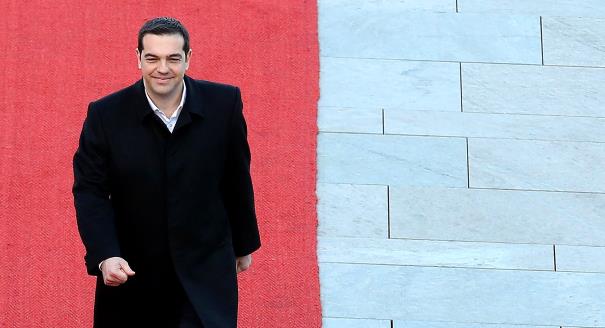
Source: Getty
Greek Prime Minister Alexis Tsipras travels to Moscow on April 8 desperate to win concessions over cheap energy and to play Russia off against Germany. Will he succeed?
Hardly three weeks since German Chancellor Angela Merkel rolled out the red carpet for Alexis Tsipras in Berlin, the Greek prime minister heads to Moscow on April 8 to meet Vladimir Putin, the Russian president.
Merkel had gone out of her way to improve ties with the Greek government. Relations had become poisoned because of the anti-German rhetoric used by Athens over World War II reparations that Greece alleged it was owed by Berlin.
The war reparations claim and Tsipras’s visit to Moscow may be attempts by Athens to play Russia off against the European Union—or rather, against Germany. But if Tsipras’s intention is to use his talks with Putin to exert leverage over eurozone countries to ease the conditions for extending financial assistance to Greece, his efforts could well backfire. Tsipras needs Merkel more than he needs Putin.
It is she who is Europe’s undisputed leader. It is she, and her Finance Minister Wolfgang Schäuble, who can influence the terms under which the other eurozone countries—via the so-called troika of the International Monetary Fund, the European Central Bank, and the European Commission—will extend more loan guarantees to Athens.
Greece also needs the EU more than it needs Russia, even though Greece has traditionally had very close ties with Russia. The EU is Greece’s largest trading partner. And for the period from 2014 to 2020, the EU allocated a total of up to €20 billion ($22 billion) in structural and investment funds to Greece. Can Russia match that?
Before the Ukraine crisis, some EU governments had considered that if Greece were to leave the EU, the union could weather that storm. They are mistaken. Despite the immense difficulties and frustrations in dealing with the Tsipras government, a Grexit would do untold damage to the credibility of the euro and of the EU.
Furthermore, Russia’s March 2014 annexation of Crimea and its invasion of eastern Ukraine have changed the parameters of Greece’s continuing financial and political crisis. The crisis has profound geostrategic implications that cannot be overestimated. The EU cannot afford a fractured bloc—something that the Kremlin would no doubt welcome.
Yet Tsipras and other EU leaders continue to court Russia. In almost all cases, apart from personal connections, it is energy that drives them to Moscow. Tsipras needs cheap energy, but also cheap loans and the chance to sell fruit and other produce again to Russia.
Russia slapped embargoes on certain EU food products in retaliation for the sanctions the EU imposed on Russia after its annexation of the Crimean Peninsula. Now, according to Greek and Russian press reports, Moscow might consider lifting its embargo of Greek produce. More importantly, Putin might also lower the price of gas exports to Greece. Were he to do so, he would simply confirm once again how the Kremlin uses energy as a political instrument.
This was clear on April 7 when the Greek, Serbian, Hungarian, and Macedonian foreign ministers, along with the Turkish European affairs minister, met in Budapest to discuss energy ties with Russia. There, they agreed to consider participating in plans by Russia to build a new pipeline that would bring gas from Russia via the Black Sea to a gas hub at the Turkish-Greek border.
“It is very important to find alternative solutions, like low-cost credit or competitiveness through cheap energy,” said Nikos Kotzias, the Greek foreign minister.
The Budapest meeting exposed the EU’s weak flank in Southeastern Europe. Putin was already given the red carpet treatment during his visits to Austria in June 2014, to Serbia (an EU candidate country) in October 2014, and to Hungary in February 2015. And don’t forget the trips to Moscow in March by the Cypriot president and the Italian prime minister.
As if to sow further divisions inside the EU, Russia hinted that it might also lift its embargo for exports from Hungary and Cyprus as well as Greece.
Moscow’s actions may be part of a plan to weaken the EU’s resolve before leaders meet in June to consider whether to prolong the bloc’s sanctions on Russia. Merkel has repeatedly said the sanctions will remain in place until the February 2015 accord known as Minsk II, which set out the terms for a ceasefire in eastern Ukraine, is fully implemented.
So far, against all the odds and all the misgivings of Tsipras and other leaders over the sanctions, the EU has held together. Tsipras, at this stage, can hardly afford to break ranks, cheap promises of energy notwithstanding. But for how long can Merkel maintain that unity?

Nonresident Senior Fellow, Carnegie Europe
Judy Dempsey is a nonresident senior fellow at Carnegie Europe
Recent Work
Judy Dempsey
Judy Dempsey
Carnegie does not take institutional positions on public policy issues; the views represented herein are those of the author(s) and do not necessarily reflect the views of Carnegie, its staff, or its trustees.
As we close out another season of Strategic Europe, it is worth taking stock of the deep shifts underway.

Rym Momtaz
The EU had to compromise to adopt a twenty-first sanctions package against Russia, exposing growing cracks in the union’s resolve. Is this latest, weaker round worth it to keep pressure on Moscow?
Rym Momtaz, ed.

Trump is distracted and Ukraine wants Europe to step up. The continent’s leaders must find their voice and assert it in talks with Russia.

Alissa de Carbonnel

Mounting economic strain and battlefield losses will not necessarily make the Kremlin less dangerous. They could instead push Moscow toward a more aggressive hybrid campaign designed to test NATO’s Eastern flank, exploit allied hesitation, and fracture European resolve.

Maksym Beznosiuk

Over the past ten years, NATO has held almost as many summits as it did during the entirety of the Cold War. Are they still useful, or is it time to stop holding annual meetings?
Rym Momtaz, ed.