

Commentary
Judy Dempsey
{
  "authors": [
    "Judy Dempsey"
  ],
  "type": "commentary",
  "blog": "Strategic Europe",
  "centerAffiliationAll": "",
  "centers": [
    "Carnegie Endowment for International Peace",
    "Carnegie Europe",
    "Carnegie Russia Eurasia Center"
  ],
  "collections": [
    "Europe’s Eastern Neighborhood"
  ],
  "englishNewsletterAll": "",
  "nonEnglishNewsletterAll": "",
  "primaryCenter": "Carnegie Europe",
  "programAffiliation": "",
  "programs": [],
  "projects": [],
  "regions": [
    "Europe",
    "Eastern Europe",
    "Ukraine"
  ],
  "topics": [
    "Security",
    "EU"
  ]
}
Source: Getty
The OSCE has no unhindered access to check what and who enters Ukraine from Russia. That makes a mockery of the ceasefire in Ukraine and undermines the organization.
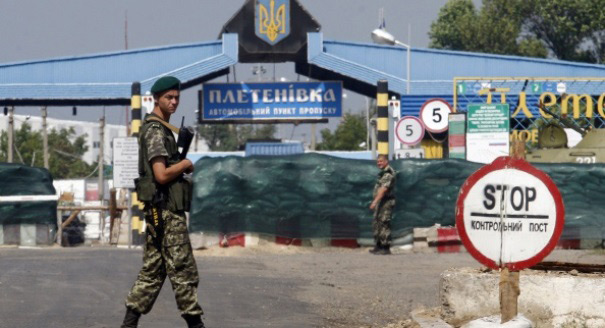
Each day and night, monitors from the Organization for Security and Cooperation in Europe (OSCE) keep watch on Russia’s side of the country’s border with Ukraine. The monitors—nineteen in total (yes, nineteen)—have a mandate to observe what happens at the Russian checkpoints of Donetsk (not to be confused with the Ukrainian city of Donetsk) and Gukovo.
That mandate began in July 2014 and should have had more importance. Indeed, it should even have been strengthened after the Minsk II ceasefire accord reached in February 2015 by French, German, Russian, and Ukrainian leaders. But it wasn’t.
The OSCE monitors have no illusions about the difficulties in implementing the ceasefire. Indeed, the monitors are so hindered in almost everything they do that they have no idea what and who crosses over from Russia to Ukraine each day.
What they do know is that weapons and soldiers from Russia can and do easily cross into Ukraine, where they can then supply the rebel-held areas of Donetsk and Luhansk in eastern Ukraine. That is the assessment of OSCE diplomats who are familiar with the Russian crossing points and who spoke to Carnegie Europe on condition of anonymity.
The nineteen monitors, who take it in turns to observe in pairs over a twenty-four-hour stretch, keep watch over a mere 20 meters (66 feet) of land that divides the entry and exit points of the Russian frontier crossings at Donetsk and Gukovo.
In theory, that should give the monitors plenty of opportunity to see exactly what is taking place. In practice, they can see. But that is all. What they see does not always reflect the reality. “We don’t have any law enforcement capabilities,” an OSCE diplomat said. “We cannot inspect.”
According to another OSCE diplomat, since the end of February 2015, almost every day about 100 men, and some women, dressed in camouflage have entered Ukraine through these border crossings. “Some have told us they are volunteer fighters,” the diplomat said. “They all carry rucksacks. And they carry weapons, but nonlethal ones.” How many volunteers cross the other border points is anyone’s guess.
The @OSCE is powerless in stopping fighters from entering #Ukraine.Tweet This
Then there are the many civilians who cross too. The OSCE has no idea if any of them are volunteers. What the organization does know is that from July 2014 until the end of February 2015, some 2 million civilians have gone back and forth, many seeking refuge in Russia but returning to Ukraine once it was safe to do so.
Just as the OSCE is powerless in stopping fighters from entering Ukraine, so too they are powerless in inspecting the so-called humanitarian aid lorries. “We simply don’t have full freedom to check them,” the diplomat explained.
That’s an understatement. On any given day, if a truck crosses, the monitors can “check” it. “The trucks are visually checked by opening their back doors. You look at what you see. You can’t climb into the truck. This is not an inspection. It takes less than a minute,” he added.
There are special X-ray systems in which a truck drives through an open-ended container that can scan the vehicle’s contents. “The Russians don’t allow that,” the diplomat said. “So we have no idea what’s in any of the trucks.”
Things aren’t much better for the team of OSCE monitors who are supposed to observe the ceasefire on the Ukrainian side of the border. They are not allowed to approach those parts of the frontier held by the rebels.
And even if they want to observe what is happening along the ceasefire lines, they have to ask permission or are escorted by the rebels. There is no scope for spontaneity. Besides, it is still dangerous. The daily report issued on April 27 by the OSCE’s Special Monitoring Mission to Ukraine makes for grim reading. It described how the area around Ukraine’s Donetsk airport had “seriously deteriorated.”
The #OSCE has no illusions about the difficulties in implementing the ceasefire in #Ukraine.Tweet This
Some 550 explosions were heard near Donetsk. “Approximately 90% of all the explosions were caused by 120mm mortar and heavy artillery rounds. The number of violations in this area has increased sharply compared to the violations recorded in the previous days,” according to the report. And the village of Sakhanka, just 24 kilometers (15 miles) east of Mariupol, a strategic city still under Ukrainian control, was shelled on April 25.
This upsurge of fighting may be a prelude to the seventieth anniversary of the end of World War Two, which will be celebrated with a huge military parade in Moscow on May 9. Whatever the outcome, the OSCE monitors know what they cannot do. And even if they called for a more robust mandate, they would never obtain it. It would be vetoed by one of the organization’s 57 members—Russia.

Nonresident Senior Fellow, Carnegie Europe
Dempsey is a nonresident senior fellow at Carnegie Europe
Recent Work
Judy Dempsey
Judy Dempsey
Carnegie does not take institutional positions on public policy issues; the views represented herein are those of the author(s) and do not necessarily reflect the views of Carnegie, its staff, or its trustees.
Hungarians head to the polls on April 12 for an election of national and European consequence. Three different outcomes are on the cards, each with their own implications for the EU.
Zsuzsanna Szelényi
The far right failed to win big in France’s municipal elections. But that’s not good news for the country’s left wing, which remained disunited while the broader right consolidated its momentum ahead of the 2027 presidential race.
Catherine Fieschi
Donald Trump has demanded that European allies send ships to the Strait of Hormuz while his war of choice in Iran rages on. He has constantly berated NATO while the alliance’s secretary-general has emphatically supported him.

Rym Momtaz, ed.
The EU is structurally incapable of reacting to today’s foreign policy crises. The union must fold the EEAS into the European Commission and create a security council better prepared to take action on the global stage.

Stefan Lehne
The war in Ukraine is costing Russia its leverage overseas. Across the South Caucasus and Middle East, this presents an opportunity for Europe to pick up the pieces and claim its own sphere of influence.

William Dixon, Maksym Beznosiuk