

Commentary
Judy Dempsey
{
  "authors": [
    "Judy Dempsey"
  ],
  "type": "commentary",
  "blog": "Strategic Europe",
  "centerAffiliationAll": "",
  "centers": [
    "Carnegie Endowment for International Peace",
    "Carnegie Europe"
  ],
  "collections": [
    "EU Integration and Enlargement"
  ],
  "englishNewsletterAll": "",
  "nonEnglishNewsletterAll": "",
  "primaryCenter": "Carnegie Europe",
  "programAffiliation": "",
  "programs": [],
  "projects": [],
  "regions": [
    "Europe",
    "Western Europe",
    "Germany"
  ],
  "topics": [
    "Foreign Policy",
    "EU"
  ]
}
Source: Getty
Something is out of sync between Berlin and Warsaw at a time when they need more than ever to work together.
Carnegie Europe was on the ground at the 2016 Munich Security Conference, offering readers exclusive access to the debates as they unfolded and providing insights on today’s most urgent international issues. Check out our live coverage here.
*
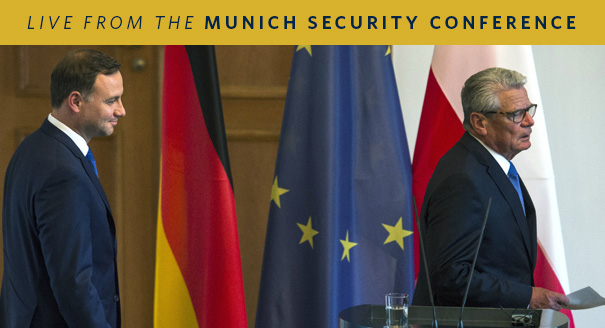
When Polish President Andrzej Duda was recently hosted in Berlin by his German counterpart Joachim Gauck, he had only praise for a relationship that has blossomed between both countries. “It’s a treasure of one,” a Polish diplomat said after the state visit.
But after so many years of suspicion, a certain trust between the neighbors took hold. That trust got a boost in 2006, when Merkel went out of her way to defend Poland when Russia extended an embargo on Polish meat imports. In Russia view, Poland’s live animal products failed certain hygienic standards.
Yet since the election of the Law and Justice party last October, preceded by Duda’s election as president with the Law and Justice party’s support, the relationship between Berlin and Warsaw has lost a special stability and predictability.
Duda, who participated in a presidential panel discussion at the Munich Security Conference this morning, spelt out what was going wrong. “We want good relations with Germany but we want a partner relationship. We want an equal partnership,” he said.
When he was asked to be a bit more specific, Duda replied: “We want that the interests of both countries are respected. And if we have problems, we should discuss and understand each other.”
When Duda was again pressed further to explain the problem, he said that Poland’s customs and interests should be respected. Presumably, he wanted the German media to lay off criticizing the Law and Justice party’s conservative values, its reshuffle of constitutional court judges, and its radical overhaul of editors and chiefs of the state broadcasting channels.
But one of the biggest issues dogging the Polish-German relationship is the Nord Stream 2 pipeline project. This second pipeline that is being built by Gazprom and German, Austrian, and French energy companies will increase Russia’s ability to send gas directly to Germany. In doing so, it will weaken Russia’s dependence on Ukraine as the main transit country for Russian gas exports to Europe.
It is hard to underestimate Poland’s criticism of this project. “We heard that the project is only about business. Private business,” said Duda. “But in reality it is a political problem. There is no economic reason to invest in it. We have many other pipelines between Russia and Europe. Why should the Germans build together with Gazprom a pipeline against the interests of Poland and other countries [in the region]?” Duda asked.
And here is the real nub of the problem that gets to the heart of the Polish-German complex. Poland has a residual fear of Germany’s old relationship with Russia. While this relationship has changed a great deal under Merkel, Polish elites—but also the Polish public—still have a deep-seated fear and experience of Germany and Russia doing deals behind Poland’s back; doing deals that will undermine Poland and its interests. History has shaped these perceptions of this highly complex Polish-German relationship.
The energy issue feeds into a Polish resentment over Merkel’s refugee policy.
The former Civic Platform government had opposed Merkel’s open-door policy and the request by the European Commission that member states accept a quota system for receiving refugees across the EU. Similar to Poland, other countries in the region are not willing to toe the line from either Berlin or the commission. In any case, said Witold Waszczykowski, the Polish foreign minister, to Carnegie Europe, “we inherited some problems from the previous government.”
The German Chancellery and foreign ministry have been loath to criticize Poland’s new stance. But the fact that Beata Szydło made her first official visit as prime minister of Poland to Budapest, not Berlin, was a blow to a relationship that Polish and German diplomats hope could one day match the Franco-German rapprochement. There’s a long way to go.

Nonresident Senior Fellow, Carnegie Europe
Judy Dempsey is a nonresident senior fellow at Carnegie Europe
Recent Work
Judy Dempsey
Judy Dempsey
Carnegie does not take institutional positions on public policy issues; the views represented herein are those of the author(s) and do not necessarily reflect the views of Carnegie, its staff, or its trustees.

Trump is distracted and Ukraine wants Europe to step up. The continent’s leaders must find their voice and assert it in talks with Russia.

Alissa de Carbonnel

Mounting economic strain and battlefield losses will not necessarily make the Kremlin less dangerous. They could instead push Moscow toward a more aggressive hybrid campaign designed to test NATO’s Eastern flank, exploit allied hesitation, and fracture European resolve.

Maksym Beznosiuk

Over the past ten years, NATO has held almost as many summits as it did during the entirety of the Cold War. Are they still useful, or is it time to stop holding annual meetings?

Rym Momtaz, ed.
Nearly a year and a half after Europeans leaned into sucking up to Trump, the strategy has produced some benefits when it comes to Ukraine.
Rym Momtaz
Far-right leader Marine Le Pen can—and will—run in France’s next presidential election. What does the outcome of her appeal against a 2025 embezzlement conviction mean for the country’s political future?
Catherine Fieschi