

Article
Marc Pierini
{
  "authors": [
    "Marc Pierini"
  ],
  "type": "commentary",
  "blog": "Strategic Europe",
  "centerAffiliationAll": "",
  "centers": [
    "Carnegie Endowment for International Peace",
    "Carnegie Europe"
  ],
  "collections": [
    "Turkey’s Transformation",
    "Europe’s Southern Neighborhood"
  ],
  "englishNewsletterAll": "",
  "nonEnglishNewsletterAll": "",
  "primaryCenter": "Carnegie Europe",
  "programAffiliation": "",
  "programs": [],
  "projects": [],
  "regions": [
    "Europe",
    "Türkiye",
    "Middle East",
    "Western Europe"
  ],
  "topics": [
    "EU",
    "Migration",
    "Security"
  ]
}
Source: Getty
The dialogue between Brussels and Ankara on refugees needs to be recalibrated with a sharper focus on fundamentals.
Less than three months after being agreed to, the November 29, 2015, EU-Turkey joint action plan on refugees is far from yielding any significant results, despite countless visits in both directions by political figures and senior officials. So far, the deal has essentially produced acrimonious statements, and its success is by no means assured due to the worsening conflict in Syria, the EU’s flawed approach, and a tense domestic situation in Turkey.
Well beyond the refugee issue, the bigger picture is staggering. For the first time ever, Ankara finds itself in a position to be an actor—along with Russia—in dismantling a major element of the European political architecture, namely the Schengen Agreement on passport-free travel, and in feeding an EU-wide political crisis. This is no small matter, and contrary to the chest-beating attitudes of some, Turkey stands to lose immensely if Europe becomes weaker economically and politically. Turkey’s leadership should size up the historic nature of the situation.
Meanwhile, the EU has seen few improvements in Turkey’s control of the vast mafia networks that channel refugees from Turkey’s Aegean coast to adjacent Greek islands. Turkey has arrested some small-scale traffickers, but the flow remains high, with 60,000 crossings in January 2016 alone. Traffickers have extracted huge amounts of money from desperate refugees, with a conservative estimate of €2 billion ($2.2 billion) in 2015.
By diplomatic standards, the joint action plan is a curious exercise in bazaar diplomacy initiated by a panicky EU leadership. Before reaching the implementation stage, the deal has already lent itself to more bargaining, has projected a miserable image of Europe as a model democracy, and has been seen as betrayal by the 50 percent of Turkish voters who did not opt for the ruling Justice and Development Party (AKP) in the November 2015 parliamentary election.
The lack of quick results on the refugee deal and the huge trust deficit between the EU and Turkey inevitably led to a worsening of the relationship.
On February 9, a scathing editorial in a pro-government daily called the EU incapable, perverse, and pontificating, warning ominously of the moment “when the trickle [the 1 million refugees who arrived in the EU in 2015] turns to [a] flood.” Turkey has also threatened to open its border with Bulgaria. Such fiery narratives may be useful to flatter the nationalist strand of Turkish public opinion, but they hardly smack of a true cooperative spirit.
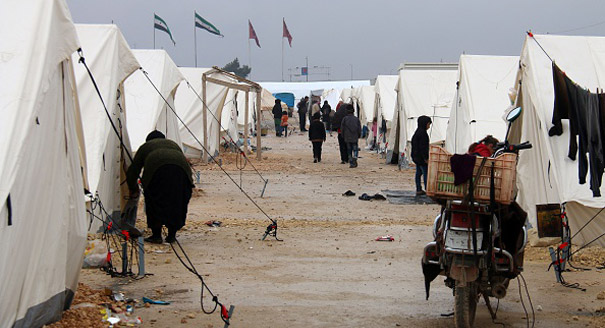
The situation in Aleppo is worsening and is resulting in greater tensions. Turkey keeps its border with Syria closed but will open it “if necessary,” while the EU urges Turkey to open the border but to keep the refugees in the country. The Turkish NGO IHH Humanitarian Relief Foundation is setting up refugee camps on the Syrian side of the border as a way to enforce the safe zone the government in Ankara has long called for, but without any possibility of military protection, least of all from Turkish forces. This initiative runs the risk that Russian forces will attack refugees as they try to reach these camps. Another humanitarian disaster is looming amid a hugely complicated international crisis.
The dialogue between Brussels and Ankara on refugees needs to be reset with a sharper focus on fundamentals. There are several major expectations to be fulfilled as a matter of urgency—some by Turkey, some by the EU, and some by both together.
Turkey must seriously go after the international mafia networks that are operating on the Aegean coast and are actively involved in trafficking migrants, such as Afghans and Pakistanis, via Turkey. This calls for a massive land-based police action together with international cooperation, beyond spectacular gestures like NATO patrols in the Aegean Sea. Democracies cannot indefinitely ask Turkish and EU taxpayers to spend billions to help refugees while mafias roam freely and make billions themselves out of the same refugees. Simultaneously, the EU should work with authorities at the other end of these mafia operations in, say, Kabul and Islamabad.
Turkey should implement measures it adopted recently on work permits and education for refugees. The EU should apply its funding to job creation schemes and Arabic-language education. It is critical to reach out to the 85–90 percent of refugees living on their own in towns and cities, not just those in showcase camps.
The usual operators of EU assistance—specialized UN agencies and European NGOs—should be the prime actors assisting refugees in Turkey, in coordination with Turkish authorities. Local host communities should also receive support. Conversely, should the EU be inclined to fund refugee camps on Syrian territory, this would embroil the union in Ankara’s disputed policy of creating a safe zone and would create new security risks for civilians given the current military situation on the ground.
Turkey should consider allowing the process of determining refugee status to be conducted on Turkish territory according to standards of the UN refugee agency and, together with the EU, creating procedures for safe passage.
And Ankara must seal the remaining border between Turkey and territory controlled by the self-proclaimed Islamic State to jihadists, ammunition, and smuggled oil. This would remove the pretext for attacks by the Syrian regime and Russian forces on refugees in the area.
For their part, EU leaders should publicly return to their normal narrative on the rule of law and freedom of expression—a narrative that the EU uses as a policy tool with candidate countries. Asking Turkey for help and simultaneously forgetting about the EU’s fundamental values is an unforgivable mistake that puts the EU in an odd position of weakness and inconsistency.
In parallel, the EU should look at its own systemic shortcomings, such as the failed transfer of foreign policy making to heads of state and government in the European Council and the occasional tendency for member states to undercut EU institutions. The EU’s weaknesses have also shown how a lack of decisive action on predictable security challenges (the Islamic State, counterterrorism coordination, and migration) can morph into drastic new challenges on the domestic scene.
Whereas past external crises have triggered major advances in EU integration, the current set of outside challenges may deal fatal blows to key pillars of the EU’s architecture. This trend is worth a serious look from the 28 member states.

Senior Fellow, Carnegie Europe
Marc Pierini is a senior fellow at Carnegie Europe, where his research focuses on developments in the Middle East and Turkey from a European perspective.
Recent Work
Marc Pierini
Marc Pierini
Carnegie does not take institutional positions on public policy issues; the views represented herein are those of the author(s) and do not necessarily reflect the views of Carnegie, its staff, or its trustees.

A summer of escalation in the Black Sea has hurt Ukraine economically and is exacerbating world food security. A truce is needed—as is a broader reframing of Europe’s Ukraine strategy.

Thomas de Waal

Are Germany’s economic, industrial, and political struggles becoming a liability for the EU’s ability to rise to the geopolitical moment?

Rym Momtaz, ed.

European Commission President Ursula von der Leyen is about to give her annual address on the state of the EU. Here’s what she won’t—but should—say.
Rym Momtaz

The aftermath of the Ceuta crisis shows Europe has drawn the wrong lessons. Rather than doubling down on failed migration policies, the EU needs to address the underlying roots of such episodes.

Richard Youngs

An overwhelming victory by a far-right-wing party in a small state in eastern Germany will have major repercussions for Chancellor Friedrich Merz’s coalition.

Judy Dempsey