

Commentary
Marc Pierini
{
  "authors": [
    "Marc Pierini"
  ],
  "type": "commentary",
  "blog": "Strategic Europe",
  "centerAffiliationAll": "",
  "centers": [
    "Carnegie Endowment for International Peace",
    "Carnegie Europe"
  ],
  "collections": [
    "Turkey’s Transformation"
  ],
  "englishNewsletterAll": "",
  "nonEnglishNewsletterAll": "",
  "primaryCenter": "Carnegie Europe",
  "programAffiliation": "",
  "programs": [],
  "projects": [],
  "regions": [
    "Europe",
    "Türkiye",
    "Middle East",
    "Western Europe"
  ],
  "topics": [
    "EU",
    "Migration",
    "Foreign Policy"
  ]
}
Source: Getty
EU leaders need to withstand Ankara’s emotional narrative and postpone Turkey’s EU accession negotiations until better times.
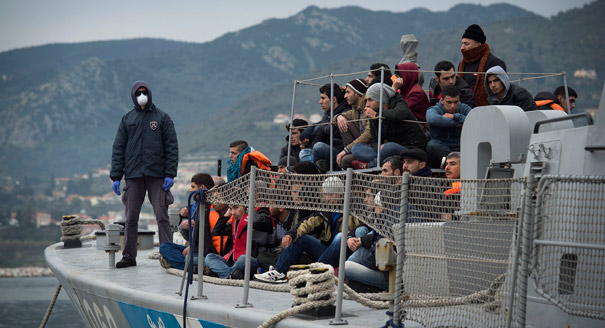
In the past four weeks, Turkish President Recep Tayyip Erdoğan has moved closer to an executive presidency and Turkey’s rule-of-law architecture has moved farther away from EU standards. Simultaneously, German Chancellor Angela Merkel has voiced criticisms of Turkey’s policies, and Turkish leaders have responded with more threats to cancel the refugee deal Ankara sealed with the EU in March 2016. Because the Turkish president is going down the authoritarian road with new powers for himself and more restrictions on the rule of law, Turkey can no longer entertain the EU’s criteria, be they on visa liberalization or on accession.
The pretense behind the refugee deal may soon be over. How will the EU and Turkey do business with each other?
In the “New Turkey,” there is only one leader—Recep Tayyip Erdoğan—and trying to pretend otherwise leads to dismissal. In just six days, from May 19 to 25, the Turkish president ushered in a compliant prime minister, Binali Yıldırım. Gone are all appearances of a parliamentary regime, as prescribed by the current constitution: the new prime minister declared that aligning the constitution with Turkey’s de facto presidential regime was his utmost priority.
For her part, when meeting Erdoğan in Istanbul on May 23, Merkel, under heavy criticism at home and in the European Parliament, criticized the lifting of parliamentary immunity for lawmakers suspected of abetting terrorism.
She also repeated EU demands for Turkey to amend its antiterrorism legislation. Although this criterion is nothing new—it has been on the table since 2013—the Turkish president has said again that he will not amend the legislation for the sake of achieving a visa-free regime for Turkish citizens traveling to EU countries. The very principle of meeting this condition is now challenged, which may derail the entire refugee deal.
Erdoğan’s intransigence is rooted in his quest for absolute power. The pro-Kurdish Peoples’ Democratic Party (HDP) emerged as the third-largest force in the Turkish parliament in both the June 7 and November 1, 2015, elections and is the main obstacle to the president’s march toward total supremacy. Having already dropped the peace process he had launched with Turkey’s Kurds, the president is fighting a strong insurgency from the Kurdistan Workers’ Party (PKK). The next step is to make the pro-Kurdish party fall under the 10 percent threshold required to send deputies to the parliament. Their parliamentary immunity having just been lifted, a number of HDP deputies could be prohibited from running in a future election. But neither the lifting of the parliamentarians’ immunity nor their potential prohibition is compatible with EU standards.
The lifting of Turkish parliamentarians’ immunity is not compatible with EU standards.Tweet This
As for the EU-Turkey refugee deal, the German chancellor stands no chance of convincing the European Parliament and the European Council to mellow the conditionality regarding the antiterrorism law. More generally, it has become politically impossible to endlessly bow to Ankara’s strident blasts, especially as the rule of law and freedom of expression in Turkey keep deteriorating. Former Turkish prime minister Ahmet Davutoğlu’s fervent proclamations toward the EU always sounded like virtual reality, and repeating the same narrative won’t be convincing any longer.
Moreover, on June 2, the German Bundestag will discuss a resolution regarding the 1915 Armenian genocide, a debate Merkel cannot thwart. This will send Turkey into frantic protests, adding another reason for Ankara to challenge the refugee deal.
Conversely, Ankara’s threat to send cohorts of Syrian migrants to the EU is not a viable option, as it would run counter to Turkey’s much-proclaimed compassion for refugees. Similarly, the bluff to call off the EU-Turkey Customs Union would badly hurt Turkey, not the EU. But, typically, Ankara’s nationalist narrative would be well served by a string of harsh moves against the EU.
In today’s Turkey, the president’s march toward total power is unstoppable. Soon, a snap legislative election is likely to result in a three-party parliament (without the Kurds), in which the ruling Justice and Development Party (AKP) will hold an overwhelming majority, leading the way to a new constitution. Introducing a radical change in the country’s political landscape is the Turkish president’s foremost priority.
The main protagonists of the refugee deal are now locked into their respective domestic constraints. Hard choices, not pretenses, lie ahead.
Erdoğan is reaching absolute power. He doesn’t need Europe anymore for this.Tweet This
Erdoğan is reaching absolute power. He doesn’t need Europe anymore for this. On the contrary, EU standards have become a roadblock, as his political supremacy hinges on absolute firmness on the Kurdish issue, antiterrorism measures, freedom of expression, and the rule of law. It is time for EU leaders to realize that these political goals cannot be attained in an EU-style environment with critics and checks and balances, and that Ankara’s EU narrative has become inconsistent with current Turkish politics.
EU leaders including the German chancellor need to prolong the refugee deal with Turkey. However illegal and immoral the deal is by EU standards, they have agreed to pay that price. They should say that the huge fund foreseen for Turkey in the deal should be used faster—but only on Turkish soil, so as not to serve Turkey’s own policy in Syria. Beyond that, EU leaders need to withstand Ankara’s emotional narrative, wait for Turkey to fulfill all the criteria on visa liberalization (if ever), and postpone the country’s EU accession negotiations until better times.
If they compromise further EU core principles, EU leaders will not only suffer more vexing words from Ankara but will also have offered the European extreme right a huge bonanza. Merkel, France’s François Hollande, the UK’s David Cameron, the Netherlands’ Mark Rutte, Belgium’s Charles Michel, and others had better look twice at political trends at home before bowing once again to Recep Tayyip Erdoğan. In the EU, like in Turkey, all politics are local.

Senior Fellow, Carnegie Europe
Marc Pierini is a senior fellow at Carnegie Europe, where his research focuses on developments in the Middle East and Turkey from a European perspective.
Recent Work
Marc Pierini
Marc Pierini
Carnegie does not take institutional positions on public policy issues; the views represented herein are those of the author(s) and do not necessarily reflect the views of Carnegie, its staff, or its trustees.
Europe has an interest in supporting Armenian leader Nikol Pashinyan as he tries to make peace with neighbors and loosen ties with Russia. But it is depersonalized support in the long term, not quickfire flash, that will win the day.

Thomas de Waal
Following Ursula von der Leyen’s gaffe equating Turkey to Russia and China, relations with Ankara risk deteriorating even further. Without better, more consistent diplomatic messaging, how can the EU pretend to be a geopolitical power?

Sinan Ülgen
Closer EU-UK ties could help address urgent European concerns. But is the EU ready for rapprochement with the United Kingdom?

Rym Momtaz, ed.
Europe has been standing by while its Southern neighborhood is being redrawn by force. To establish a path to peace between Israel and Lebanon, it’s time for Europeans to get involved with hard power.
Rym Momtaz
In Ukraine, Gaza, and Iran, AI warfare has come to dominate, with barely any oversight or accountability. Europe must lead the charge on the responsible use of new military technologies.

Raluca Csernatoni