

Commentary
Judy Dempsey
{
  "authors": [
    "Judy Dempsey"
  ],
  "type": "commentary",
  "blog": "Strategic Europe",
  "centerAffiliationAll": "",
  "centers": [
    "Carnegie Endowment for International Peace",
    "Carnegie Europe"
  ],
  "collections": [
    "EU Integration and Enlargement",
    "Brexit and UK Politics"
  ],
  "englishNewsletterAll": "",
  "nonEnglishNewsletterAll": "",
  "primaryCenter": "Carnegie Europe",
  "programAffiliation": "",
  "programs": [],
  "projects": [],
  "regions": [
    "Europe",
    "Eastern Europe",
    "Western Europe",
    "Germany"
  ],
  "topics": [
    "EU",
    "Foreign Policy"
  ]
}
Source: Getty
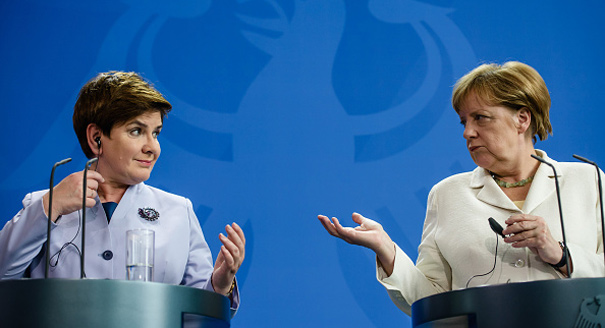
Britain’s decision to leave the EU is a chance for Poland and Germany to work more closely together for Europe and the transatlantic relationship.
When the right-wing Law and Justice party was elected in October 2015, Poland’s new government shifted its foreign policy. After a long spell of deepening political ties with Germany under the former coalition led by the center-right Civic Platform, Law and Justice looked to London as a counterweight to Berlin.
For Warsaw, it was Britain that would check the powers of the European Commission, the EU’s executive. It was Britain that would try to claw back more powers to the member states. It was Britain that would put a brake on immigration. The latter sat uncomfortably with Warsaw. With over 700,000 Poles living in the UK, Law and Justice wanted guarantees that their rights as EU citizens living there would be protected, Brexit or no Brexit. Above all, it was Britain that would halt any further political integration of Europe.
When Poland joined the EU in 2004, it strongly supported the commission rather than the EU Council, which represents the member states. At the time, Warsaw believed it would be the commission that would identify more with Poland’s interests and act as a counterweight to the member states, particularly the big ones. But in recent years, Warsaw and its neighbors have increasingly moved away from supporting the commission to defending their national interests in the council.
Now, Britain’s decision on June 23 to leave the EU has robbed Poland and the other members of the Visegrád Group—the Czech Republic, Hungary, and Slovakia—of a major ally. As all EU member states try to come to terms with a British exit, the Visegrád Four may end up turning to German Chancellor Angela Merkel to defend their interests.
This may seem a paradox. After all, apart from big differences with Berlin over migration and refugees, Warsaw and its neighbors fear that economic integration will now be sped up and that the eurozone countries will forge ahead by working toward a fiscal and banking union.
Such integration should in any case have been an inevitable outcome of the crisis in several eurozone countries. With Brexit a reality, the temptation by some leaders in the eurozone countries to press ahead with a two-speed Europe could be extremely attractive, in addition to being logical. The reality would be the realization that Europe must go forward and not remain static at the risk of atrophy.
Poland and other non-eurozone countries dread the idea of a two-speed Europe. Even though their voting rights in the council would not be affected, they fear their status in the EU would be diminished, despite repeated assurances to the contrary from Merkel. They fear too that the EU will be dominated by France and Germany, the bloc’s biggest and most important members, and this time without any constraints that Britain had exercised.
Merkel, however, is not in a hurry to move ahead with a more integrated Europe—at least, not yet. She knows there is little support for it at the moment, even though a more efficient and tighter eurozone is needed. Furthermore, as she sets the pace and tone for negotiating Britain’s exit from the EU, Merkel’s goal is also to reassure Germany’s Eastern neighbors that the vacuum left by Britain will not be to their disadvantage.
She can do this in three ways. First, as she has already done over the past few days, she can try to push back attempts by the Social Democrats, her coalition partners, by the European Commission, and by the European Parliament to speed up Britain’s exit. Merkel wants neither revenge against the Brits nor a rush to reduce the EU to 27 members.
Second, Poland in particular needs Merkel to hold the course when it comes to maintaining sanctions on Russia. Warsaw could rely on outgoing British Prime Minister David Cameron to stick to that policy. But it must be remembered that Cameron, during the early moves to impose sanctions on Russia in response to its annexation of Crimea and its subsequent invasion of parts of eastern Ukraine in early 2014, was very reluctant to go down the sanctions route. It was Merkel who piled on the pressure on London.
Third, Poland needs Merkel for the transatlantic relationship. Even though the special Anglo-American axis had weakened over the years, those old ties between London and Washington were a reassurance policy for Warsaw. Poland—along with the Baltic states, Slovakia, and, farther south, Romania—saw Britain as key to ensuring the EU had a strong Atlanticist faction.
An EU without Britain has the potential to weaken transatlanticism in the EU, which is why Merkel’s role will become increasingly important for Warsaw. The rising anti-Americanism that resonates from those who oppose the proposed Transatlantic Trade and Investment Partnership (TTIP) confirms this trend.
An EU with a weakened Atlanticist outlook would suit some Euroskeptic leaders, some of whom even question NATO. And it would suit Vladimir Putin. Indeed, the Russian president must be quietly reveling in Brexit because it will marginalize Britain in Europe and weaken further the cohesion of the EU. That is why Merkel’s role should assume even greater importance for eurozone and non-eurozone countries alike. Poland, which takes over the presidency of the Visegrád Four on July 1, needs to support her.

Nonresident Senior Fellow, Carnegie Europe
Dempsey is a nonresident senior fellow at Carnegie Europe
Recent Work
Judy Dempsey
Judy Dempsey
Carnegie does not take institutional positions on public policy issues; the views represented herein are those of the author(s) and do not necessarily reflect the views of Carnegie, its staff, or its trustees.
French President Emmanuel Macron has unveiled his country’s new nuclear doctrine. Are the changes he has made enough to reassure France’s European partners in the current geopolitical context?

Rym Momtaz, ed.
European reactions to the war in Iran have lost sight of wider political dynamics. The EU must position itself for the next phase of the crisis without giving up on its principles.

Richard Youngs
Europe isn’t as weak in the new geopolitics of power as many would believe. But to leverage its assets and claim a sphere of influence, Brussels must stop undercutting itself.

Dimitar Bechev
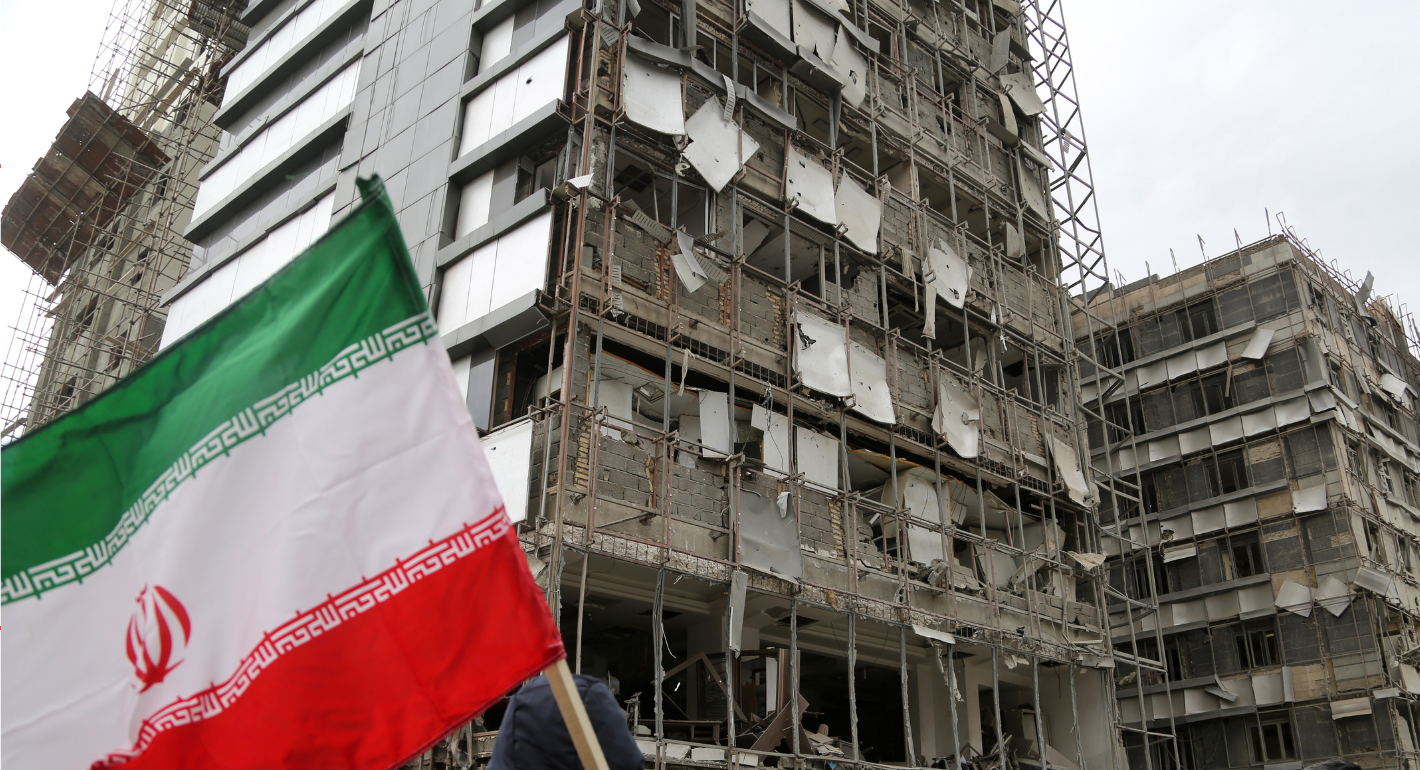
Europe’s reaction to the war in Iran has been disunited and meek, a far cry from its previously leading role in diplomacy with Tehran. To avoid being condemned to the sidelines while escalation continues, Brussels needs to stand up for international law.

Pierre Vimont
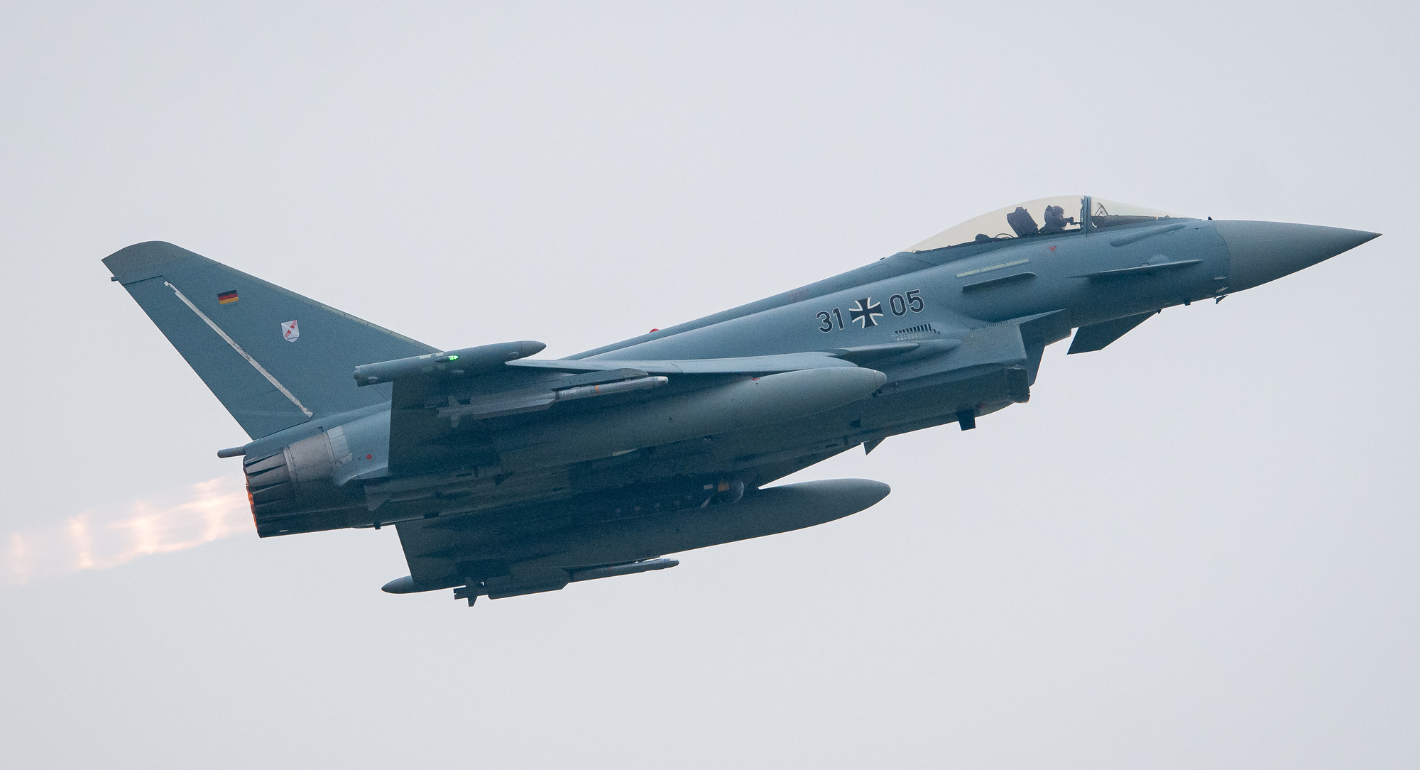
France and Germany’s failure to agree on the Future Combat Air System (FCAS) raises questions about European defense. Amid industrial rivalries and competing strategic cultures, what does the future of European military industrial projects look like?
Rym Momtaz, ed.