

Commentary
Nathalie Tocci, Jan Techau
{
  "authors": [
    "Jan Techau"
  ],
  "type": "commentary",
  "blog": "Strategic Europe",
  "centerAffiliationAll": "",
  "centers": [
    "Carnegie Endowment for International Peace",
    "Carnegie Europe"
  ],
  "collections": [
    "Europe’s Southern Neighborhood",
    "EU Integration and Enlargement"
  ],
  "englishNewsletterAll": "",
  "nonEnglishNewsletterAll": "",
  "primaryCenter": "Carnegie Europe",
  "programAffiliation": "",
  "programs": [],
  "projects": [],
  "regions": [
    "Europe",
    "Western Europe"
  ],
  "topics": [
    "EU",
    "Economy",
    "Migration",
    "Climate Change"
  ]
}
Source: Getty
There is nothing particularly existential about the refugee crisis. The real threat to the EU remains the unreformed eurozone.
Is the refugee crisis a threat to the European Union’s existence? Listening to commentators and politicians alike, this seems to be the overall consensus today. Porous borders let in too many alien subjects, increase the risk of terrorism, breed populism, and undermine the identities of the natives.
Or so the story goes. There is no doubt that the refugee crisis that exploded in 2015 has violently pushed Europe’s political systems to solve a problem that was created partly by years of neglect. But in reality, there is nothing particularly existential about the refugee crisis. The real threat to the EU remains the unreformed eurozone.
Why is the refugee crisis not an existential one? In short, because it is widely known what needs to be done, and compromise is possible. The EU needs to adopt some sort of shared asylum standard, speed up asylum procedures, improve control over the EU’s external border, find the key to a fair distribution of refugees among the 28 member states, and improve relations with countries of origin. The union also needs to improve help for countries that host armies of stranded refugees, notably Greece and Turkey.
And while there is no doubt that these policy items will require painful negotiations and much swallowed pride, they can be achieved. Some of them are even at the early stages of implementation.
It also helps that migration is a policy field in which compromise can be bought. Countries that don’t want to share the burden can be asked to pay instead. This is not popular, and the opponents to it will be noisy. But the monetization of issues is one of the little secrets of compromise building in Brussels, and there is no reason why it should not happen here, once all the hollering and screaming is over.
Similarly, after the noise subsides, Europeans will recognize that this is one of those issues that they can only solve together. Experts predict that significantly increased numbers of refugees will arrive in Europe over the next decades, primarily from Africa. The entire EU will be affected by this. What happens when Africa doubles its population by 2050—without the economic growth needed to offer these people a future—is easy to foresee. Those looking for brighter prospects will not go to Russia. And closing national borders will be a futile exercise. Either the intake of migrants will be controlled by EU countries together, or it will not be controlled. Eventually, the EU’s member states will choose control, even though much more pain will be needed to get there.
Most importantly, however, the tricky issue of identity, which leads so many people to believe that refugees will destroy the EU, is not an EU issue at all. Integration of immigrants cannot and will not be made a common European policy. This sounds banal, but it is not. On the question of who can become a citizen, member states have—and will keep—full sovereignty. The poison of identity politics can be used and abused, and it certainly will, but in the end it need not stand in the way of a technical solution.
So if the refugee crisis can be managed, why is the unreformed eurozone so much more dangerous?
Because unlike with refugees and integration, on the euro, the EU’s different cultures cannot be separated. On the contrary, they must somehow merge. If the euro is supposed to survive, the economic and mercantile cultures and traditions of the South and the North will have to be brought together in compromise. This goes very far beyond a technical solution. This will require political compromise on an unprecedented scale in the history of European integration.
The key to the euro’s survival is the creation of a full-fledged fiscal union among the countries that share the common currency. Essentially, the eurozone will have to be turned into a political union, in which fiscal policies, the true hallmark of national sovereignty, will have to be communalized.
To build such a fiscal union, Germany and France, and their respective allies, will have to agree on a system of transfers, debt mutualization, fiscal oversight, and spending limits. More broadly, they will need to decide how much state interventionism is healthy for functional capitalism. How liberal should labor markets be? How long should people work, in a week and in their lives? What is a reasonable tax regime to stimulate business and equip the state with the funds needed to fulfill its duties? Perhaps crucially, eurozone members must also determine how a unified fiscal approach can be democratically legitimized. They will have to consider whether national parliaments are enough, or whether the eurozone needs its own separate legislature.
In other words: for the euro to survive, you need dramatically more Europe. More integration anyone? Madame Le Pen? Mijnheer Wilders? Herr Strache?
Any one of these issues is more politically poisonous than the more or less technical issues of the refugee crisis. Also, the timing is not great. The shock waves of the upcoming British referendum on EU membership, no matter what the result, will resonate long after June 23; and after that, elections in France and Germany are looming in 2017. Not much will be done before all of that is out of the way. And while more and more time passes without action, the structural flaw in the eurozone, an integrated currency area without a political union, will keep on doing its destructive work.
And that is why refugees, in the end, will bring Europe closer together, while the euro might break the union.

Director, Europe Team, Eurasia Group
Techau is director with Eurasia Group's Europe team, covering Germany and European security from Berlin. Previously, he was director of Carnegie Europe.
Recent Work

Nathalie Tocci, Jan Techau
Jan Techau
Carnegie does not take institutional positions on public policy issues; the views represented herein are those of the author(s) and do not necessarily reflect the views of Carnegie, its staff, or its trustees.

Are Germany’s economic, industrial, and political struggles becoming a liability for the EU’s ability to rise to the geopolitical moment?

Rym Momtaz, ed.

European Commission President Ursula von der Leyen is about to give her annual address on the state of the EU. Here’s what she won’t—but should—say.
Rym Momtaz

The aftermath of the Ceuta crisis shows Europe has drawn the wrong lessons. Rather than doubling down on failed migration policies, the EU needs to address the underlying roots of such episodes.

Richard Youngs
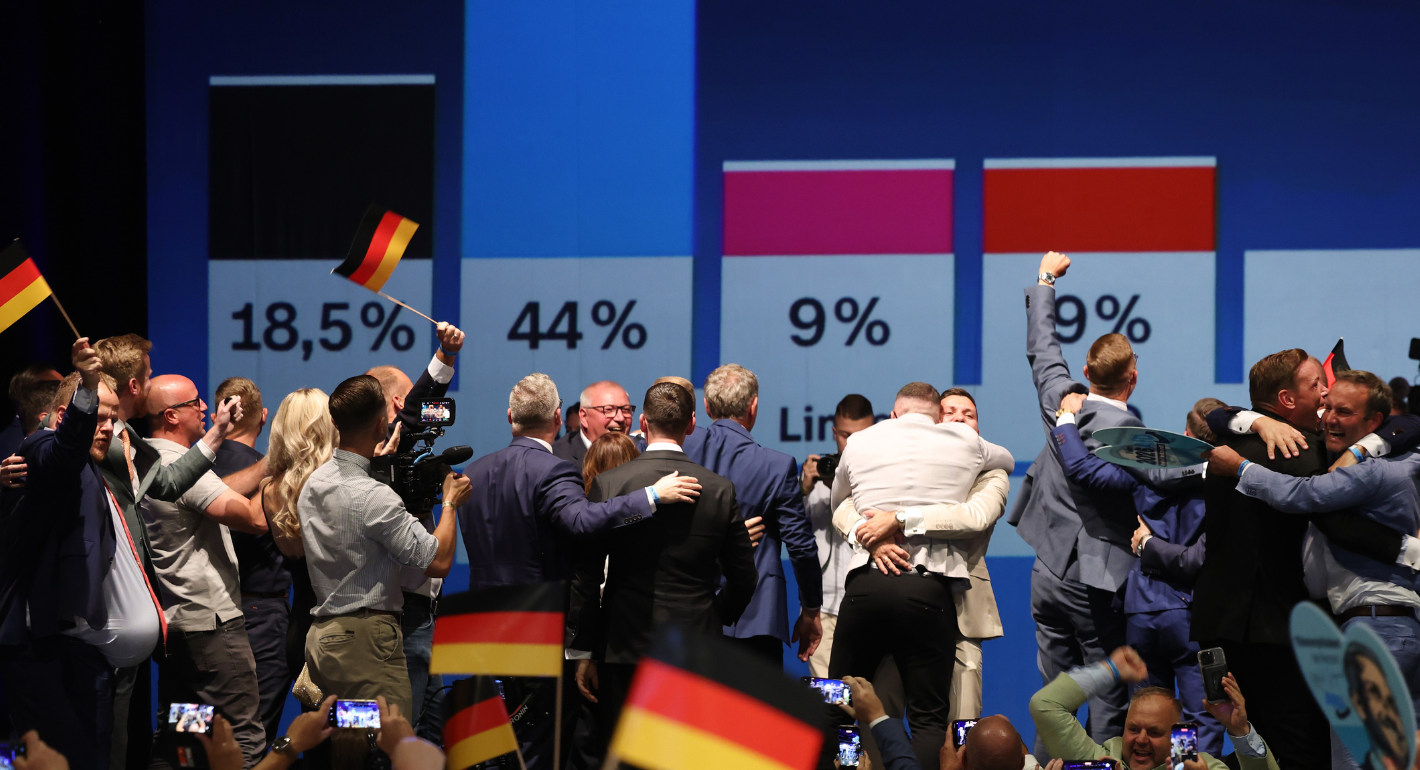
An overwhelming victory by a far-right-wing party in a small state in eastern Germany will have major repercussions for Chancellor Friedrich Merz’s coalition.

Judy Dempsey

Canadian Prime Minister Mark Carney has twice inspired praise for standing up to U.S. President Donald Trump: at the 2026 World Economic Forum in Davos and on Canada-U.S. trade negotiations. Is Carney showing a third way better than the EU has in dealing with the Trump administration?
Rym Momtaz, ed.