

Commentary
Alexander Baunov
{
  "authors": [
    "Alexander Baunov"
  ],
  "type": "commentary",
  "blog": "Strategic Europe",
  "centerAffiliationAll": "",
  "centers": [
    "Carnegie Endowment for International Peace",
    "Carnegie Europe"
  ],
  "collections": [
    "Europe’s Eastern Neighborhood"
  ],
  "englishNewsletterAll": "",
  "nonEnglishNewsletterAll": "",
  "primaryCenter": "Carnegie Endowment for International Peace",
  "programAffiliation": "",
  "programs": [],
  "projects": [],
  "regions": [
    "Russia",
    "Eastern Europe",
    "Western Europe",
    "Europe"
  ],
  "topics": [
    "Security"
  ]
}
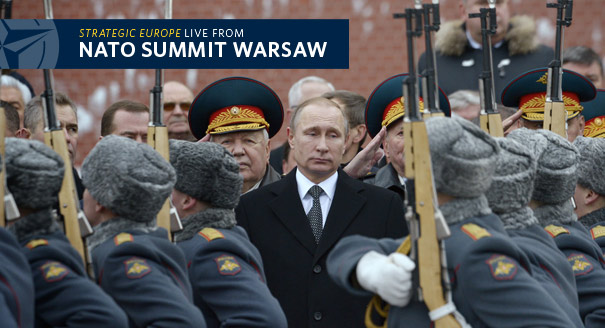
Source: Getty
Russian diplomats see almost every NATO summit as a hostile event. There is particular bitterness when alliance leaders meet in a former Soviet or Warsaw Pact capital.
Carnegie Europe was on the ground at the NATO summit in Warsaw, offering readers exclusive access to the high-level discussions as they unfolded. See our live coverage here.
*
Almost every NATO summit is seen by Russian diplomats and official media as a hostile event. Russian observers are especially bitter when a summit takes place in a country of the former Soviet bloc or—as is the case with the 2016 meeting on July 8–9—in a capital of the former Warsaw Pact. In this form, NATO embodies the worst of what Russian politicians and a big part of the public think about the West. Russians generally feel betrayed by the West, and NATO in Warsaw is the most palpable incarnation of this fraud.
When the Soviet Union under Mikhail Gorbachev dismantled the Soviet military bloc and sphere of influence, the West didn’t do the same. Instead, the West enlarged NATO, moving it closer to the Russian border but without offering membership to Russia itself. The West understood this voluntarily reduction of the Russian military presence—the result of a combination of economic difficulties, the political spring in Eastern Europe, and free will in Moscow—as a legitimate Western victory. The Russians, meanwhile, understood it as a gift and a reason to join the winners’ camp. That didn’t happen. This view is the basis of Russia’s current foreign policy.
Formally, the agenda of the 2016 NATO summit should provoke the Kremlin’s anger. It’s not about moving the political border of the alliance, but about deploying NATO troops closer to that border. And certainly, there are and will be plenty of critical Russian voices. But the current summit in Warsaw is less crucial and annoying for Russia than the summit in Bucharest in 2008, when the question of giving Ukraine and Georgia plans for NATO membership was discussed in earnest. Now, thanks to its own actions and by capitalizing on the faults of Ukrainian and Georgian politicians, the Kremlin has prevented any real perspective of either post-Soviet country joining NATO anytime soon. Moscow can therefore be more relaxed in this respect.
But since Russia became more assertive and even aggressive in Eastern Europe, NATO as an organization is feeling more comfortable too, having restored a lost part of its raison d’être.
What is more, both sides—Russia and NATO—feel that they have gone too far in the confrontation, which has become dangerous, and that some detoxification of relations should be undertaken. Of course, NATO’s move to deploy more troops in the Baltic states and Poland won’t help here and will most probably be answered by a Russian countermove. But there is a general feeling that the confrontation should not be heightened further.
The real problem is not Russian aggression against Poland or Latvia but the possibility of a technical incident between NATO and Russian ships or planes in the Baltic or Black Sea. Such an incident cannot be excluded: after an unexpectedly successful show of force in Syria, part of the Russian political and military leadership wants to show force in the Baltic in the same way. This view is not shared by everybody in the Russian leadership.
Senior Fellow, Editor-in-Chief, Carnegie Russia Eurasia Center
Baunov is a senior fellow and editor-in-chief at the Carnegie Russia Eurasia Center.
Recent Work
Alexander Baunov
Alexander Baunov
Carnegie does not take institutional positions on public policy issues; the views represented herein are those of the author(s) and do not necessarily reflect the views of Carnegie, its staff, or its trustees.

Russia is testing the waters of NATO’s mutual defense clause. What do strikes in Romanian territorial waters mean for the alliance’s posture toward Moscow?

Dimitar Bechev

With its public finances in shambles, the far right polling at 35 percent ahead of the 2027 presidential election, and a growing protest movement, is France’s crisis a threat to the EU’s geopolitical awakening?

Rym Momtaz, ed.

Ahead of a tough winter for Ukraine, Donald Trump’s swing back toward Russia bodes ill. But instead of panicking, Kyiv’s European allies are focusing on action.
Rym Momtaz

While the EU and European governments are embracing the much-lauded middle-power moment, this entails three difficult conundrums.

Richard Youngs

Much has been said of the changes Brussels is trying to make to the EU enlargement process. Here’s why gradual integration might—or might not—be the answer.
Dimitar Bechev