

Commentary
Nathalie Tocci, Jan Techau
{
  "authors": [
    "Jan Techau"
  ],
  "type": "commentary",
  "blog": "Strategic Europe",
  "centerAffiliationAll": "",
  "centers": [
    "Carnegie Endowment for International Peace",
    "Carnegie Europe"
  ],
  "collections": [],
  "englishNewsletterAll": "",
  "nonEnglishNewsletterAll": "",
  "primaryCenter": "Carnegie Europe",
  "programAffiliation": "",
  "programs": [],
  "projects": [],
  "regions": [
    "Europe",
    "Western Europe",
    "Germany"
  ],
  "topics": [
    "Foreign Policy",
    "Security"
  ]
}
Source: Getty
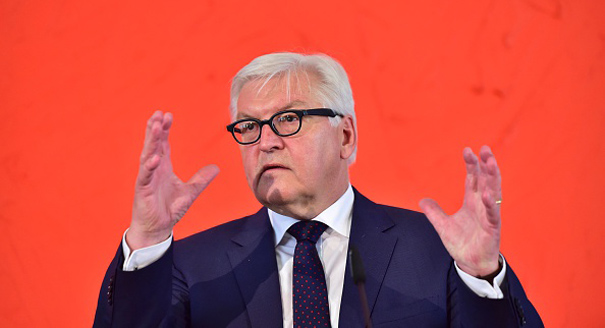
A recent article by Germany’s foreign minister sidesteps the key foreign policy questions to which Berlin’s allies are looking for answers.
For people outside Germany, the country’s pains at growing up as a foreign policy power often look wondrous and slightly bizarre—so morally charged is every debate, so infused with self-doubt, and often so faraway from the strategic realities of the day. Much ink has been spilled over this subject, but some particularly important ink has just been added to this ocean of pondering.
In the July–August issue of Foreign Affairs, Frank-Walter Steinmeier, Germany’s foreign minister and one of the country’s longest-serving top politicians, published an essay entitled “Germany’s New Global Role.” If you want to understand the continuous self-therapeutic nature of the German foreign policy debate, you need not go any farther than this article. It contains everything you need to know.
Steinmeier rightfully describes how Germany has already come a long way in its foreign policy. He lists Germany’s leadership in the negotiations over the Iranian nuclear program, its active military engagement in Kosovo and Afghanistan, its unusual exposure after the Ukraine crisis, and its firm course in the eurozone and refugee crises.
Steinmeier also says something that cannot be stated often enough: that Germany has not been seeking this new role, that there is no extended foreign policy ambition that drives Berlin’s newfound position. He is right. Whoever reads Germany’s more active role in the international community as the fruit of a newly developed appetite for power is indeed gravely mistaken.
In Steinmeier’s eyes, of course, this is meant to reassure the country’s neighbors and partners that whatever residual distrust they might have of an overly powerful Germany in the middle of Europe is unjustified.
And this is where the problems start. Not for everyone is Germany’s restraint and lack of foreign policy ambition a virtue. For many observers, it is either an attempt to shun responsibility (which I think it is not) or a sign of Germany’s unresolved ego disturbance when facing power and force, the raw materials of foreign policy. On that last point they are right, unfortunately.
Steinmeier’s text illustrates the continuous soul-searching of a still historically traumatized society. That the trauma still exists is no surprise. Historically speaking, very little time has passed since Germany committed both genocide and moral suicide between 1933 and 1945. The problem is not that the trauma continues. The problem is that dealing with it takes lots and lots of time but a world has emerged outside Germany that does not grant the country the time to come to grips with its demons before engaging more.
Steinmeier’s essay reveals this dilemma. It is a dance around the key issues on which Berlin’s allies are expecting better answers than the country can give. It is a dance around the issue of Russia and how Berlin intends to deal with a country whose regime is hell-bent on undermining the exact order that Germany needs to live at peace with itself and its neighbors.
It is a dance around the question of how a continent that is safe only because the United States keeps it safe can manage dependency when its great protector feels less inclined to do the heavy lifting. As a consequence, it is also a dance around the eternal question of Germany’s role as a military power and reliable ally. Finally, it is a dance around the question of what kind of order Germany wants for Europe, for the Eastern neighborhood, for the Middle East, and for a world in which the West ceases to dominate.
The text has no answers, and contrary to its title, it says very little about Germany’s new global role. Steinmeier can’t give answers, because Germany can’t. It does not know, it is not sure, it is overwhelmed, it feels uncomfortable.
A meek reference to the rules-based international order must suffice, as must a nod to Germany’s reliable European instincts, in the very last sentence. The rest is soul-searching—and soul-searching that has a tendency to smack of condescension, as when Steinmeier portrays Germany as the “reflective power,” as if others don’t do deep thinking.
There is almost more talk about the United States than about Germany, and the Iraq War looms large in the whole text. This obsession does not come as a surprise. Germany’s government, when the war started in 2003, had the right instinct. Many others, like me, were wrong. And even though German opposition to the invasion back then had nothing to do with strategy, it is now very convenient to bask in the glory of the moment when Germany’s moralistic view, for once, overlapped with what would have been strategic wisdom.
From that obsession with Iraq stems Steinmeier’s biggest mistake in the text. He reduces military engagement to intervention. But the problem with Germany’s restraint on military affairs has very little these days to do with its reluctance to deploy to the far corners of the planet. It has a lot more to do with Germany’s role in reassurance and deterrence on NATO territory.
Germany’s military continues to be starkly underfunded, despite a slight increase in spending. Germany forces NATO to call an alliance exercise a Polish exercise because it fears that Russia could be provoked, when in reality the provocations are Russian. Steinmeier equates the very moderate response to Russia’s continued intrusions and aggressions on NATO’s Eastern flank with “saber rattling and war mongering,” sending shock waves through NATO (and the German Chancellery, too). He embraces a version of Ostpolitik that never mentions the fact that Germany’s previous Eastern détente was built on massive military strength, not just good intentions. No wonder Germany’s reliability as an ally is questioned.
Germany’s attitude toward the use of force remains the litmus test of its foreign policy maturity, no matter how tired the Berlin elites are of hearing this argument. In the end, Steinmeier’s efforts only highlight the size of the problem. His tragedy is that he wants the right thing but avoids calling a spade a spade. But truth avoidance will neither heal the wounds nor produce good policy. It never helps the patient in therapy. Most importantly, it won’t keep Europe and Germany safe at a time when that security is more brittle than at any moment in the last quarter century.
Director, Europe Team, Eurasia Group
Techau is director with Eurasia Group's Europe team, covering Germany and European security from Berlin. Previously, he was director of Carnegie Europe.
Recent Work
Nathalie Tocci, Jan Techau
Jan Techau
Carnegie does not take institutional positions on public policy issues; the views represented herein are those of the author(s) and do not necessarily reflect the views of Carnegie, its staff, or its trustees.

While the EU and European governments are embracing the much-lauded middle-power moment, this entails three difficult conundrums.

Richard Youngs

Much has been said of the changes Brussels is trying to make to the EU enlargement process. Here’s why gradual integration might—or might not—be the answer.

Dimitar Bechev

The European Commissioner for Trade is headed to China. But after President Xi’s bridge-building visit to Washington, can a more isolated EU overcome Beijing’s stranglehold on critical raw materials? Who will blink first?

Rym Momtaz, ed.

The domestic impacts of how long it is taking to end the war in Ukraine have pushed the French electorate to the political extremes and compromised the country’s diplomatic capacity.
Rym Momtaz

Before the next wave of EU enlargement takes place, the union needs to grapple with thorny questions of how power is distributed among its members.


Emil Sondaj Hansen, Ditte Brasso Sørensen