

Article
Kristina Kausch
{
  "authors": [
    "Kristina Kausch"
  ],
  "type": "commentary",
  "blog": "Strategic Europe",
  "centerAffiliationAll": "",
  "centers": [
    "Carnegie Endowment for International Peace",
    "Carnegie Europe"
  ],
  "collections": [
    "Brexit and UK Politics"
  ],
  "englishNewsletterAll": "",
  "nonEnglishNewsletterAll": "",
  "primaryCenter": "Carnegie Europe",
  "programAffiliation": "",
  "programs": [],
  "projects": [],
  "regions": [
    "Europe",
    "Western Europe"
  ],
  "topics": [
    "Foreign Policy",
    "EU"
  ]
}
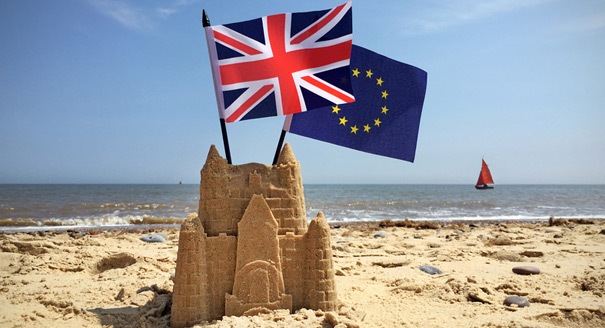
Source: Getty
As a foreign policy road map, the EU global strategy may be wishful thinking. But it is also a manifesto for the defense of a liberal internationalist world order.
On June 28, EU Foreign Policy High Representative Federica Mogherini launched her long-awaited global strategy, meant to guide the union’s common foreign policy in the years ahead. Under normal circumstances, the procedure for think tank pundits would be to appreciatively dissect the document, saying what’s good but above all what’s bad, and top this with a mandatory remark that politely doubts implementation on the grounds of the EU’s internal dysfunction.
But two weeks after Britain voted to leave the EU, these are exceptional circumstances, and I cannot merely rearrange the deck chairs on the Titanic. In the midst of the union’s greatest crisis since its inception, the strategy acquires a broader symbolic meaning as a forceful reminder that the union stands for a liberal internationalist world order that Europeans need to stand up for much more vigorously.
A look at the document itself reveals a good deal of sensible and innovative thinking amid a generally toned-down level of transformative rhetoric. Other analyses have already noted the conceptual quantum leap embodied in the concept of resilience as the new guiding objective for the neighborhood that replaces narrower earlier language on democracy; the factual downgrading of the European Neighborhood Policy; and the awkwardness of the paper’s pledge for “strategic autonomy” by means of building meaningful EU defense capabilities. The concept of resilience ends (at least conceptually) a period of confusing back and forth over the EU’s primary goal in the neighborhood, which in the past oscillated between opposing poles on the values–interests continuum, from stability to deep democracy and back.
On the Middle East and North Africa, the strategy does well to stress the EU’s comparative advantages and otherwise tone down expectations. The emphasis on functional regional cooperation and the overdue diversification of channels are welcome developments, including an unusually frank acknowledgment of the deficiencies of regional organizations such as the Arab League. The focus on balance in the EU’s relations with the Gulf Cooperation Council (GCC) countries and Iran is sensible advice that in practice has proved tricky. Lessons learned from the EU’s omissions in Libya abound, such as the pledge to “act at all stages of the conflict cycle.”
Laudable is also Mogherini’s sustained faith that Turkey can be pulled back from the edge, although in light of Turkish President Recep Tayyip Erdoğan’s authoritarian tilt, this view is unlikely to earn her much applause. The distinction between resilience of states and of societies—which in the Arab world are often at opposing ends of a spectrum—is useful, although the EU has pledged many times before to increase engagement with civil society without any quantum leaps happening.
On the broader meaning the strategy acquires in the current geopolitical context, many say the timing and political momentum to come forward with an initiative to strengthen EU foreign policy could hardly have been worse. Days after the Brexit shock, a document that was meant to give a major push to the EU’s foreign policy entered quietly, tiptoeing, almost embarrassed of its own ambition. But zooming out, maybe Mogherini and her team, and the European Council, which endorsed the document, should be not embarrassed but proud of the strategy’s (arguably quite counterintuitive) tone and ambition at this particular moment.
The global battle of ideas to which the strategy contributes was succinctly described by Bernd Ulrich in a recent article in the German weekly Die Zeit: “Something bigger is going on, something of which Brexit is an expression; something from which the EU is suffering but that it does not cause.” This bigger development, Ulrich continues, is a fundamental clash of inequalities between and within societies that results from a critical point of globalization in which the walls between the global South and the North are torn down.
Two main responses to this clash compete with each other: authoritarian nationalism and liberal internationalism. Unfortunately, as witnessed by the Brexit vote, the authoritarian nationalists (the likes of Britain’s Nigel Farage, France’s Marine Le Pen, and America’s Donald Trump) come much better prepared. Meanwhile, the EU bubble wails over Brexit as an endemic institutional crisis, which it is not—at least, not primarily.
As Carnegie’s Stefan Lehne has noted, as a foreign policy strategy, Mogherini’s paper is a perhaps overly optimistic vision for EU foreign policy rather than a depiction of its current realities. Indeed, some of the unity language now reads rather awkwardly, and it is not without irony that the paper reiterates its determination to promote “state and societal resilience” abroad at a time when it is so blatantly struggling to achieve this goal at home.
At this critical juncture, however, as much as it is a slightly wishful foreign policy strategy, the document is also a manifesto for the defense of a liberal internationalist world order. Launched at the height of Brussels’s self-flagellation, the EU global strategy offers reassurance that the cooperative internationalist model the union was built on has by no means lost its relevance, and that the EU is determined to face up to those who want to challenge that order with narratives of retrenchment and otherness. At this watershed moment for the future of the global order, the strategy wants to “enable the union to effectively navigate our times”—and appeals to European leaders, for heaven’s sake, to get the ship seaworthy.

Deputy Managing Director and Senior Fellow at the German Marshall Fund.
Kristina Kausch is the deputy managing director and Senior Fellow at the German Marshall Fund.
Recent Work
Kristina Kausch
Kristina Kausch
Carnegie does not take institutional positions on public policy issues; the views represented herein are those of the author(s) and do not necessarily reflect the views of Carnegie, its staff, or its trustees.

Much has been said of the changes Brussels is trying to make to the EU enlargement process. Here’s why gradual integration might—or might not—be the answer.

Dimitar Bechev

The European Commissioner for Trade is headed to China. But after President Xi’s bridge-building visit to Washington, can a more isolated EU overcome Beijing’s stranglehold on critical raw materials? Who will blink first?

Rym Momtaz, ed.

The domestic impacts of how long it is taking to end the war in Ukraine have pushed the French electorate to the political extremes and compromised the country’s diplomatic capacity.
Rym Momtaz

Before the next wave of EU enlargement takes place, the union needs to grapple with thorny questions of how power is distributed among its members.


Emil Sondaj Hansen, Ditte Brasso Sørensen

A summer of escalation in the Black Sea has hurt Ukraine economically and is exacerbating world food security. A truce is needed—as is a broader reframing of Europe’s Ukraine strategy.

Thomas de Waal