

Commentary
Nathalie Tocci, Jan Techau
{
  "authors": [
    "Jan Techau"
  ],
  "type": "commentary",
  "blog": "Strategic Europe",
  "centerAffiliationAll": "",
  "centers": [
    "Carnegie Endowment for International Peace",
    "Carnegie Europe"
  ],
  "collections": [],
  "englishNewsletterAll": "",
  "nonEnglishNewsletterAll": "",
  "primaryCenter": "Carnegie Europe",
  "programAffiliation": "",
  "programs": [],
  "projects": [],
  "regions": [
    "Europe",
    "Western Europe"
  ],
  "topics": [
    "Foreign Policy",
    "EU",
    "Security"
  ]
}
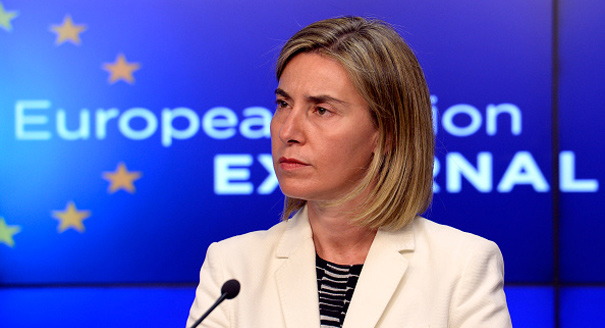
Source: Getty
The recently unveiled EU global strategy is an unusually thoughtful and rich document. The EU’s leaders would be well-advised to study it.
Sometimes, timing is just horrible. Under normal circumstances, June 28 should have been a very notable day for anybody involved in the EU’s attempts to build a more unified, meaningful foreign policy. It was the day on which the European Council in Brussels adopted the brand-new Global Strategy for the European Union’s Foreign And Security Policy. But after the British referendum on June 23 sealed the UK’s departure from the EU, circumstances were not normal, and so the heads of state and government had very little time for the 60-page document. They waved it through and then moved on.
This superficial treatment of the new strategy is understandable, but it is also telling. The member states’ political bigwigs could not care less about a document they will not feel bound by. But essentially ignoring the paper was also very unjust. Because what the EU’s foreign policy chief, Federica Mogherini, and her team have cooked up over almost two years is an unusually thoughtful and rich EU document. The EU’s leaders would be well-advised to actually study the document they said yes to.
The new strategy is one of the few EU texts of its kind that derives its ambition not from some abstract faith in the integration idea but from urgent necessity. The hyperbole—and there is hyperbole in the text—does not feel as stale as it usually does. The document should be read as a sign that its authors have understood the brutal seriousness of Europe’s bleak geopolitical situation. They use their big words not to lull you in but to wake you up. That might look like a small difference, but the mind-set behind it is miles away from the lazy attitude of conventional EU documents.
So what are the new strategy’s strengths and weaknesses?
Let’s start with the strengths. The document strikes a fine balance between reduced and increased ambition. It establishes the concept of “principled pragmatism,” anchoring its prescription in a realism that is direly needed in the EU. Importantly, it stops overestimating the transformative power of the EU, which observers believed to be very strong only to find out that nearly nowhere in its wider neighborhood has the EU had any decisive influence on how things unfolded.
Most strikingly, as the Egmont Institute’s Sven Biscop has argued in his analysis of the new strategy, the overbearing language on democracy promotion has disappeared. This was highly overdue, not because democracy is no longer desirable, but because promoting it is better done silently, not with missionary zeal that tends to fall flat.
By contrast, the document gets very ambitious at the policy level. It contains a large number of concrete proposals, not spelled out in detail, but defined precisely enough to point toward action, not just good intentions. Whether any of these suggestions will be picked up by the member states is another question. But one can’t blame Mogherini and her team for engaging in just lofty talk.
Another strength is the silent farewell to the EU’s European Neighborhood Policy. The ENP is mentioned a few times, but merely to pay tribute to a term that can’t be ignored entirely. Conceptually, it is replaced by two things: resilience as the new guiding principle of the EU’s relationship with its immediate surroundings; and an emphasis on tailored approaches to individual countries. Out goes the idea of a somewhat coherent space around Europe.
The emphasis on resilience is important, as Mogherini defines this as “the ability of states and societies to reform, thus withstanding and recovering from internal and external crisis.” Implicitly, this acknowledges that for positive change to happen, states and societies also need to show a willingness to reform. This puts an end to the naïveté of the old ENP, which based its entire transformative agenda on the automatic assumption that the governments of ENP countries—say, Algeria, Belarus, Egypt, or Moldova—really wanted change. They don’t, hence the utter uselessness of the ENP there.
The document also shows its strength in stressing the necessity of EU support for and investment in the international rules-based order. This is a clear commitment to multilateral institutions and the universal principles behind them. This can’t be stressed often enough. It remains the key question for regional and global stability, and for global governance in general.
Finally, being honest about Russia’s violations of international law and its continued attempts to destabilize Ukraine, as the paper is, can’t be praised enough these days.
But the document also has its flaws. While it bids farewell to the ENP, the new strategy does not analyze the structural reasons for the fairly spectacular failure of the EU’s transformative agenda in its neighborhood. If EU foreign policy is meant to improve, this analysis will be sorely needed.
Nor is the paper honest about EU enlargement, which is still listed as a key foreign policy tool but whose use in the future is highly doubtful, and not only with respect to Turkey. The strategy is also silent on the ugly reality that the Lisbon Treaty has actually weakened EU foreign policy by removing the foreign ministers from European Council meetings, separating the European Commission from the European External Action Service (EEAS), underfunding and underequipping the EEAS and the foreign policy high representative, and hopelessly bureaucratizing decisionmaking procedures in this fractured institutional lineup.
However, the new strategy’s biggest weakness is perhaps its halfhearted approach to what Mogherini calls “strategic autonomy” for the EU. While it is highly desirable for Europeans to build foreign policy, security, and defense capabilities that will allow them to do more for their own security instead of relying solely on the United States for protection and global services, the paper should have been much more realistic about how faraway that option is.
For some time to come, EU foreign policy will be about managing its dependence on Washington. So while formulating a high ambition is right, the document also needs to define how to cope in the meantime. The United States will remain key to the EU’s role in the world for many years to come, and the paper’s blind spot on this crucial and uncomfortable part of the transatlantic relationship is not healthy.
Having said all this, with its new global strategy, the EU has a highly useful document to chart its course into the next decade. It will serve as the standard against which action will now be measured. To be sure, the document will not have a massive impact on the member states’ behavior, especially in crisis management. But nobody can blame Federica Mogherini and the EEAS for not having said what’s necessary if Europe wants to stay safe and count for something in the world.

Director, Europe Team, Eurasia Group
Techau is director with Eurasia Group's Europe team, covering Germany and European security from Berlin. Previously, he was director of Carnegie Europe.
Recent Work

Nathalie Tocci, Jan Techau
Jan Techau
Carnegie does not take institutional positions on public policy issues; the views represented herein are those of the author(s) and do not necessarily reflect the views of Carnegie, its staff, or its trustees.

European Commission President Ursula von der Leyen is about to give her annual address on the state of the EU. Here’s what she won’t—but should—say.

Rym Momtaz

The aftermath of the Ceuta crisis shows Europe has drawn the wrong lessons. Rather than doubling down on failed migration policies, the EU needs to address the underlying roots of such episodes.

Richard Youngs

An overwhelming victory by a far-right-wing party in a small state in eastern Germany will have major repercussions for Chancellor Friedrich Merz’s coalition.

Judy Dempsey

Canadian Prime Minister Mark Carney has twice inspired praise for standing up to U.S. President Donald Trump: at the 2026 World Economic Forum in Davos and on Canada-U.S. trade negotiations. Is Carney showing a third way better than the EU has in dealing with the Trump administration?
Rym Momtaz, ed.

The EU’s responses to two recent incidents expose the gulf between European perceptions and capabilities. Unless the union can bridge that gap, it will never become a real geostrategic power.
Rym Momtaz