

Article
Marc Pierini
{
  "authors": [
    "Marc Pierini"
  ],
  "type": "commentary",
  "blog": "Strategic Europe",
  "centerAffiliationAll": "",
  "centers": [
    "Carnegie Endowment for International Peace",
    "Carnegie Europe"
  ],
  "collections": [
    "Turkey’s Transformation",
    "Europe’s Southern Neighborhood"
  ],
  "englishNewsletterAll": "",
  "nonEnglishNewsletterAll": "",
  "primaryCenter": "Carnegie Europe",
  "programAffiliation": "",
  "programs": [],
  "projects": [],
  "regions": [
    "Europe",
    "Türkiye",
    "Middle East"
  ],
  "topics": [
    "Security",
    "Foreign Policy"
  ]
}
Source: Getty
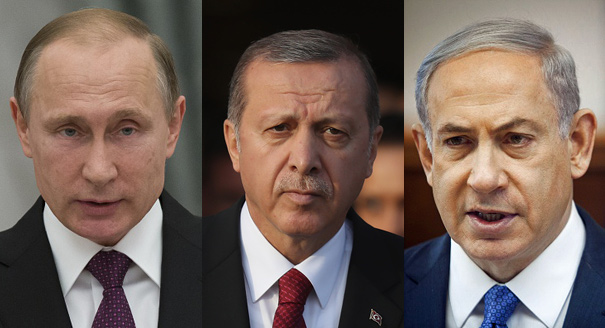
Ankara’s recent foreign policy shifts on Israel and Russia have been welcomed in the West. But a number of unanswered questions about Turkey’s future remain.
In fast succession, Turkey has recalibrated its policies vis-à-vis Israel and Russia. Some say Egypt is next in line. Turkey’s ability to perform sudden U-turns at high speed is always impressive, and this time, it left Washington and Brussels not just acquiescing but wondering about the next steps.
The immediate reasons for Turkey to fix its relations with Israel are rather simple. An underwater pipeline bringing Israeli gas to the Turkish coast is of mutual interest, diversifying Turkey’s supplies and boosting its standing as a multiple-source supplier to Europe while offering Israel a much-needed outlet. Tourism might pick up again, given the proper security measures. In addition, counterterrorism cooperation could bring useful intelligence to Turkey, while military cooperation (contracts and training) could resume.
Normalizing relations will not necessarily mean great harmony between the two countries. The blockade of Gaza remains a major worry for the Turkish leadership, and Ankara’s proximity to the Palestinian Islamist organization Hamas still causes headaches in Israel.
The reasons for Turkey to mend fences with Russia are similar. Tourism is badly needed—Russian arrivals fell by 92 percent after Turkey shot down a Russian Sukhoi bomber aircraft in November 2015. Meanwhile, a gas pipeline from Russia to Turkey is much wanted. Turkish exports and construction contracts in Russia will bring additional income at a time of sluggish economic activity. Even more important will be counterterrorism cooperation in the wake of the June 29 Istanbul airport attack, of which terrorists from Dagestan and Central Asia were mentioned as the core suspected perpetrators.
Yet Moscow and Ankara might not see eye to eye soon on the strategy toward a Syrian settlement. Turkey might implicitly accommodate the Syrian political reality that President Bashar al-Assad will not go quickly. But a major divergence will remain on the role—military now, political later—to give the Syrian Kurds in a settlement for the country.
More generally, Ankara probably felt that diplomatic loneliness was perhaps no longer as precious as it was once regarded. Admittedly, Turkey’s neighborhood is one of extreme difficulties, and staying immune from the chaotic developments was hard, especially when a mix of hubris, hazardous assumptions, and religious considerations was at work.
Some lessons have been drawn: former Turkish prime minister Ahmet Davutoğlu’s ambitious policy of “zero problems with neighbors” has been swiftly replaced by the more modest attitude of his successor, Binali Yıldırım, to “increase the number of friends and reduce the number of enemies.” The short take is that money, energy, and counterterrorism prevailed over what Yıldırım called “meaningless and empty discourse.”
Turkey’s recent decisions are welcome in Washington and EU capitals, but the most important developments still lie ahead. Will Ankara make a decisive move against the Islamic State—by sealing the Syrian-Turkish border against jihadists, ammunition, and oil smuggling—despite the risk of reprisals? Will Ankara be amenable to considering the crucial role Syrian Kurds play in defeating the Islamic State despite the narrative about their ideological links with Turkey’s domestic Kurdistan Workers’ Party (PKK) insurgency?
In short, have Turkey’s delusions of dominance come to an end, and will a more realistic approach take over? These are all open questions.
Leaders at the July 8–9 NATO summit in Warsaw heard a strong plea from Turkish President Recep Tayyip Erdoğan for support against all forms of terrorism, which in his view includes the Syrian Kurdish People’s Protection Units (YPG). As a result, and assuming all necessary approvals are given, NATO’s airborne warning and control system (AWACS) aircraft will be deployed over Turkish airspace to help fight the Islamic State, but Turkey’s position on the Syrian Kurds will remain hugely different from that of NATO.
Dealing with Islamic State militants and the Syrian Kurds will inevitably have domestic repercussions in Turkey and raise the issue of resuming the peace process with the country’s own Kurds, which was abandoned in July 2015. Whatever Ankara’s political narrative about the Islamic State and the PKK, there is a devastating cumulative effect: both brands of terrorism bring immense human suffering to the people and undo Turkey’s past successes on tourism and air transportation.
When terrorist activities reach a threshold of repeatedly tearing a society apart and denting key economic activities, they stand at the very core of a country’s politics. This is no more politically sustainable in Turkey than it is in France or Belgium. A decisive leap forward is therefore needed against the Islamic State and toward peace with Turkey’s Kurds.
By contrast, the EU-Turkey track is in no real need of a spectacular recalibration. Rather, trudging along seems to be the order of the day. Both sides need to implement the March 2016 refugee deal, which promises €3 billion ($3.3 billion) in EU funds for Turkey, of which €2 billion will have been allocated by September. However, there is a seemingly intractable impasse on the conditions for visa liberalization, as Turkey has declared it will not amend its antiterrorist legislation.
Aside from the cosmetic progress on Turkey’s EU accession negotiations, which are heading nowhere in substance as long as Turkey’s rule of law and freedom of expression are where they are, useful progress can be achieved by revamping the EU-Turkey Customs Union, with substantial benefits for both sides.
Before dreaming of a fast conclusion to the Cyprus reunification talks and therefore Turkey’s full political endorsement and military withdrawal from the divided island, it would be useful to focus the EU-Turkey relationship on the fundamentals. On terrorism, Turkey should admit that it is on the same side as its European partners, a step that should trigger seamless cooperation. On the economy (excluding energy supplies), Turkey’s anchor for trade, investment, and technology remains the EU, and there are no alternatives. Both sides should organize themselves better to make the most of their relationship.

Senior Fellow, Carnegie Europe
Marc Pierini is a senior fellow at Carnegie Europe, where his research focuses on developments in the Middle East and Turkey from a European perspective.
Recent Work
Marc Pierini
Marc Pierini
Carnegie does not take institutional positions on public policy issues; the views represented herein are those of the author(s) and do not necessarily reflect the views of Carnegie, its staff, or its trustees.

European Commission President Ursula von der Leyen is about to give her annual address on the state of the EU. Here’s what she won’t—but should—say.

Rym Momtaz

The aftermath of the Ceuta crisis shows Europe has drawn the wrong lessons. Rather than doubling down on failed migration policies, the EU needs to address the underlying roots of such episodes.

Richard Youngs

An overwhelming victory by a far-right-wing party in a small state in eastern Germany will have major repercussions for Chancellor Friedrich Merz’s coalition.

Judy Dempsey

Canadian Prime Minister Mark Carney has twice inspired praise for standing up to U.S. President Donald Trump: at the 2026 World Economic Forum in Davos and on Canada-U.S. trade negotiations. Is Carney showing a third way better than the EU has in dealing with the Trump administration?
Rym Momtaz, ed.

The EU’s responses to two recent incidents expose the gulf between European perceptions and capabilities. Unless the union can bridge that gap, it will never become a real geostrategic power.
Rym Momtaz