

Commentary
Judy Dempsey
{
  "authors": [
    "Judy Dempsey"
  ],
  "type": "commentary",
  "blog": "Strategic Europe",
  "centerAffiliationAll": "",
  "centers": [
    "Carnegie Endowment for International Peace",
    "Carnegie Europe"
  ],
  "collections": [],
  "englishNewsletterAll": "",
  "nonEnglishNewsletterAll": "",
  "primaryCenter": "Carnegie Europe",
  "programAffiliation": "",
  "programs": [],
  "projects": [],
  "regions": [
    "Europe",
    "North America",
    "Western Europe"
  ],
  "topics": [
    "EU",
    "Economy",
    "Climate Change",
    "Trade"
  ]
}
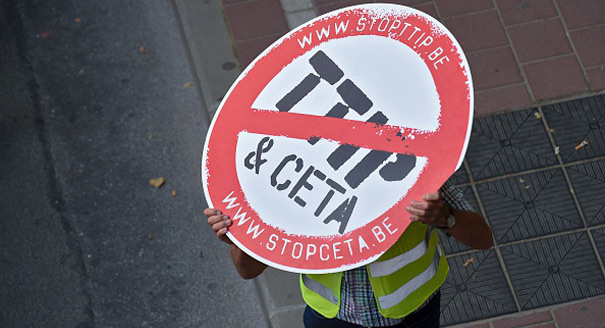
Source: Getty
By blocking a major trade accord between Canada and the EU, a region of Belgium is destroying Europe as a global economic player.
Any hope that the European Union could show some sense of unity and purpose after Britain voted in June to leave the bloc has been thrown into doubt by a small group of politicians in the Belgian region of Wallonia. The region’s left-wing premier, Paul Magnette, delivered on threats he made months ago: that this region of just 3.5 million people would block the EU-Canada Comprehensive Economic and Trade Agreement (CETA). The rest of the EU’s 500 million citizens would be held hostage to Wallonia.
CETA, which took seven years to negotiate, is about Canada and the EU having such a wide-ranging trade accord that almost all tariffs would be scrapped. About 92 percent of EU agriculture and food products could be exported to Canada duty free, and eliminating duties on industrial goods would save European exporters almost €600 million ($652 million) a year, according to the EU.
No matter how much Canadian and EU trade officials worked to bring Wallonia on board, all attempts have so far failed. Unless Magnette, now joined by the government in the Belgian region of Brussels, lifts his opposition to CETA, the damage to Europe will be irreparable.
For one thing, other countries outside Europe will ask whether it is really worth trying to reach a trade agreement with the EU if it cannot even strike a deal with an open, liberal, democratic country such as Canada. These bitter disagreements over ratifying CETA bode ill for the EU and the United States, which are concluding talks on the proposed Transatlantic Trade and Investment Partnership (TTIP). And if anyone hoped to believe that it would be easy for Britain to reach a trade deal with the EU after it leaves the bloc, such hopes are now dashed.
Even more worryingly for Europe’s ambitions to be a truly global player, the CETA negotiations have shown that the EU is now beholden to groups of politicians and an ever-growing movement that opposes globalization and free trade.
Forget the fact that it was trade, combined with huge financial support from the United States, that helped Europe get back onto its feet after World War II. Forget the fact that a 2011 EU trade deal with South Korea has already led to an increase in EU service exports to South Korea of 40 percent and a rise in goods exports of 55 percent. Such statistics simply get in the way or are ignored by some politicians in Europe, who believe that such trade deals only benefit multinational companies.
Antiglobalizers, who are grouped around populists and Euroskeptic movements, would do well to visit small, export-driven companies in Germany. These companies support CETA and TTIP. If TTIP were ever concluded—and it is now increasingly unlikely—then those small and medium-sized German companies that export to the United States would not have to change the colors and configurations of wires in electric plugs to conform to U.S. standards. The savings would run into hundreds of millions of euros according to the Federation of German Industries. But that, it seems, is an irrelevant detail for antiglobalizers.
Leaving all these issues aside, and regardless of what happens to CETA, this latest setback for the EU reveals two important facts.
The first is that the European Commission, which under the EU treaties has the power to negotiate trade agreements, has had its authority undermined. Under pressure from national governments, the commission put forward CETA as a so-called mixed agreement, having previously emphasized that it saw the deal as an EU-only agreement.
It has been impossible to square that circle. A mixed agreement has to be ratified not only by the EU as a whole but also by the 28 member states. In the case of Belgium, that means regional parliaments such as that of Wallonia must give their consent as well. An EU-only agreement, by contrast, gives the EU alone the power to conclude the deal.
Some regional legislatures have seized on the growing movement against free trade, leaving the commission unable to defend its powers, as the case of CETA shows. The result is that EU trade policy now risks going in the same direction as foreign policy: renationalization. But if some member states believe they can go it alone in the twenty-first century, they are living a dangerous delusion.
This is why the second fact revealed by CETA—whether or not Wallonia will change its mind—is that there is a glaring need for a two-speed Europe. The eurozone countries cannot afford to ignore the implications of Brexit and the rejection of CETA. Both events weaken Europe and the euro. And even though the public mood is against more integration, the eurozone countries still have sufficient authority to pull the EU out of its miserable and dangerous malaise by pushing for a two-speed Europe. It is that move that could keep the political and economic integration project alive.
As it is, the failure of CETA has shown how the decisionmaking process in the EU is inexorably leading the bloc toward paralysis and implosion. Just when the Western liberal order is being challenged not only by Russia and China but also by politicians and movements in the West, it is time for eurozone leaders to rescue Europe, before it is too late.

Nonresident Senior Fellow, Carnegie Europe
Judy Dempsey is a nonresident senior fellow at Carnegie Europe
Recent Work
Judy Dempsey
Judy Dempsey
Carnegie does not take institutional positions on public policy issues; the views represented herein are those of the author(s) and do not necessarily reflect the views of Carnegie, its staff, or its trustees.

Trump is distracted and Ukraine wants Europe to step up. The continent’s leaders must find their voice and assert it in talks with Russia.

Alissa de Carbonnel

Mounting economic strain and battlefield losses will not necessarily make the Kremlin less dangerous. They could instead push Moscow toward a more aggressive hybrid campaign designed to test NATO’s Eastern flank, exploit allied hesitation, and fracture European resolve.

Maksym Beznosiuk

Over the past ten years, NATO has held almost as many summits as it did during the entirety of the Cold War. Are they still useful, or is it time to stop holding annual meetings?

Rym Momtaz, ed.
Nearly a year and a half after Europeans leaned into sucking up to Trump, the strategy has produced some benefits when it comes to Ukraine.
Rym Momtaz
Far-right leader Marine Le Pen can—and will—run in France’s next presidential election. What does the outcome of her appeal against a 2025 embezzlement conviction mean for the country’s political future?

Catherine Fieschi