

Commentary
With its public finances in shambles, the far right polling at 35 percent ahead of the 2027 presidential election, and a growing protest movement, is France’s crisis a threat to the EU’s geopolitical awakening?
Rym Momtaz, ed.
{
  "authors": [
    "John Kornblum"
  ],
  "type": "commentary",
  "blog": "Strategic Europe",
  "centerAffiliationAll": "",
  "centers": [
    "Carnegie Endowment for International Peace",
    "Carnegie Europe"
  ],
  "collections": [
    "Transatlantic Cooperation"
  ],
  "englishNewsletterAll": "",
  "nonEnglishNewsletterAll": "",
  "primaryCenter": "Carnegie Europe",
  "programAffiliation": "",
  "programs": [],
  "projects": [],
  "regions": [
    "Europe",
    "North America",
    "South America",
    "Western Europe"
  ],
  "topics": [
    "Security",
    "EU"
  ]
}
Source: Getty
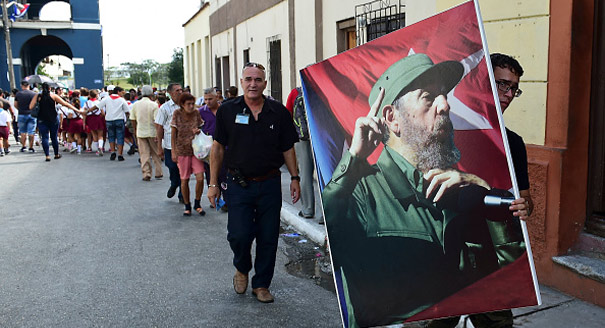
The death of former Cuban leader Fidel Castro and the imminent arrival of Donald Trump as U.S. president offer Europeans a chance to reassess their approach to security.
The deputy editor of the New Republic magazine suggested on November 26 that how one approaches the legacy of former Cuban leader Fidel Castro more or less defines how one relates to the Cold War. Those who honor Castro as a fighter for freedom against hegemonic U.S. power tend to see the Cold War as little more than a battle for influence between two equally ruthless blocs. Those skeptical or negative about Castro are more likely to believe that the Cold War was a test of wills between the forces of good and evil.
The European press has devoted considerable page space to positive treatment of the Cuban leader’s memory. Munich’s Süddeutsche Zeitung published seven separate articles covering Castro’s legacy and passing. Coverage in Berlin’s Tagesspiegel stretched over three pages. Meanwhile, European Commission President Jean-Claude Juncker said many people considered Castro a hero, but he didn’t specify what sort of hero he meant.
Over the years, Americans were often taken aback by the sympathy Europeans of all political colors poured over the murderous liberation movements of Africa and Latin America. Many Europeans returned from visits to Havana dizzied by Castro’s charm and often convinced by his logic.
Castro was a romantic diversion for Europeans desperate to demonstrate independence from a protecting power they knew they couldn’t do without. But he was also a ruthless despot who in 1962 brought the world to the brink of nuclear war during the Cuban Missile Crisis. Soviet leader Nikita Khrushchev’s Caribbean adventure actually stabilized Europe by helping cement U.S. support for NATO only a year after the construction of the Berlin Wall.
In 2016, things are very different. U.S. President-elect Donald Trump probably didn’t like Castro much, but he seems to care even less for the ideological confrontations that resulted from the Cold War. Even his tweet “Fidel Castro is dead!” was about as free of emotion as could be imagined. He seemed to say the necessary without much else.
Such disinterest can only add to the concerns of Europeans who are wondering how they are going to make do without the American security umbrella that in the past they so loved to denounce together with Castro over rum and cigars. Trump is said to admire Vladimir Putin, and the Russian president has returned the favor. NATO appears to be far down on the incoming U.S. leader’s agenda.
Europeans could risk pilgrimages to Havana, because observers knew they had no real meaning. Now, Europeans are truly independent and don’t really like the feeling. European leaders warn Trump about values but can’t even find a quorum for a meeting to discuss how to deal with him.
Will more European money be spent on defense, as many have urged? Should Trump be criticized for his weak stand on Western values, or is it better for Europeans to define their own direction? Alas, nowhere in Europe is there a strategy for how to wrest important commitments on values, trade, and defense from a leader who seems to care more about his hairdo than about the European peace project.
John Kornblum is a senior counselor at Noerr LLP and former U.S. ambassador to Germany.
John Kornblum
Centre for Strategic and International Studies
Carnegie does not take institutional positions on public policy issues; the views represented herein are those of the author(s) and do not necessarily reflect the views of Carnegie, its staff, or its trustees.

With its public finances in shambles, the far right polling at 35 percent ahead of the 2027 presidential election, and a growing protest movement, is France’s crisis a threat to the EU’s geopolitical awakening?

Rym Momtaz, ed.

Ahead of a tough winter for Ukraine, Donald Trump’s swing back toward Russia bodes ill. But instead of panicking, Kyiv’s European allies are focusing on action.
Rym Momtaz

While the EU and European governments are embracing the much-lauded middle-power moment, this entails three difficult conundrums.

Richard Youngs

Much has been said of the changes Brussels is trying to make to the EU enlargement process. Here’s why gradual integration might—or might not—be the answer.

Dimitar Bechev

The European Commissioner for Trade is headed to China. But after President Xi’s bridge-building visit to Washington, can a more isolated EU overcome Beijing’s stranglehold on critical raw materials? Who will blink first?
Rym Momtaz, ed.