

Commentary
Judy Dempsey
{
  "authors": [
    "Judy Dempsey"
  ],
  "type": "commentary",
  "blog": "Strategic Europe",
  "centerAffiliationAll": "",
  "centers": [
    "Carnegie Endowment for International Peace",
    "Carnegie Europe"
  ],
  "collections": [
    "Transatlantic Cooperation"
  ],
  "englishNewsletterAll": "",
  "nonEnglishNewsletterAll": "",
  "primaryCenter": "Carnegie Europe",
  "programAffiliation": "",
  "programs": [],
  "projects": [],
  "regions": [
    "Europe",
    "North America",
    "United States",
    "Western Europe"
  ],
  "topics": [
    "Foreign Policy",
    "Security",
    "EU"
  ]
}
Source: Getty
As the United States embarks on a new era, European leaders should respond by focusing on security, trade, and stability.
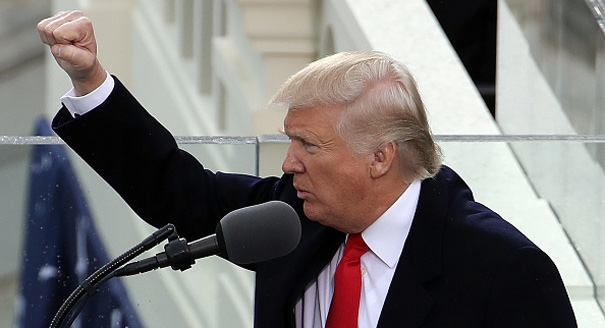
European leaders should harbor no illusions or hopes about Donald Trump, whose short and pugnacious inauguration speech on January 20 just after he was sworn in as U.S. president set the tone of his administration. Leaving aside the intense nationalist tenor of his speech, his message to America’s allies was that his administration was going to put interests, not values, first.
Most leaders of EU member states and of EU institutions speak about putting values before interests. For them, values define Europe. And no matter which U.S. president was in the White House, the mantra—until Trump’s inauguration—was that the transatlantic relationship was built on values. Interests hardly got a look-in.
Trump has changed all that. The EU now has to take a hard look at its interests, because the reality is that interests more than values have been the basis of the Euro-Atlantic community. NATO’s top officials repeatedly argue that the alliance is based on values. But NATO didn’t admit Turkey or Spain because of their values. And today, the political decay of Turkey’s democracy challenges NATO’s views about shared values. Put simply, NATO is based on hard-nosed interests and realpolitik. Admitting authoritarian countries during the Cold War was about expanding security and consolidating Western Europe.
Over a quarter century since the collapse of the Berlin Wall, NATO’s motivations have not changed. Had the alliance been based on values, then NATO would several years ago have admitted Georgia and not Montenegro, which signed an accession protocol in 2016. In short, the transatlantic alliance has served the interests of both the United States and Europe, even though Trump chooses to dismiss that reality.
The EU could take a leaf out of NATO’s book and Trump’s speech. Since the new U.S. president is determined to defend America’s interests—at any cost, it seems, and to the detriment of previous trade agreements—EU leaders should take a hard look at defending their interests.
Preaching and defending values are important and noble. But if values are not coupled with a definition of Europe’s interests, then the EU will be in no fit state to deal with the Trump administration—just as it has been singularly unprepared to devise a strategy for Russia beyond sanctions or a long-term approach toward Ukraine or the Middle East.
Europe’s interests are not difficult to define. They fall into three categories: security, trade, and stability.
First, it is in Europe’s interest to have clearly defined defense and security policies. Leaders in the European Parliament such as Guy Verhofstadt and Germany’s Defense Minister Ursula von der Leyen argue repeatedly for more European defense. But the detail and the political will are absent.
It is also in Europe’s interest and safety to have integrated defense and security policies. It’s all very well having Atlanticists over in Washington pledging unending support for NATO, but the reality is that Europeans can no longer take America’s security guarantee for granted—even though that security guarantee was in America’s interest, too. That is why Europeans need a hard-nosed approach to defense and security.
Second, the European Commission, the EU’s executive, needs to protect its prerogative in negotiating trade accords. This is more urgent than ever. As Trump talks a language of protectionism, this is no time for Europe to dawdle in forging trade accords in a bid to protect its economy from the United States, the world’s biggest economy, which is threatening to shut its doors to manufacturers that want to sell to America but will not invest there.
The third interest is stability. This is not about turning a blind eye to authoritarian regimes, as most European governments did in North Africa and the Middle East before the Arab Spring erupted in 2010. It is about promoting stability through trade, economic and political incentives, and special support for building democratic institutions. Rather than impose its values, which doesn’t work, Europe should underpin democratic movements by helping them with training, exchanges, grants, support for independent media, and education. These elements are all in Europe’s interest because they are to do with promoting and slowly spreading stability.
It is very easy to argue that instead of articulating these interests, the EU should focus on its many internal weaknesses. Apart from Britain’s decision to leave the union and the rise of populist, isolationist leaders, corruption and weak governance are back with a vengeance in Romania as the new government plans to commute sentences for nonviolent crimes—meaning releasing politicians jailed for corruption. Neighboring Hungary has plans to rein in nongovernmental organizations that are critical of Viktor Orbán’s government. And Poland’s conservative Law and Justice government is polarizing the country at a time when it should be pushing for a stronger and more integrated Europe.
But those weaknesses are precisely why it is in Europe’s interest to push hard and fast for security, trade, and stability. All three, logically, mean a more integrated Europe, whether all countries together or at different speeds. Complaining about the Trump administration may make some European leaders feel good. But that is no substitute for strategy.

Nonresident Senior Fellow, Carnegie Europe
Judy Dempsey is a nonresident senior fellow at Carnegie Europe
Recent Work
Judy Dempsey
Judy Dempsey
Carnegie does not take institutional positions on public policy issues; the views represented herein are those of the author(s) and do not necessarily reflect the views of Carnegie, its staff, or its trustees.

European Commission President Ursula von der Leyen is about to give her annual address on the state of the EU. Here’s what she won’t—but should—say.

Rym Momtaz

The aftermath of the Ceuta crisis shows Europe has drawn the wrong lessons. Rather than doubling down on failed migration policies, the EU needs to address the underlying roots of such episodes.

Richard Youngs

An overwhelming victory by a far-right-wing party in a small state in eastern Germany will have major repercussions for Chancellor Friedrich Merz’s coalition.
Judy Dempsey

Canadian Prime Minister Mark Carney has twice inspired praise for standing up to U.S. President Donald Trump: at the 2026 World Economic Forum in Davos and on Canada-U.S. trade negotiations. Is Carney showing a third way better than the EU has in dealing with the Trump administration?
Rym Momtaz, ed.

The EU’s responses to two recent incidents expose the gulf between European perceptions and capabilities. Unless the union can bridge that gap, it will never become a real geostrategic power.
Rym Momtaz