

Commentary
With its public finances in shambles, the far right polling at 35 percent ahead of the 2027 presidential election, and a growing protest movement, is France’s crisis a threat to the EU’s geopolitical awakening?
Rym Momtaz, ed.
{
  "authors": [
    "Andrew A. Michta"
  ],
  "type": "commentary",
  "blog": "Strategic Europe",
  "centerAffiliationAll": "",
  "centers": [
    "Carnegie Endowment for International Peace",
    "Carnegie Europe"
  ],
  "collections": [
    "Transatlantic Cooperation"
  ],
  "englishNewsletterAll": "",
  "nonEnglishNewsletterAll": "",
  "primaryCenter": "Carnegie Europe",
  "programAffiliation": "",
  "programs": [],
  "projects": [],
  "regions": [
    "Europe",
    "North America",
    "United States",
    "Western Europe"
  ],
  "topics": [
    "Security",
    "Military"
  ]
}
Source: Getty
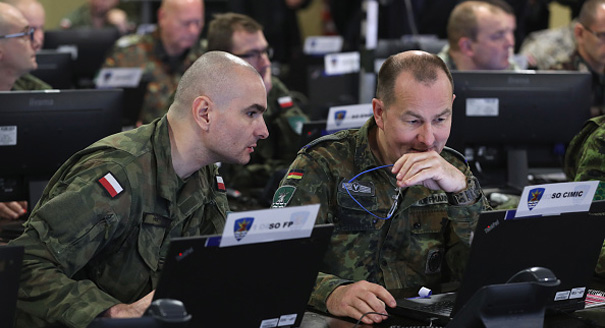
As territorial defense and counterterrorism rise to the top of NATO’s agenda, these two issues offer the alliance an opportunity to develop a shared strategic vision.
To say that the European members of NATO should spend 2 percent of their GDP on defense, as they agreed at the alliance’s 2014 summit in Wales, is to state the obvious; but increases in defense spending alone will not revitalize NATO. The alliance’s future hinges on the key question of strategic consensus—that is, a deeply internalized recognition of the threats confronting the allies.
The last twenty-five years have offered ample reason for pessimism that NATO can agree on a unifying purpose. However, today for the first time since the end of the Cold War, the alliance seems to have enough of a shared security optics to begin to forge an enduring common threat assessment.
At first blush, guarded optimism about NATO’s future may seem counterintuitive, as for years the alliance has come up short when it comes to resources and a shared strategic vision. Debates in NATO on what to prioritize continue unabated. Still, two issues are rising fast to the top of the organization’s agenda: regionally, a resurgent and geostrategically assertive Russia; and globally, the accelerating threat of Islamic terrorism.
These two topics offer a unique opportunity for NATO to align the security outlooks of key European members with that of the United States. It appears that the next NATO summit, in Brussels in May 2017, may deliver a strategic vision that—much as during the Cold War—will condense a common understanding of NATO’s mission into a clearly articulated set of goals that publics will embrace.
Notwithstanding the doom and gloom of op-eds and commentaries predicting NATO’s twilight, the United States and its European allies have already delivered a remarkably coordinated response to Russian pressure along the alliance’s Eastern flank, in both political and military terms. The presence of the U.S. Armored Brigade Combat Team in Poland and the impending deployments of NATO multinational battalions in the Baltics are a breakthrough in how the United States and NATO operate in Central Europe, even if the current reinforcement of the flank remains a work in progress. The deployments demonstrate that allies recognize the geostrategic shift occurring on Europe’s doorstep in the wake of Russia’s March 2014 seizure of Crimea and the ongoing war in eastern Ukraine, and can respond in unison.
Likewise, terrorist strikes in Europe and the United States have generated a significant change in how the threat of Islamic terrorism is perceived on both sides of the Atlantic. U.S. and European leaders have identified jihadist terrorism as a direct threat, with U.S. President Donald Trump calling for an all-out effort to defeat the self-proclaimed Islamic State, French President François Hollande declaring his country to be at war after the November 2015 Paris terrorist attacks, British Prime Minister Theresa May warning that the UK faces the same terrorist threats as France, and Chancellor Angela Merkel calling terrorism the greatest threat to Germany. Similar sentiments have been echoed across other NATO capitals.
Since the end of the Cold War, NATO has been searching for its existential raison d’être, but various formulas such as “out of area,” “smart defence,” and “comprehensive approach” have come up short in large part because of allies’ divergent views of security.
Arguably, the biggest missed chance for NATO came in the wake of the 2001 terrorist attacks in New York and Washington, when the alliance invoked Article 5 of the NATO treaty in defense of the United States. Back then, it seemed for a moment that a new collective mission was staring NATO in the face, for it should have been clear that global Islamic terrorist networks were only just beginning to grow in strength. And yet, the subsequent War on Terror and the Overseas Contingency Operations pursued by the United States never germinated into a shared strategic mission, even though the alliance took the lead role in the International Security Assistance Force in Afghanistan.
Today, NATO has arguably the greatest chance since the end of the Cold War to foster a strategic consensus around its two common threats: Russia’s renewed geostrategic assertiveness along NATO’s Eastern (and, increasingly, Southern) flank, and the surge of Islamic terrorism. The key deliverable for the next NATO summit should be a strategy on Russia and terrorism, and allies should start working on it posthaste. Achieving this goal, in addition to increasing defense spending, would go a long way toward strengthening alliance cohesion.
Andrew A. Michta is the dean of the College of International and Security Studies at the George C. Marshall European Center for Security Studies. Views expressed here are his own.

Andrew A. Michta
Carnegie does not take institutional positions on public policy issues; the views represented herein are those of the author(s) and do not necessarily reflect the views of Carnegie, its staff, or its trustees.

With its public finances in shambles, the far right polling at 35 percent ahead of the 2027 presidential election, and a growing protest movement, is France’s crisis a threat to the EU’s geopolitical awakening?

Rym Momtaz, ed.

Ahead of a tough winter for Ukraine, Donald Trump’s swing back toward Russia bodes ill. But instead of panicking, Kyiv’s European allies are focusing on action.
Rym Momtaz

While the EU and European governments are embracing the much-lauded middle-power moment, this entails three difficult conundrums.

Richard Youngs
Much has been said of the changes Brussels is trying to make to the EU enlargement process. Here’s why gradual integration might—or might not—be the answer.

Dimitar Bechev

The European Commissioner for Trade is headed to China. But after President Xi’s bridge-building visit to Washington, can a more isolated EU overcome Beijing’s stranglehold on critical raw materials? Who will blink first?
Rym Momtaz, ed.