

Commentary
Judy Dempsey
{
  "authors": [
    "Judy Dempsey"
  ],
  "type": "commentary",
  "blog": "Strategic Europe",
  "centerAffiliationAll": "",
  "centers": [
    "Carnegie Endowment for International Peace",
    "Carnegie Europe"
  ],
  "collections": [
    "Transatlantic Cooperation"
  ],
  "englishNewsletterAll": "",
  "nonEnglishNewsletterAll": "",
  "primaryCenter": "Carnegie Europe",
  "programAffiliation": "",
  "programs": [],
  "projects": [],
  "regions": [
    "Europe",
    "North America",
    "United States",
    "Eastern Europe",
    "Western Europe"
  ],
  "topics": [
    "Security",
    "Military"
  ]
}
Source: Getty
Spending more on defense would boost NATO’s capabilities and reputation. But the alliance’s real weakness is its loss of institutional memory.
In Washington and at NATO’s headquarters in Brussels, the view is that alliance members spend far too little on defense. Despite repeated cajoling from U.S. defense secretaries—and now from U.S. President Donald Trump—for European allies to spend more, many European finance ministers are opposed to opening their purses to their defense counterparts.
Only a handful of NATO allies—Britain, Estonia, Greece, Poland, and the United States—spend 2 percent or more of their GDP on defense. And that’s out of an alliance of 28 members. No doubt there’ll be more cajoling at the annual Munich Security Conference when scores of leaders and hundreds of diplomats along with defense and security officials gather in the Bavarian capital on February 17.
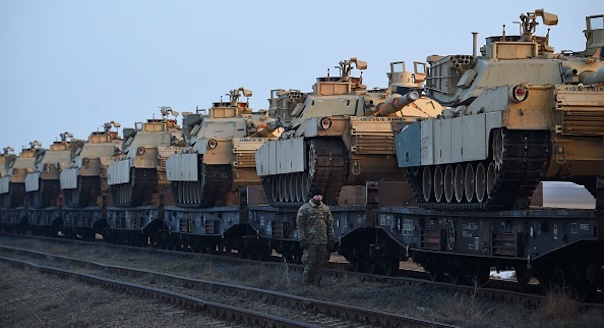
By spending more on equipment and training and sending 5,000 troops to Poland and the Baltic states, NATO aims to reassure its more vulnerable members and show Vladimir Putin, the Russian president, that the alliance is taking collective defense seriously. But something of fundamental importance is missing from the spending plea and the deployment of troops: institutional memory, or what collective defense and deterrence used to mean in substance and in practice.
During the Cold War, NATO was in top gear. Training and coordination, doctrine and capabilities, strategy and preparedness were taken as given. Collective defense was ingrained in the theory and practice of the alliance.
The nature of the threat was never underestimated, either. Just take a look at a fascinating report written by the alliance’s military committee in 1966. The Overall Strategic Concept for the Defense of the North Atlantic Treaty Organization Area is worth reading for one main reason: it set out the strategic goals of NATO and those of its adversary, the Soviet-led Warsaw Pact.
The year 1966 cannot be compared with 2017. The Warsaw Pact is defunct. In that sense, the conventional definition of the Cold War no longer applies today. But Russia is still intent on weakening or dividing NATO. The alliance’s demise remains Moscow’s goal. Russia’s determination to hold on to its immediate western neighbors—Belarus, Georgia, and Ukraine—and maintain a strong influence over Armenia and Moldova has already been tested by Moscow’s invasion of eastern Ukraine and its annexation of the Crimean Peninsula in March 2014.
Page 4 of NATO’s 1966 report states clearly that Soviet policy toward NATO—a policy that Putin is replicating today—was based on “economic means, political means, propaganda, subversion, and military power.” With a brief interlude in the early 1990s, the Kremlin hasn’t discarded these instruments.
This is NATO’s Achilles’ heel and the reason why the debate over the 2 percent spending goal could be a red herring. During the 1990s, the alliance lost its raison d’être—and understandably. Many of its members assumed Russia would embark on a different kind of cooperation or coexistence with the West. However, NATO’s bombing of Serbia in 1999 and Russia’s staunch opposition to that mission only reinforced Moscow’s Cold War perception of NATO.
The alliance, meanwhile, slowly lost the tools that underpinned territorial defense: coordination and strategic thinking. In 2001, NATO went off to Afghanistan, where crisis management and counterinsurgency eroded what the alliance was established for in the first place. “The strategic pendulum is swinging back from crisis management to deterrence and collective defense,” a top NATO diplomat told Carnegie Europe on condition of anonymity.
The problem is that on the ground, NATO’s European allies are singularly ill equipped for deterrence and collective defense. Again, there is a lack of institutional memory. “We lack the generals who knew what deterrence and collective defense were about,” another NATO diplomat said.
Just as crucially, NATO today lacks the necessary infrastructure. During the Cold War, NATO had strong bridges, aircraft, roads, and a railroad network to transport troops quickly and in large numbers. True, there were tens of thousands of NATO troops at the ready. But that infrastructure also included energy supplies and logistics, the availability of housing and food, and the ability to cross borders without bureaucratic delays. All these have been largely eroded. If NATO is serious about deterrence and collective and territorial defense, it has to remake this infrastructure.
As the 1966 report stated, “to be fully effective against an attack with little or no strategic warning forces should be provided with adequate combat and logistic support, possess the necessary tactical mobility, and be deployed forward with appropriate echeloning in depth in suitable tactical locations.”
NATO cannot revive this depleted institutional memory. A whole generation of military, diplomatic, and security personnel has been replaced. That is why the 2 percent spending issue will become a red herring unless NATO realizes what it has lost and what Russia has retained.

Nonresident Senior Fellow, Carnegie Europe
Judy Dempsey is a nonresident senior fellow at Carnegie Europe
Recent Work
Judy Dempsey
Judy Dempsey
Carnegie does not take institutional positions on public policy issues; the views represented herein are those of the author(s) and do not necessarily reflect the views of Carnegie, its staff, or its trustees.

A summer of escalation in the Black Sea has hurt Ukraine economically and is exacerbating world food security. A truce is needed—as is a broader reframing of Europe’s Ukraine strategy.

Thomas de Waal

Are Germany’s economic, industrial, and political struggles becoming a liability for the EU’s ability to rise to the geopolitical moment?

Rym Momtaz, ed.

European Commission President Ursula von der Leyen is about to give her annual address on the state of the EU. Here’s what she won’t—but should—say.
Rym Momtaz

The aftermath of the Ceuta crisis shows Europe has drawn the wrong lessons. Rather than doubling down on failed migration policies, the EU needs to address the underlying roots of such episodes.

Richard Youngs

An overwhelming victory by a far-right-wing party in a small state in eastern Germany will have major repercussions for Chancellor Friedrich Merz’s coalition.
Judy Dempsey