

Commentary
Marc Pierini
{
  "authors": [
    "Marc Pierini"
  ],
  "type": "commentary",
  "blog": "Strategic Europe",
  "centerAffiliationAll": "",
  "centers": [
    "Carnegie Endowment for International Peace",
    "Carnegie Europe",
    "Carnegie Russia Eurasia Center"
  ],
  "collections": [
    "Turkey’s Transformation"
  ],
  "englishNewsletterAll": "",
  "nonEnglishNewsletterAll": "",
  "primaryCenter": "Carnegie Europe",
  "programAffiliation": "",
  "programs": [],
  "projects": [],
  "regions": [
    "Europe",
    "Türkiye",
    "Middle East"
  ],
  "topics": [
    "Democracy",
    "Political Reform",
    "EU"
  ]
}
Source: Getty
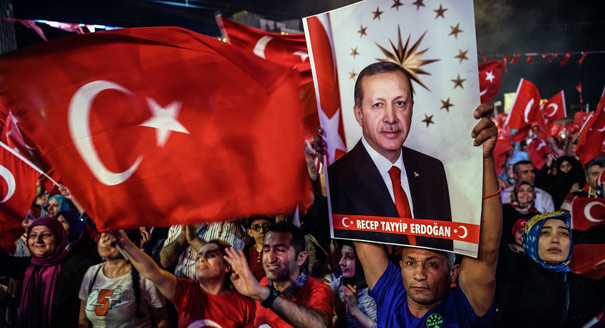
Extreme tensions created by the July 2016 failed coup were decisive in hastening a debate on a draft new constitution in Turkey. If approved, the country will effectively adopt a one-man-rule system.
Speaking on July 16, 2016, Turkish President Recep Tayyip Erdoğan stated that the failed coup the previous night was a “gift from God” that would allow him to cleanse the army and the state of terrorists. Turkey’s post-coup purge had the most extensive scope imaginable. Not only rebellious officers were targeted but also scores of opponents—real or perceived—in local administration, the media, schools and universities, culture, and business. In addition, the government set in motion a massive crackdown on dissent and social media, and so-called enemies of the state from within and outside were routinely denounced.
After measures taken in response to the failed coup turned into a full-fledged purge, a second opportunistic move is now in the offing: a radical transformation of the Turkish state.
The extreme tensions created by the failed coup, as well as regional crises, were decisive in helping the country’s leadership hasten a debate on a draft new constitution that would confer extensive executive powers on the president, with very limited checks and balances. Turkey, the government argued, needed a strong man at the helm and citizens should be consulted once every five years. On January 21, parliamentarians voted to approve the draft, which will now go to a referendum on April 16, unless an opposition petition in the Constitutional Court of Turkey blocks the process.
The issue is highly divisive—even in AKP ranks—as illustrated by the very heated debate in the parliament. Secret voting was in practice replaced by open voting in the chamber, suggesting an iron-fist strategy within the AKP. Because many deputies of the pro-Kurdish Peoples’ Democratic Party (HDP) are in jail pending trial, the entire group abstained in protest. Now, the referendum is the last ditch before Turkey formally adopts a one-man-rule system.
If approved, the new constitution would introduce drastic changes to the country’s governance. The position of prime minister would disappear, and the president would appoint vice presidents and ministers. Able to govern by decree, the head of state would remain at the helm of his political party, shaping his political group in the legislature as he sees fit by deciding who from his party can run for parliament. The president would also have a more direct authority on the High Council of Judges and Prosecutors—the body that appoints members of the judiciary—by appointing four of its members himself while the parliament elects seven other members, and by having the undersecretary of the ministry of justice sitting permanently on the Council.
Under the new constitution, presidential and parliamentary elections would take place at the same time, every five years, giving a lead role to the president, who in reality would run the main campaign. Meanwhile, the parliament would lose its powers to interpellate and audit the government.
The majoritarian logic of such a system has been explicit since Erdoğan’s 2014 presidential election campaign. In the president’s view, because he was directly elected by a majority of voters for the first time in the country’s history, he has complete legitimacy, meaning that his policies cannot be subjected to challenges by the legislative or judicial branches—let alone civil society or interest groups. As the government explained after the 2014 election, Turkey’s constitution is now being aligned to the political reality of the country.
If passed, this new power architecture would allow Erdoğan not only to possess all the levers of power but also to impose a religious-conservative society that reflects the views of about half of Turkish citizens. This would mean the triumph of the AKP’s narrative of “it’s our turn.” Turkey’s religious conservatives, who have felt suppressed and oppressed by Kemalism since 1923, would shape Turkish society their way. That would erase the message voters sent in the June 2015 parliamentary election, in which a solid majority of voters rebuffed the Turkish president’s majoritarian and polarizing policies by opting for other parties.
If Erdoğan attains his goal, he will largely dismantle the foundations of the Turkish secular republic proclaimed in 1923 by Kemal Atatürk, who pivoted the country toward Western legal, dress, and cultural standards and even changed peoples’ names and the alphabet used by the Turkish language. The political, social, and economic consequences of shifting away from the system established ninety-four years ago would be profound and unpredictable.
For Erdoğan, 2017 is a year of multiple tests. Amid a dire security and economic context, with a shaken security apparatus, and with few friends left abroad, the president will find it extremely costly to attain his two overarching political objectives: a religious-conservative society and a system of one-man rule.
To succeed in his goals, Turkey’s leader will probably have to continue relying on conspiracy theories—internal and external—to explain the country’s difficulties, clamp down further on the liberal half of Turkey, discard any future coexistence with the country’s Kurds, and promote the draft constitution through a muscular referendum campaign. This hardly leads Turkey toward a peaceful future, although the sentiment one gets from some observers after the January 21 vote in the parliament is resignation rather than fierce opposition.
Internationally, the EU and the United States are on notice that postreferendum Turkey may no longer be an ally that values its ethnic, social, and religious diversity. An authoritarian regime would put Turkey at odds with its memberships of NATO and the Council of Europe and would send Ankara’s EU application into an irreversible coma. These are momentous consequences that would be felt most strongly in the economic arena.
Some observers have speculated that such a deep gap between Turkey and the West would secretly cause European leaders to rejoice, all too happy to shrink their relationship with Erdoğan to a mere discussion on trade, counterterrorism, and refugees. Conversely, the Turkish president would supposedly be gladly relieved of EU rule-of-law norms, which, if implemented in Turkey, would impede his power. If this is the calculus, both sides will quickly come to measure the magnitude of the negative fallout of such a divorce.
When they go to vote in the constitutional referendum this spring, Turkey’s citizens will have on their shoulders a responsibility of historic proportions, by far the biggest since the proclamation of the republic in 1923.
Text updated on February 14.

Senior Fellow, Carnegie Europe
Marc Pierini is a senior fellow at Carnegie Europe, where his research focuses on developments in the Middle East and Turkey from a European perspective.
Recent Work
Marc Pierini
Marc Pierini
Carnegie does not take institutional positions on public policy issues; the views represented herein are those of the author(s) and do not necessarily reflect the views of Carnegie, its staff, or its trustees.

The EU can impose sanctions but struggles to enforce them without the United States. With Washington increasingly disinterested in backing European interests, the bloc must now fend for itself.


Nicu Popescu, Tiago Antunes

Russia is testing the waters of NATO’s mutual defense clause. What do strikes in Romanian territorial waters mean for the alliance’s posture toward Moscow?

Dimitar Bechev

With its public finances in shambles, the far right polling at 35 percent ahead of the 2027 presidential election, and a growing protest movement, is France’s crisis a threat to the EU’s geopolitical awakening?

Rym Momtaz, ed.

Ahead of a tough winter for Ukraine, Donald Trump’s swing back toward Russia bodes ill. But instead of panicking, Kyiv’s European allies are focusing on action.
Rym Momtaz

While the EU and European governments are embracing the much-lauded middle-power moment, this entails three difficult conundrums.

Richard Youngs