

Commentary
Judy Dempsey
{
  "authors": [
    "Judy Dempsey"
  ],
  "type": "commentary",
  "blog": "Strategic Europe",
  "centerAffiliationAll": "",
  "centers": [
    "Carnegie Endowment for International Peace",
    "Carnegie Europe"
  ],
  "collections": [
    "Transatlantic Cooperation"
  ],
  "englishNewsletterAll": "",
  "nonEnglishNewsletterAll": "",
  "primaryCenter": "Carnegie Europe",
  "programAffiliation": "",
  "programs": [],
  "projects": [],
  "regions": [
    "Europe",
    "North America",
    "United States",
    "Western Europe",
    "Germany"
  ],
  "topics": [
    "Foreign Policy",
    "EU"
  ]
}
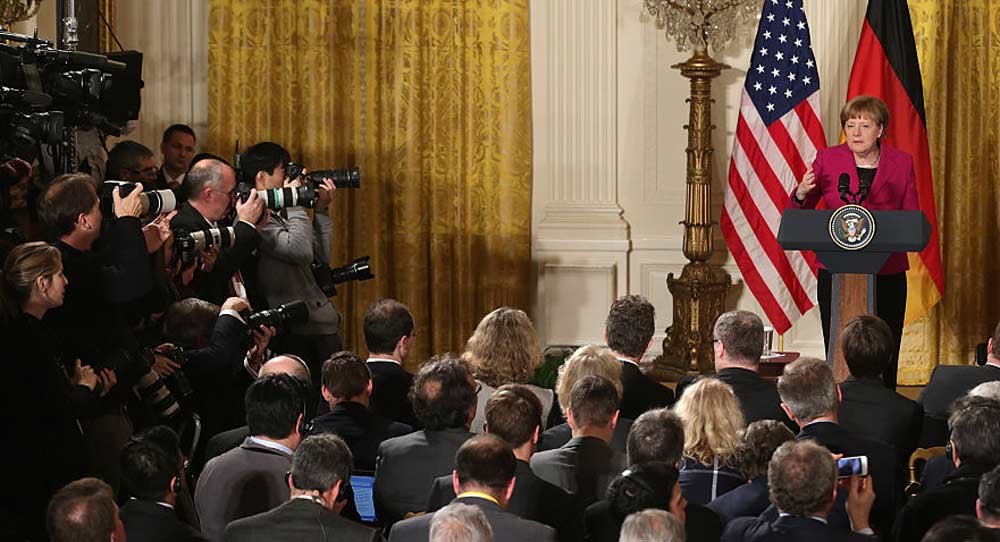
Source: Getty
When she meets the U.S. president, the German chancellor will have the awesome task of defending Germany, Europe, and the Western liberal order.
Angela Merkel is not easily intimidated. Vladimir Putin tried to unnerve her back in 2007 when he had his dog sit in on some of their discussions. He knew the German chancellor didn’t like dogs. But no matter. The Russian president didn’t set much store by respect for Europe’s most important leader. Merkel, however, didn’t give him the pleasure of balking at such rudeness or showing fear.
Across the Atlantic, Merkel had her fair share of difficult talks with former U.S. presidents George W. Bush and Barack Obama. She never held back in criticizing Bush’s use of torture. Nor did she bow to Obama’s criticism of Germany’s tough austerity measures meted out to Greece and other eurozone countries to make their economies more competitive.
In the end, it was Merkel, not the leaders of the EU institutions or any other head of government, to whom Bush and Obama deferred. They respected her for her values, consistency, and lack of bravado.
Now comes Merkel’s first encounter with U.S. President Donald Trump, which will take place on March 17. It will be the third U.S. administration she has had to deal with since taking office in 2005.
This visit pits two radically different leaders against each other. Merkel, who was brought up in Communist East Germany, had no experience of freedom until November 1989, when, as the Berlin Wall was being torn down, she went across to the Western part of the city and then returned to her apartment a few hours later.
She has never taken for granted the new freedom, security, and opportunity that the post-1989 period offered her. Although she initially lacked a strategy to deal with the up to 1 million refugees and migrants who entered Germany in 2015–2016, she allowed them in because they needed safety. For Merkel, it was about values, decency, and openness.
Trump’s worldview, in contrast, is about the freedom to make money, make deals, and decide which countries America wants to do business with. Interests take precedence over values. And Trump’s United States, at least for the moment, matters more than anything else—even more than protecting the West’s liberal tradition.
So unlike Merkel, whose country for historical and political reasons is embedded in multilateral institutions and regards the EU as one of the pillars of the Western liberal order, Trump sees multilateral institutions and trade pacts as hindrances. The idea that they might be reciprocal or mutually beneficial doesn’t enter the equation, a stance that is interesting for the leader of a country that over many decades sought to build alliances and was instrumental in establishing the EU.
But for the Trump administration, multilateral deals do not allow for the articulation and defense of national interests or sovereignty. That is certainly the philosophy propagated by Steven Bannon, Trump’s ideologist. “Bannon firmly believes that the nation-state takes precedence, that the European Union is an anachronism,” a German diplomat told Carnegie Europe.
Trump and some of his cabinet members have already weighed in on Merkel’s refugee policy. “I think she made one very catastrophic mistake, and that was taking all of these illegals. And nobody even knows where they come from,” Trump said in an interview on January 15. Peter Navarro, head of the new U.S. National Trade Council, has said that Germany is using the euro to “exploit other countries in the EU as well as the US.” It’s as if the EU were a pushover.
But more than that, Trump, like Bannon, believes EU countries should go the way of Britain: leave the bloc, as the British voted to do in a referendum in June 2016. Yet, one could argue that the U.S. administration fears the economic strength of Germany and the EU because they mean competition and because the EU also represents the West. That is why Trump’s team recently asked Germany to make a bilateral trade deal with the United States. “We don’t do such trade deals,” replied Peter Wittig, the German ambassador to Washington. That, he believed, was the EU’s business.
Merkel, who has spent much time studying Trump in preparation for this visit, is not one to lecture. But when it comes to defending a liberal West that is in retreat, she will speak her mind—on Putin’s Russia, which Trump rarely if ever criticizes; on NATO, whose European allies Trump has criticized for free riding on the United States; and on the EU, because of what it represents.
But nor is Merkel one to openly criticize, except when bilateral, private talks have yielded little. Her record of biding her time is legendary, as is her patience—combined with a certain charm and persuasiveness that are not often obvious to the public. Readouts from the talks will take time to percolate through. But if Merkel and Trump agree to give a joint press conference, it will be fascinating to watch and hear how both leaders, each almost the other’s antithesis, see one another.

Nonresident Senior Fellow, Carnegie Europe
Judy Dempsey is a nonresident senior fellow at Carnegie Europe
Recent Work
Judy Dempsey
Judy Dempsey
Carnegie does not take institutional positions on public policy issues; the views represented herein are those of the author(s) and do not necessarily reflect the views of Carnegie, its staff, or its trustees.

A summer of escalation in the Black Sea has hurt Ukraine economically and is exacerbating world food security. A truce is needed—as is a broader reframing of Europe’s Ukraine strategy.

Thomas de Waal

Are Germany’s economic, industrial, and political struggles becoming a liability for the EU’s ability to rise to the geopolitical moment?

Rym Momtaz, ed.

European Commission President Ursula von der Leyen is about to give her annual address on the state of the EU. Here’s what she won’t—but should—say.
Rym Momtaz

The aftermath of the Ceuta crisis shows Europe has drawn the wrong lessons. Rather than doubling down on failed migration policies, the EU needs to address the underlying roots of such episodes.

Richard Youngs

An overwhelming victory by a far-right-wing party in a small state in eastern Germany will have major repercussions for Chancellor Friedrich Merz’s coalition.
Judy Dempsey