

Commentary
Marc Pierini
{
  "authors": [
    "Marc Pierini"
  ],
  "type": "commentary",
  "blog": "Strategic Europe",
  "centerAffiliationAll": "",
  "centers": [
    "Carnegie Endowment for International Peace",
    "Carnegie Europe",
    "Carnegie Russia Eurasia Center"
  ],
  "collections": [
    "Turkey’s Transformation",
    "Europe’s Southern Neighborhood"
  ],
  "englishNewsletterAll": "",
  "nonEnglishNewsletterAll": "",
  "primaryCenter": "Carnegie Europe",
  "programAffiliation": "",
  "programs": [],
  "projects": [],
  "regions": [
    "Europe",
    "Türkiye",
    "Middle East"
  ],
  "topics": [
    "Security",
    "Foreign Policy"
  ]
}
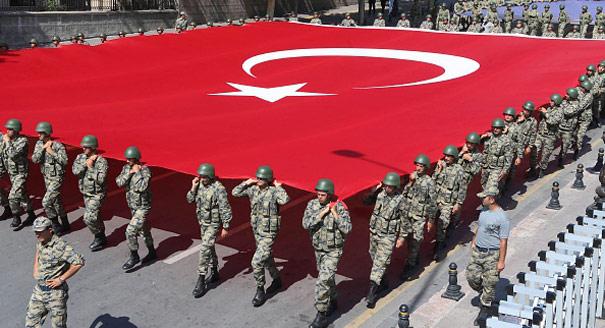
Source: Getty
Ankara faces a number of foreign policy challenges, from the war in Syria to relations with the West. In each case, Turkey’s options are determined by domestic priorities.
As citizens of Turkey head to a crucial vote on April 16 on whether to adopt a new constitution, the country’s leadership is facing multiple challenges on the external front: Syria, Russia, the United States, NATO, and the EU. Typically, each of these challenges is closely linked to Turkey’s tense domestic political situation.
With Operation Euphrates Shield, Turkish armed forces are involved in Syria in a rare expeditionary combat mission. Albeit geographically limited (no troops or armor are more than 19 miles from the Turkish border, meaning all resupply, maintenance, and rescue operations are completed within hours), the mission has already taken a substantial toll on soldiers and equipment.
Euphrates Shield is officially designed to fight troops of the self-styled Islamic State and push them away from the Turkish border. This goal has been partly achieved, including through Turkey’s proclaimed capture of the Syrian town of al-Bab on February 24. But the actual aim of the mission is to prevent Syrian Kurdish forces (the People’s Protection Units, or YPG) from reuniting their Kobane district, east of the Euphrates River, with their westernmost district of Afrin, as that would give the Syrian Kurds control of most of the Syrian-Turkish border. Ankara’s narrative is that both branches of the Syrian Kurdish organization—the Democratic Union Party (PYD) and the YPG, its military wing—are mere subsidiaries of the Kurdish separatist movement of Turkey, the Kurdistan Workers’ Party (PKK).
This is where foreign policy blends with domestic politics. To succeed in its current domestic strategy of crushing both the pro-Kurdish political party in Turkey, the Peoples’ Democratic Party (HDP), and the insurgent PKK to win the upcoming referendum, given the Kurds’ opposition to the proposed constitution, the leadership in Ankara needs international support. That implies convincing Russia and Western powers to drop their support for the Syrian Kurds.
But the reality on the international scene is very different. Both Washington and Moscow crucially rely on the YPG to advance on Raqqa, the so-called Syrian capital of the Islamic State. The YPG troops are remarkably effective and have received military supplies and operational support from the United States and other Western countries. They are also supported by Moscow.
More importantly, in the current proxy war against the Islamic State, the YPG forces are by far the most battle ready and the most successful in combat. Retaking Raqqa without the YPG, as Turkey is demanding, is next to impossible. Neither Washington nor Moscow is likely to risk mixing Syrian Kurdish forces with Turkish troops, a recipe for inevitable trouble and possible failure on the ground.
Ankara is replicating its request on the political front and wants to exclude the Syrian Kurds from the international talks on Syria that have just restarted in Geneva. This, again, is almost impossible, as Washington has consistently argued in favor of their involvement for the sake of lasting peace in northern Syria. Ankara is probably betting on a policy reversal by the administration of U.S. President Donald Trump—although, as with other U.S. foreign policy choices, the White House’s next move is anybody’s guess.
In addition, Turkey will face Moscow’s opposition, because Russian President Vladimir Putin clearly stated in September 2015 Russia’s desire to see the Syrian Kurds as one of the pillars of a political settlement. In other words, Ankara faces two major challenges in Syria: a military and a political one.
Yet, Turkey repeatedly boasts about its military operation on Syrian territory and its participation in direct talks on Syria with both Russia and Iran. Turkey has consistently aimed at restoring close cooperation with Russia since a Turkish fighter jet shot down a Russian Sukhoi aircraft in November 2015 and an off-duty Turkish policeman assassinated the Russian ambassador to Turkey in the heart of Ankara in December 2016. This reconciliation has been achieved in part, allowing Turkey to break the diplomatic isolation that followed the extensive repression after the July 2016 failed coup and entertain a proud nationalist narrative internally.
However, seen from abroad, Turkey’s foreign military operation and its diplomatic successes are rather limited and offset by risks taken along the way. In particular, the question arises of whether Ankara has become a pawn in Moscow’s vast chess game aimed at systematically undermining both NATO and the EU, especially in defense and energy.
The Turkish minister of defense declared on February 22 that discussions on the purchase of Russian S400 missiles for Turkey’s antimissile defense were progressing well, which was revealing of the country’s current foreign policy conundrum. If Ankara were to build its entire missile defense architecture around Russian systems, it would associate itself with Moscow and strike two major blows to NATO’s policies: first, by introducing Russian-made systems and accompanying experts into NATO’s second-largest conventional army; and second, by leaving a gaping hole in NATO’s own missile defense shield, to which Turkey has repeatedly committed itself.
One can easily comprehend Ankara’s tactical appetite for such a move, but its strategic implications would be of unfathomable depth, especially if a yes vote in the upcoming referendum gave Turkish President Recep Tayyip Erdoğan almost unlimited powers until 2029.
In comparison with these strategic stakes, Turkey’s relationship with the EU now looks almost benign, although greatly significant on the economic and rule-of-law fronts. With the state of emergency imposed after the failed coup, Turkey’s rule-of-law architecture has been so degraded that no progress on the country’s EU accession talks can realistically be expected. Similarly, steps toward visa liberalization—a mutually desirable objective—are impeded by Turkey’s firm priority to keep its antiterrorism law as it is.
Again, a yes vote in the referendum is likely to result in an almost permanent state of emergency and minimal rule-of-law standards. That is nothing that would worry Moscow much, but it would bring the EU-Turkey relationship to a transactional rather than a strategic level. A modernized EU-Turkey Customs Union is likely to become the only flagship project between Turkey and the EU.
All politics are local: Turkey’s current foreign policy choices are dictated by domestic political imperatives. Ankara’s foreign military operations and postures, as well as a key defense decision and deliberate backtracking on progress toward EU membership, are only parts of an internal power drive. The likely winner: Putin, more than Erdoğan.

Senior Fellow, Carnegie Europe
Marc Pierini is a senior fellow at Carnegie Europe, where his research focuses on developments in the Middle East and Turkey from a European perspective.
Recent Work
Marc Pierini
Marc Pierini
Carnegie does not take institutional positions on public policy issues; the views represented herein are those of the author(s) and do not necessarily reflect the views of Carnegie, its staff, or its trustees.
When the U.S.-Iran memorandum of understanding was announced, the UK, France, Germany, and Italy declared their readiness to help demine the Strait of Hormuz and lift nuclear sanctions on Tehran. But does Europe need new tools to recover a diplomatic role?

Rym Momtaz, ed.
The Franco-German relationship is on the rocks again. But unlike previous moments of tension, the epochal changes on the world stage require that both step up investment in their bilateral ties.
Rym Momtaz
The EU is putting together a new security strategy to meet today’s myriad challenges. But for any proposal to be effective, the union needs to grapple with its identity and ambitions.

Pierre Vimont

The EU’s new migration policy is not suited to today’s realities. With climate change increasingly becoming a driver of displacement, Europe needs to rethink its deterrence-focused approach.

Shana Tabak
The battle over free speech has taken center stage since U.S. Vice President JD Vance accused Europe of censorship. From travel bans to social media regulation, especially around the Israel-Palestine conflict, are liberal democratic governments weaponizing free speech?
Rym Momtaz, ed.