

Commentary
Marc Pierini
{
  "authors": [
    "Marc Pierini"
  ],
  "type": "commentary",
  "blog": "Strategic Europe",
  "centerAffiliationAll": "",
  "centers": [
    "Carnegie Endowment for International Peace",
    "Carnegie Europe"
  ],
  "collections": [
    "Turkey’s Transformation"
  ],
  "englishNewsletterAll": "",
  "nonEnglishNewsletterAll": "",
  "primaryCenter": "Carnegie Europe",
  "programAffiliation": "",
  "programs": [],
  "projects": [],
  "regions": [
    "Europe",
    "Türkiye",
    "Middle East",
    "Western Europe"
  ],
  "topics": [
    "EU",
    "Political Reform"
  ]
}
Source: Getty
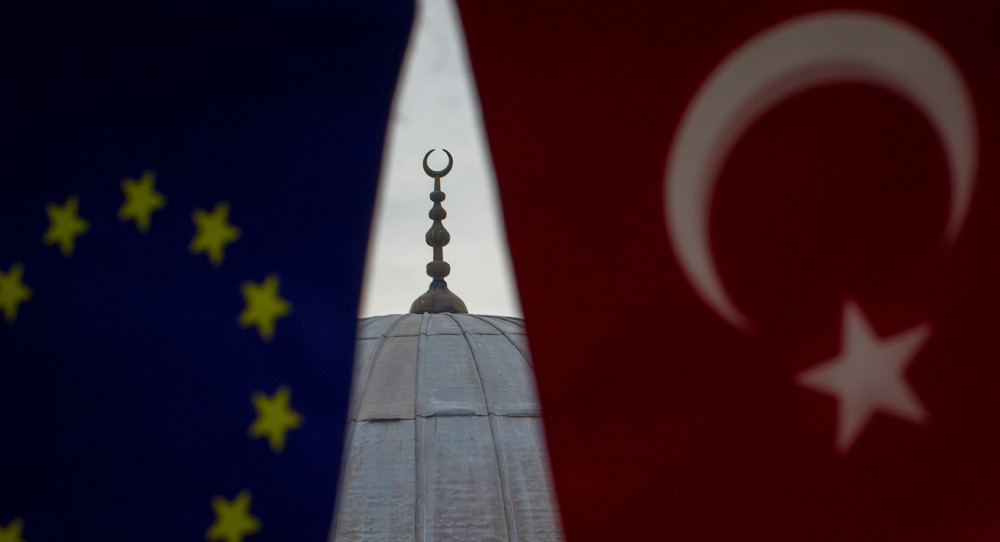
Upcoming meetings in Brussels may offer a chance for progress toward reconciliation between the EU and Turkey—but Ankara’s EU accession prospects remain remote.
In Turkey, after the approval of a wide-ranging constitutional reform on April 16 and an informal EU foreign ministers’ meeting on April 28–29, two impressions prevail. The Turkish leadership thinks it has made EU leaders recognize their mistakes, while defenders of democracy think the EU has let them down. Against great odds, some progress may be made in the margins of the May 25 NATO meeting in Brussels, provided there is enough goodwill on Turkey’s end and that the EU and Turkey can sort out their most immediate priorities. That would leave the issue of restarting Ankara’s EU accession negotiations for a future date.
There is not much room for grandstanding; rather, a sober assessment is in order. EU leaders have been miffed—a major understatement—by the deluge of invective directed at them during the constitutional referendum campaign and perplexed by the narrow, contested result of the vote.
Yet, at their Malta meeting at the end of April, EU foreign ministers chose the path of moderation, with EU foreign policy chief Federica Mogherini even voicing “respect” for the result of the referendum. Such an unexpected qualification—read by liberal Turks as approval—has caused shock among democracy and human rights defenders, who see EU realpolitik reaching extremes they believed were off limits. But the EU ministers set clear redlines: the degradation in Turkey’s rule of law leaves no room for progress in the country’s EU accession negotiations, and it is up to Ankara to show real progress toward EU democratic standards.
Turkey’s rule of law, referendum procedures, and constitutional reform have received unanimously negative assessments from all organizations concerned: the Council of Europe’s Venice Commission and Parliamentary Assembly, the Organization for Security and Cooperation in Europe, the European Parliament, and the European Commission. Yet, there is no word on where to go from here.
The next opportunity for dialogue will be in the margins of the NATO meeting in Brussels on May 25, when the Turkish president will have at least two crucial meetings: one with the newly elected French president, Emmanuel Macron, and the other with the European Commission president, Jean-Claude Juncker, and the European Council president, Donald Tusk.
Ahead of these talks, Ankara’s narrative is that Turkey should be supported by the EU in its fight against terrorism and not kept waiting any longer at the door with unfulfilled promises. Despite their attractiveness in Turkey, these words will not go far in Brussels, for two reasons. First, labeling all the followers—real or suspected—of the movement of exiled Turkish preacher Fethullah Gülen as “terrorists” never sounded convincing. Second, the EU’s so-called unfulfilled promises only illustrate Turkey’s unwillingness to align itself with EU governance standards. The rest is either diplomatic choreography or virtual-reality discourse, such as when Turkey’s EU minister said, “The picture in the aftermath of the referendum shows Turkey’s democratic strength.”
In an ideal world, Turkey’s leadership would want the EU to take a lenient view of the country’s dire human rights conditions, vastly degraded rule-of-law architecture, and upcoming one-man-rule system. This is simply not going to happen. Ankara’s second-best option would be to carry on with the EU on trade and investment matters irrespective of governance issues, in the name of Turkey’s strategic importance. This is not going to happen either.
In the real world, the road to pacification between European and Turkish leaders is very constrained. It will depend on a few goodwill measures by Turkey and a mutual agreement on a package of priority steps.
First, Turkey should respect EU fundamentals, by abandoning plans to reinstate the death penalty and making a measurable return toward a liberal democratic architecture. The country’s current situation is nowhere near the necessary standards, and its international image is dismal. The EU has been careful not to close the door, and has only recalled the principles to which Ankara has agreed. It is now up to Turkey to decide whether to stay away from these principles or to move closer to them. A clear and early statement from Turkey’s leadership that reinstating the death penalty is not in the cards would go a long way to ease tensions. However, many Europeans doubt that Turkey’s internal politics will allow this to happen.
Second, Ankara should understand that the EU will not trash its own values when it comes to defending human rights and promoting democracy in Turkey: tactical blindness is not an option for EU leaders. Instead, Ankara should come up with symbolic but concrete measures such as, first, immediately freeing the democratically elected parliamentarians of the Peoples’ Democratic Party (HDP) and the many journalists and intellectuals currently in jail and, second, unblocking the highly symbolic EU-funded Jean Monnet scholarships. These would be tangible signs of openness to real dialogue with the EU.
Third, Turkey and the EU should prioritize four actions in fields of mutual interest: modernization of the EU-Turkey Customs Union; structural work on asylum and refugees; steady implementation of programs supporting Turkey’s multisector modernization and of people-to-people activities such as the EU’s Erasmus education program and cultural activities; and cooperation on antiterrorism policies. The rule of law and human rights in Turkey should remain part and parcel of these priority actions.
If and when Turkey decides to move back to a level of rule of law that is compatible with EU standards, discussions on accession might resume. However, this is a very long way off, as it runs counter to the recently approved constitutional reform and the political pronunciations of Turkey’s leadership.
From a European political perspective, the steps suggested above constitute the most favorable achievements conceivable in the short term, especially considering the upcoming French and German parliamentary elections. This relative openness might not last forever.
From a wider foreign policy perspective, restarting a dialogue with Europe might prove to be one of the few diplomatic avenues currently open to Turkey, at a time when relations with both Russia and the United States are in dire straits.

Senior Fellow, Carnegie Europe
Marc Pierini is a senior fellow at Carnegie Europe, where his research focuses on developments in the Middle East and Turkey from a European perspective.
Recent Work
Marc Pierini
Marc Pierini
Carnegie does not take institutional positions on public policy issues; the views represented herein are those of the author(s) and do not necessarily reflect the views of Carnegie, its staff, or its trustees.

Before the next wave of EU enlargement takes place, the union needs to grapple with thorny questions of how power is distributed among its members.


Emil Sondaj Hansen, Ditte Brasso Sørensen

A summer of escalation in the Black Sea has hurt Ukraine economically and is exacerbating world food security. A truce is needed—as is a broader reframing of Europe’s Ukraine strategy.

Thomas de Waal

Are Germany’s economic, industrial, and political struggles becoming a liability for the EU’s ability to rise to the geopolitical moment?

Rym Momtaz, ed.

European Commission President Ursula von der Leyen is about to give her annual address on the state of the EU. Here’s what she won’t—but should—say.
Rym Momtaz

The aftermath of the Ceuta crisis shows Europe has drawn the wrong lessons. Rather than doubling down on failed migration policies, the EU needs to address the underlying roots of such episodes.

Richard Youngs