

Commentary
Judy Dempsey
{
  "authors": [
    "Judy Dempsey"
  ],
  "type": "commentary",
  "blog": "Strategic Europe",
  "centerAffiliationAll": "",
  "centers": [
    "Carnegie Endowment for International Peace",
    "Carnegie Europe"
  ],
  "collections": [
    "Transatlantic Cooperation"
  ],
  "englishNewsletterAll": "",
  "nonEnglishNewsletterAll": "",
  "primaryCenter": "Carnegie Europe",
  "programAffiliation": "",
  "programs": [],
  "projects": [],
  "regions": [
    "Europe",
    "North America",
    "United States",
    "Western Europe",
    "United Kingdom"
  ],
  "topics": [
    "Foreign Policy",
    "Security",
    "Technology",
    "EU"
  ]
}
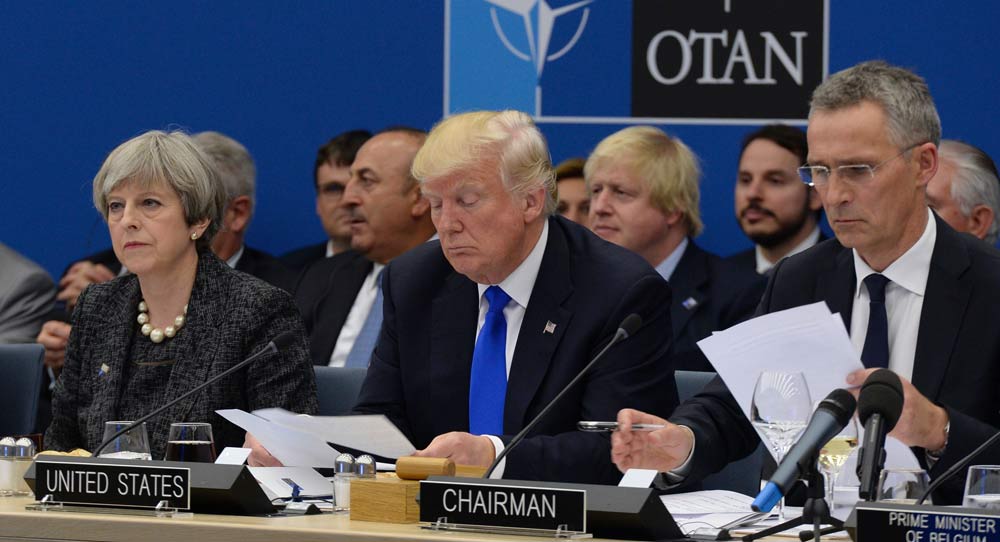
Source: Getty
Don’t expect Britain, for one, to rush to increase intelligence sharing among NATO members.
Carnegie Europe was on the ground at the NATO leaders meeting in Brussels on May 25, giving readers exclusive insights into the high-level event.
*
NATO has been grappling over how to share intelligence for years. The spate of terrorist attacks across Europe, including this week’s killing of 22 people and injuring of scores of others in Manchester, has put the spotlight on the need for security services to share crucial information.
At the May 25 NATO leaders meeting in Brussels, Secretary General Jens Stoltenberg said that the alliance had agreed to establish a “new terrorism intelligence cell. Improving how we share intelligence, including on foreign fighters. And we will decide to appoint a coordinator to oversee NATO’s efforts in the fight against terrorism,” he told reporters.
Were it as easy as that.
The reality is that intelligence sharing has never been an automatic reflex inside NATO. A culture of deep cooperation does not exist inside the alliance because the members do not trust each other.
Moreover, recently leaked U.S. intelligence—including the publication of photographs of the bomb site in Manchester by the New York Times—has made Stoltenberg’s work even harder. It has also dealt a blow to the special relationship between London and Washington. Part of that relationship was based on intelligence sharing, though British officials have often complained of too much one-way traffic.
Since the leak about the Manchester attacks, British police forces have suspended intelligence sharing with their U.S. counterparts, which shows the extent of their distrust. Yet it is a vital relationship need given the vulnerability of Britain and other European countries to terrorist attacks.
British Prime Minister Theresa May said in a televised statement just before departing for the NATO meeting that she would “make clear to President Trump that intelligence that is shared between our law enforcement agencies must remain secure.”
Trump, probably strung by May’s comments, was quick to respond.
“The alleged leaks coming out of government agencies are deeply troubling,” Trump said in a statement. “I am asking the Department of Justice and other relevant agencies to launch a complete review of this matter, and if appropriate, the culprit should be prosecuted to the fullest extent of the law.”
This is not the first time that Trump has upset his allies.
Earlier this month in the White House, he had discussed highly sensitive intelligence with Russia related to Syria. That intelligence was originally supplied by Israel, a staunch U.S. ally. Trump has also had run-ins with his own intelligence services, particularly over pending investigations concerning his relations with Russia during the presidential election campaign. By the way, let’s not forget about how under the Obama administration the German government and media were spied upon.
In short, if there is a breakdown of trust between the United States and its closest allies, it is difficult to see NATO’s new terrorism intelligence cell getting off the ground.
The trust deficit doesn’t end there. Although NATO doesn’t like to name and shame, several diplomats said candidly that other members cannot be trusted for fear that sensitive information would be passed to a third party. When Bulgaria and Romania joined in 2004, followed later by Albania, the idea of “talking intelligence” was out of the question.
And in 2008, Sándor Laborc, the new chief of the Hungarian secret services who had spent six years at the KGB's academy in Moscow during the 1980s, was appointed chairman of NATO's intelligence committee. The alliance was apparently unaware about his past. NATO diplomats admit that the level of trust is simply not deep or strong enough to share intelligence. Besides, sharing sensitive intelligence among 28 members is not feasible.
Outside NATO, it is a different matter.
Key allies, such as Britain, Canada, France, Germany, Italy, Spain, and the United States certainly share intelligence on a bilateral level—even more so given the rise of the Islamic State. And before IS came on the scene, French and Spanish intelligence services worked very closely in sharing information about ETA, the formerly armed Spanish separatist group that used violence to achieve its aims.
Then there is the so-called “Five-Eyes” network, consisting of Australia, Britain, Canada, New Zealand, and the United States, who have worked closely together since World War II and right into the digital age. Will it now be compromised by Trump’s handling of intelligence, especially with Britain?
“We tend not to speak about individual cases that involve other countries,” Canadian Prime Minister Justin Trudeau told reporters at NATO. “We are still very committed to the Five Eyes,” he added. As for sharing more intelligence inside NATO, Trudeau was noncommittal.
*
Posts on the May 25 NATO leaders meeting include:

Nonresident Senior Fellow, Carnegie Europe
Judy Dempsey is a nonresident senior fellow at Carnegie Europe
Recent Work
Judy Dempsey
Judy Dempsey
Carnegie does not take institutional positions on public policy issues; the views represented herein are those of the author(s) and do not necessarily reflect the views of Carnegie, its staff, or its trustees.

Are Germany’s economic, industrial, and political struggles becoming a liability for the EU’s ability to rise to the geopolitical moment?

Rym Momtaz, ed.

European Commission President Ursula von der Leyen is about to give her annual address on the state of the EU. Here’s what she won’t—but should—say.
Rym Momtaz

The aftermath of the Ceuta crisis shows Europe has drawn the wrong lessons. Rather than doubling down on failed migration policies, the EU needs to address the underlying roots of such episodes.

Richard Youngs

An overwhelming victory by a far-right-wing party in a small state in eastern Germany will have major repercussions for Chancellor Friedrich Merz’s coalition.
Judy Dempsey

Canadian Prime Minister Mark Carney has twice inspired praise for standing up to U.S. President Donald Trump: at the 2026 World Economic Forum in Davos and on Canada-U.S. trade negotiations. Is Carney showing a third way better than the EU has in dealing with the Trump administration?
Rym Momtaz, ed.