

Commentary
With its public finances in shambles, the far right polling at 35 percent ahead of the 2027 presidential election, and a growing protest movement, is France’s crisis a threat to the EU’s geopolitical awakening?
Rym Momtaz, ed.
{
  "authors": [
    "Jackson Janes"
  ],
  "type": "commentary",
  "blog": "Strategic Europe",
  "centerAffiliationAll": "",
  "centers": [
    "Carnegie Endowment for International Peace",
    "Carnegie Europe"
  ],
  "collections": [],
  "englishNewsletterAll": "",
  "nonEnglishNewsletterAll": "",
  "primaryCenter": "Carnegie Endowment for International Peace",
  "programAffiliation": "",
  "programs": [],
  "projects": [],
  "regions": [
    "Western Europe",
    "Germany",
    "Europe"
  ],
  "topics": [
    "EU"
  ]
}
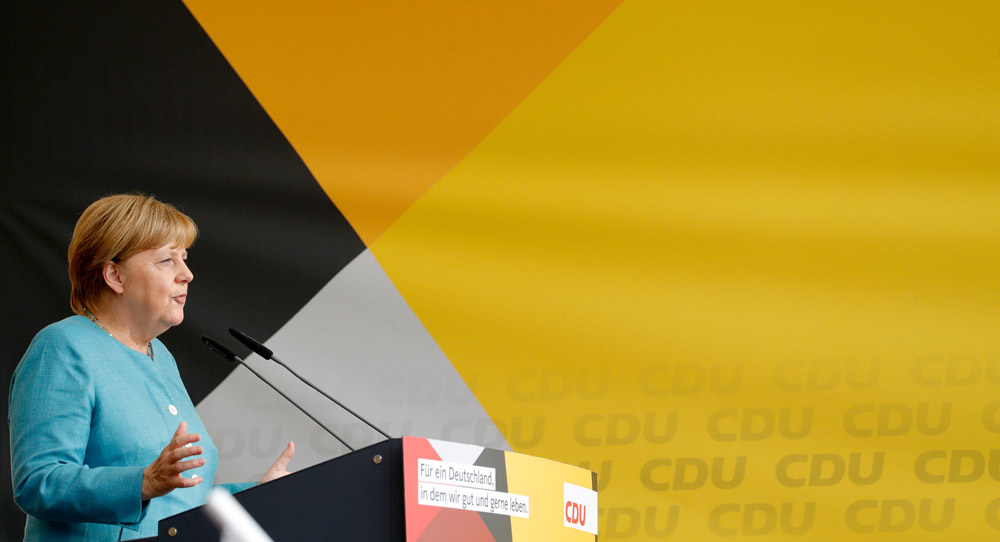
Source: Getty
The German Chancellor is using trust and stability as her currency to try to win her fourth and presumably final term in office.
On September 24, Angela Merkel is likely to match former chancellor Helmut Kohl by winning a fourth election to become Chancellor of Germany. Following that, the question is: what will be the color of her coalition? It’s possible that after the election she will govern Germany with a third version of coalition partners—a remarkable display of political talent, instinct, and adaptability in an enormously challenging and turmoil-filled environment. Over the past dozen years since Merkel was first elected in 2005, she has seen three different U.S. presidents come and go; witnessed heads of government throughout Europe defeated and replaced; and survived a series of national and global crises.
What is it that makes up Merkel’s method? In her first election victory in 2005, Merkel’s major challenge was to defeat incumbent chancellor Gerhard Schröder. The next two victories occurred amid a global recession in 2009 and then during the 2013 geopolitical storms across Europe, the Middle East, and Africa. Some of those challenges remain threats four years later.
People now call Merkel the “Teflon Chancellor,” seemingly able to deflect and diminish problems better than other political actors. “No drama Angela” seems an apt description when reviewing the chancellor’s response to heated domestic debates over refugees, or coping with difficult counterparts in Europe, Russia, and the United States. Yet in these years we have also seen a woman who can stand firm amidst controversies. “Wir schaffen das” (we can do this), remains her mantra when it comes to dealing with the one million refugees which have arrived in Germany since the start of Europe’s migration crisis. She has held President Vladimir Putin responsible for the crisis in Ukraine by supporting sanctions on Russia. She changed her mind about nuclear energy after the 2011 Fukushima disaster in Japan and remains committed to the European project despite the populist backlash across other member states.
In her past campaigns, Merkel has dealt with clashes with rival candidates mostly by conveying a message of stability and calm steerage of the ship of state. That was clearly illustrated in a television duel with SPD Leader Martin Schulz. The chancellor wants to project her competence as a crisis manager, if not a visionary. Her campaign slogan, Für ein Deutschland, in dem wir gut und gerne leben, translates as “for a Germany in which we can live well and gladly”—essentially saying, “we are in good shape so stick with me as we go forward.”
Merkel emphasizes process over proclamation to measure progress—whether it’s dealing with aggressive counterparts like Turkish President Erdoğan over the refugee crisis or with U.S. President Donald Trump over the issue of trade surpluses or defense budgets.
Elections are about hopes for the future, as well as perceptions of the past. They are also about trust—a fragile value in today’s political arena. It is trust that Merkel is using as her currency to try to win her fourth and presumably final term in office.
Should she succeed, what can and should we expect from the German chancellor’s fourth term? While the parameters of Merkel’s policies will be framed by the coalition she will lead, it is unlikely that she will change her personal style of governance. Hers is a leadership style that seems to fit the German mood so far. Keep calm and carry on with this Chancellor. One of her predecessors, Konrad Adenauer, once won an absolute majority with a similar slogan “No Experiments.”
Some of the problems and challenges Merkel has faced in recent years will not change. The refugee issues within Germany will remain contentious and will be, in fact, generational. That means that the political backlash currently embodied in both the Right and the Left wings will remain a part of Germany’s political landscape.
There is also precipitous concern increasingly felt in Germany about the sustainability of the current robust economy. Challenges posed by the digital revolution loom ever closer, with significant societal transformations foreseen ahead. Merkel knows Germany is strong now in the global economy. The question is how to sustain its competitive edge.
The struggle to hold the European Union together amidst the centrifugal forces of populist politics in many neighboring countries, and the impact of Brexit, will continue. The success of those efforts will depend on the health and synergy of Franco-German relations. Maintaining coherence and effectiveness depends on identifying the purposes of joint engagement in the perception of national interests, as well as affirming the value of joint efforts to tackle threats and crises. For reasons that reflect a variety of trends in Europe pulling at the fabric of European policymaking, it will likely fall to Germany to lead the effort to sustain that purpose in the coming years. However, one continuous challenge for Germany will be the ability to balance calls for exercise of leadership within the larger European framework, against some resistance to it.
But it will also depend on the capacity of the Chancellor to exercise leadership, not only in Germany, but by emphasizing that the future is jointly in European hands. “We have to understand, that we Europeans must fight for our own future and destiny,” voiced the chancellor to Germans and Europeans following the 2017 G7 summit. Dealing with the transatlantic implications of that declaration, and especially with the Presidency of Donald Trump, will require all of Merkel’s skills in managing both confrontations and compromise. The same will hold true for relations with a Russia under Vladimir Putin’s regime. Both of those realities will feature during her potential fourth term in office. But the central question remains: can Europeans agree on how to forge a shared future?
Merkel’s method has been tried and tested in the past twelve years. It has gotten her elected three times, and there are persuasive reasons to expect another victory on September 24, 2017. But the day after the election another test of that method will begin— and it will be no less challenging than any point in the past twelve years. Whether it will be as successful is anyone’s guess.
Jackson Janes is the president of the American Institute for Contemporary German Studies at Johns Hopkins University.
Jackson Janes
Carnegie does not take institutional positions on public policy issues; the views represented herein are those of the author(s) and do not necessarily reflect the views of Carnegie, its staff, or its trustees.

With its public finances in shambles, the far right polling at 35 percent ahead of the 2027 presidential election, and a growing protest movement, is France’s crisis a threat to the EU’s geopolitical awakening?

Rym Momtaz, ed.

Ahead of a tough winter for Ukraine, Donald Trump’s swing back toward Russia bodes ill. But instead of panicking, Kyiv’s European allies are focusing on action.
Rym Momtaz

While the EU and European governments are embracing the much-lauded middle-power moment, this entails three difficult conundrums.

Richard Youngs

Much has been said of the changes Brussels is trying to make to the EU enlargement process. Here’s why gradual integration might—or might not—be the answer.

Dimitar Bechev

The European Commissioner for Trade is headed to China. But after President Xi’s bridge-building visit to Washington, can a more isolated EU overcome Beijing’s stranglehold on critical raw materials? Who will blink first?
Rym Momtaz, ed.