

Commentary
Judy Dempsey
{
  "authors": [
    "Judy Dempsey"
  ],
  "type": "commentary",
  "blog": "Strategic Europe",
  "centerAffiliationAll": "",
  "centers": [
    "Carnegie Endowment for International Peace",
    "Carnegie Europe"
  ],
  "collections": [
    "Transatlantic Cooperation"
  ],
  "englishNewsletterAll": "",
  "nonEnglishNewsletterAll": "",
  "primaryCenter": "Carnegie Europe",
  "programAffiliation": "",
  "programs": [],
  "projects": [],
  "regions": [
    "Europe",
    "North America",
    "United States",
    "Western Europe"
  ],
  "topics": [
    "Foreign Policy",
    "EU",
    "Security",
    "Global Governance"
  ]
}
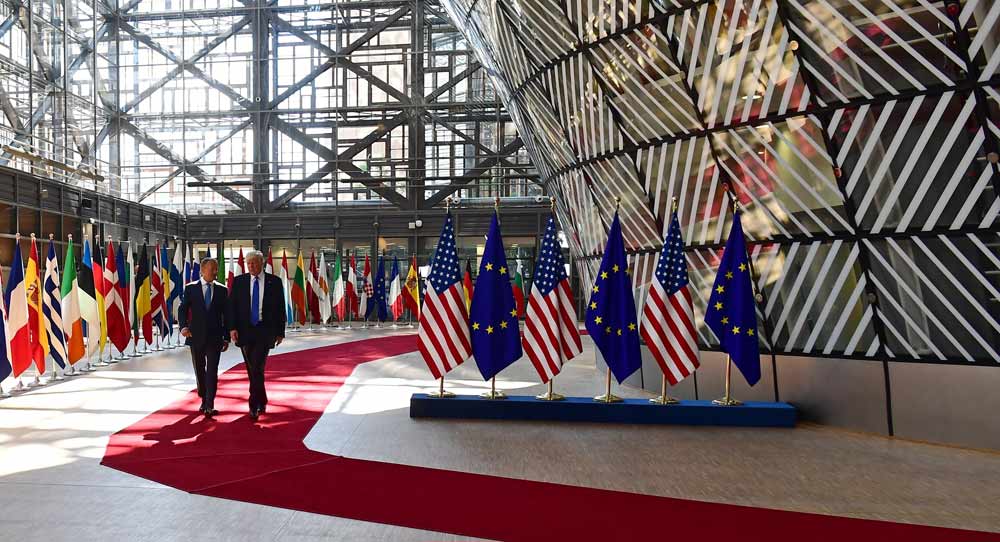
Source: Getty
Bashing the United States is no substitute for Europe’s strategic helplessness.
The West is in big trouble.
The multilateral institutions established after 1945 underpinned a liberal order that was to define the transatlantic relationship.
Whether it was the United Nations or the World Trade Organization, NATO or the joint accords forged by the United States and the EU, such as the Iran nuclear deal, they were about the West working together.
There were always up and downs in the transatlantic relationship. But somehow, the Europeans and the Americans muddled through. Not anymore. The immense complexities of globalization and the plethora of crises along Europe’s—and America’s—peripheries should logically lead to a stronger and more agile Euro-Atlantic relationship. Instead, the opposite is happening.
It is all too easy to blame U.S. President Donald Trump for trying to erode international agreements. His decision to pull out of UNESCO, an organization that former American presidents had often criticized for its bias and mismanagement, was just one of several recent attacks on multilateralism.
Indeed, Trump’s walking away from the Paris Climate accord and his undermining of the World Trade Organization confirm to those Europeans who want to believe it that the days of the transatlantic relationship are numbered. If that “logic” is pursued, then it should follow that the post-1945 era of the “West” is in decline, too. And with it, Europe.
Except some European leaders hold onto the idea that the EU can flourish on its own without the United States, forgetting the fact that America’s support for the creation of the European Coal and Steel Community, the precursor to the European Union, was critical. It was about creating a strong and liberal West capable of defending itself and capable of defending its values in the face of consistent threats from the Soviet Union.
Jean-Claude Juncker, the president of the European Commission, the EU’s executive, now holds the belief that Europe can have its own army; that it can take care of its own defense and security; and that the member states can share intelligence and pool military resources. There is, however, hardly a European leader who believes that this is possible or desirable.
Then there are other leaders—from Jarosław Kaczyński, the head of Poland’s governing nationalist-conservative party, to Viktor Orbán, Hungary’s opportunistic and populist prime minister—who believe they can carve out a special kind of national sovereignty that is bankrolled by the EU’s structural funds, which have helped so enormously to modernize the infrastructure of these countries. They also believe they are not obliged to provide protection to refugees.
Kaczyński and Orbán may find an ally in Vienna. Let’s wait and see what policies Austria’s incoming conservative Chancellor Sebastian Kurz will unveil, assuming that his new government will include the far-right Freedom Party (FPÖ). And just to add to Europe’s deepening problems, there is the question of Britain’s future relationship with the EU, not to mention how the crisis between Madrid and Barcelona will be resolved.
There is also the EU’s intellectual malaise in dealing with the Western Balkan countries and Ukraine. Improving trade conditions and access to EU markets for both is simply not enough for maintaining stability. Ukraine and the Western Balkans have a dangerous security vacuum.
Since the EU hasn’t the hard power to fill it, the least that European leaders could do is to pass this task to NATO. But the alliance is hobbled by divisions over how to deal with Russia. And similar to the EU, NATO’s strategic goal of widening and strengthening the Euro-Atlantic community has been put on the back burner.
This is a strategic mistake. If the United States is distracted by its president, it is no reason for European leaders to smugly believe that they have the moral high ground on values, on security, or on resilience. They hold none of them.
The fact that Orbán can get away with supporting what is an anti-Semitic television campaign, in which the philanthropist and financier George Soros is vilified without a whimper from most EU officials, makes a mockery of Europe’s values.
The fact that the EU has no strategic policy toward Ukraine or the Western Balkans betrays an extraordinary degree of short-sightedness concerning the stability of Europe’s neighbors.
As for Europe’s resilience, when it comes to protecting the union’s transportation, hospitals, banking, schools, and energy infrastructure against terrorism, cyberattacks or natural disasters, Europe’s citizens are highly vulnerable.
This vulnerability is linked to strategic helplessness. It is also linked to the illusion that Europe can go it alone. If that view gains momentum, then the liberal transatlantic West that grew out of the destruction of World War II will become oblivious. How Russia and China might relish such an outcome.

Nonresident Senior Fellow, Carnegie Europe
Judy Dempsey is a nonresident senior fellow at Carnegie Europe
Recent Work
Judy Dempsey
Judy Dempsey
Carnegie does not take institutional positions on public policy issues; the views represented herein are those of the author(s) and do not necessarily reflect the views of Carnegie, its staff, or its trustees.

Are Germany’s economic, industrial, and political struggles becoming a liability for the EU’s ability to rise to the geopolitical moment?

Rym Momtaz, ed.

European Commission President Ursula von der Leyen is about to give her annual address on the state of the EU. Here’s what she won’t—but should—say.
Rym Momtaz

The aftermath of the Ceuta crisis shows Europe has drawn the wrong lessons. Rather than doubling down on failed migration policies, the EU needs to address the underlying roots of such episodes.

Richard Youngs

An overwhelming victory by a far-right-wing party in a small state in eastern Germany will have major repercussions for Chancellor Friedrich Merz’s coalition.
Judy Dempsey

Canadian Prime Minister Mark Carney has twice inspired praise for standing up to U.S. President Donald Trump: at the 2026 World Economic Forum in Davos and on Canada-U.S. trade negotiations. Is Carney showing a third way better than the EU has in dealing with the Trump administration?
Rym Momtaz, ed.