

Commentary
Thomas de Waal
{
  "authors": [
    "Thomas de Waal"
  ],
  "type": "commentary",
  "blog": "Strategic Europe",
  "centerAffiliationAll": "",
  "centers": [
    "Carnegie Endowment for International Peace",
    "Carnegie Europe",
    "Carnegie Russia Eurasia Center"
  ],
  "collections": [
    "Europe’s Eastern Neighborhood"
  ],
  "englishNewsletterAll": "",
  "nonEnglishNewsletterAll": "",
  "primaryCenter": "Carnegie Europe",
  "programAffiliation": "",
  "programs": [],
  "projects": [],
  "regions": [
    "Russia",
    "Europe",
    "Eastern Europe",
    "Caucasus",
    "Georgia"
  ],
  "topics": [
    "Climate Change",
    "Economy",
    "Trade",
    "EU"
  ]
}
Source: Getty
Tbilisi and Moscow are on the verge of finalizing a transit agreement they initially made in 2011. But political fears could still sink the deal, and its big economic benefits.
Georgian-Russian relations are a strange mix of the ugly, the bad, and the good. The countries have had no diplomatic relations since Russia recognized Abkhazia and South Ossetia as being independent in 2008. That stone will not be lifted in the foreseeable future. The boundary lines of both territories, manned by Russian soldiers, continue to be a source of friction and danger.
At the same time, since the Georgian Dream government came to power in 2012, normality has resumed on many fronts. There are several direct flights between Russia and Georgia. In the streets of Tbilisi’s old town this summer, I heard lots of Russian being spoken. The Russian middle classes have rediscovered Georgia as a holiday destination, and the total numbers of Russian tourists may be around 1.5 million this year. About half of Georgia’s wine exports now go to Russia.
Now comes news that the next phase of rapprochement is getting closer. The two countries may be set to finally close a deal they first agreed in 2011 but have not finalized, connecting them via three transport corridors across the Caucasus. The deal, mediated by Switzerland, was the condition the Georgians agreed to in return for not using their veto power on Moscow joining the World Trade Organization.
Two of the corridors are highly sensitive because they cross the disputed territories of Abkhazia and South Ossetia (which are not named in the agreement, the locations being only indicated by GPS coordinates.) The cargos on the trucks are supposed to be sealed by an international company, now confirmed as the Swiss firm SGS, and monitored electronically on their journey.
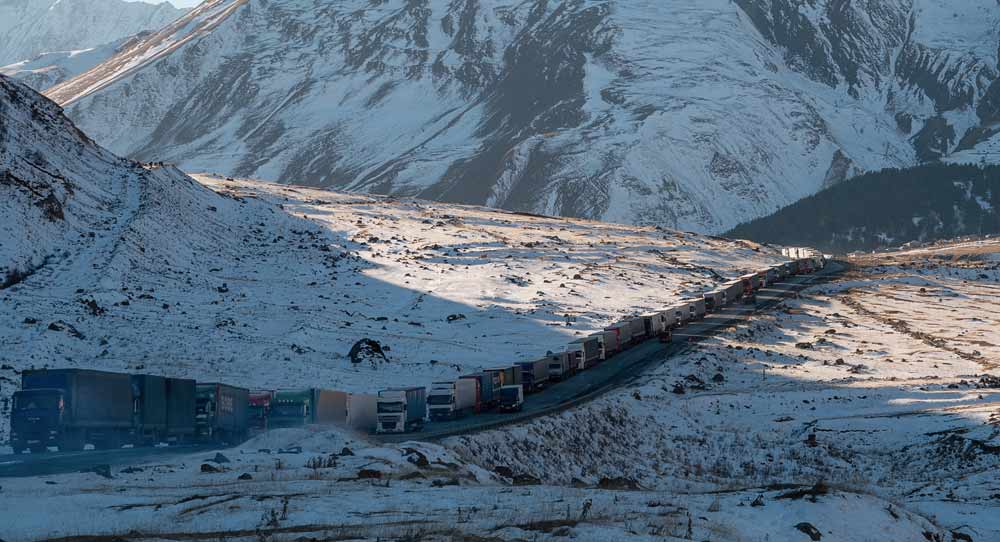
Currently, the only working Georgian-Russian border crossing at Upper Lars is problematic. The road is bad and vulnerable to avalanches. For four or five months of the year it is impassable because of bad weather. Whole cargos of citrus fruit have perished as a result of delays. The new transport corridors would substantially increase trade across the mountains, giving an economic boost not just to Georgia and Russia but to Armenia—for whom this is the main land route to the north—and eastern Turkey as well. Russian business has been lobbying hard for the deal.
Despite the obvious economic advantages, politics has held up the deal. South Ossetian leader Anatoly Bibilov insisted in the summer that South Ossetia should have equal partnership rights—something that Moscow agreed to at the time, but which obviously crosses a red line in Tbilisi.
Now, after the latest meeting in Prague of bilateral special negotiators, Zurab Abashidze and Grigory Karasin, on November 16, both Moscow and Tbilisi are making positive noises. An “expert meeting” has been called in Switzerland to address outstanding issues in the next couple of weeks, at which the two sides may sign contracts with SGS.
Although the economic rationale for doing this is clear, bigger political questions obviously hang over it.
Some Georgians (and some of their Western backers) take a fundamentalist position, saying that Georgia should not deepen its business links with Russia, as this gives political leverage to Moscow that it could theoretically use in the future, by threatening to suspend trade and hurt Georgia, for example.
This, I think, is a canard. Georgia and Russia have always done business, and continued to do so even when the fiercely anti-Russian Mikheil Saakashvili was president. Indeed, the 2011 agreement was negotiated by his government. The only exception in recent times was the economic embargo Russia imposed in 2006, which it must now concede was a big mistake. Moscow’s unilateral suspension of trade with Georgia hurt both countries and did great damage to Russia’s chief partner in the region, Armenia. Its main long-term impact was to push Georgia to raise the quality of its goods and seek new markets for them, a process that enormously helped the Georgian wine industry.
Of course, Georgia should be vigilant. But it should also be capable of a “both/and” foreign policy. By that, I mean that Georgia should have the capacity both to develop a closer economic relationship with Russia that rebuilds some trust, and sustain its long-term strategic commitment to a European future—and indeed its trading relationships with other partners such as Turkey and China.
The other political issue to be dealt with is how to manage the claims of Abkhazia and South Ossetia. Having their de facto authorities directly involved is unacceptable in Tbilisi, but there should be ways of finalizing the deal in a way that gives the regions economic benefits; for example, by earning fees for proving security or services for drivers.
More importantly, Tbilisi has a real interest in being able to monitor goods going into the two territories, but not in blocking trade with them. If cargoes are checked by a Swiss company, there should be no reason for tomatoes or shoes not being delivered from Tbilisi-controlled territory into Abkhazia or South Ossetia. There is, however, a practical issue, which is that the deal has to be made to fit with Georgia’s Law on Occupied Territories of 2008, which forbids unauthorized companies from doing business on those two territories.
On the Russian side, the willingness to deal is a test of what may become a trend: the perception that ahead of the March 2018 presidential election, which is looking more difficult than anticipated, Moscow wants to ease tensions in its neighbourhood rather than look for more trouble.
A few straws in the wind support this thesis. Moscow has backed the idea of a UN peacekeeping operation in eastern Ukraine. Even if this is a political game on Russia’s part—which is very likely—it is a game that makes Moscow less inclined to escalate the conflict on the ground. The Russian foreign ministry has also declared that it “respects” the partnership agreement that Armenia signed with the European Union in Brussels on November 24.
A final Georgian-Russian breakthrough on the 2011 transit agreement is not assured. If the last details can be ironed out, it would certainly be a victory for economics over politics in this constantly divided region.
Carnegie Europe is grateful to the Government Offices of Sweden and the Robert Bosch Stiftung for their financial support of this publication.

Senior Fellow, Carnegie Europe
Thomas de Waal is a senior fellow at Carnegie Europe, specializing in Eastern Europe and the Caucasus.
Recent Work
Thomas de Waal
Thomas de Waal
Carnegie does not take institutional positions on public policy issues; the views represented herein are those of the author(s) and do not necessarily reflect the views of Carnegie, its staff, or its trustees.

Ahead of a tough winter for Ukraine, Donald Trump’s swing back toward Russia bodes ill. But instead of panicking, Kyiv’s European allies are focusing on action.

Rym Momtaz

While the EU and European governments are embracing the much-lauded middle-power moment, this entails three difficult conundrums.

Richard Youngs

Much has been said of the changes Brussels is trying to make to the EU enlargement process. Here’s why gradual integration might—or might not—be the answer.

Dimitar Bechev

The European Commissioner for Trade is headed to China. But after President Xi’s bridge-building visit to Washington, can a more isolated EU overcome Beijing’s stranglehold on critical raw materials? Who will blink first?
Rym Momtaz, ed.

The domestic impacts of how long it is taking to end the war in Ukraine have pushed the French electorate to the political extremes and compromised the country’s diplomatic capacity.
Rym Momtaz