

Commentary
Judy Dempsey
{
  "authors": [
    "Judy Dempsey"
  ],
  "type": "commentary",
  "blog": "Strategic Europe",
  "centerAffiliationAll": "",
  "centers": [
    "Carnegie Endowment for International Peace",
    "Carnegie Europe"
  ],
  "collections": [
    "EU Integration and Enlargement"
  ],
  "englishNewsletterAll": "",
  "nonEnglishNewsletterAll": "",
  "primaryCenter": "Carnegie Europe",
  "programAffiliation": "",
  "programs": [],
  "projects": [],
  "regions": [
    "Europe",
    "Western Europe",
    "Germany"
  ],
  "topics": [
    "EU",
    "Political Reform"
  ]
}
Source: Getty
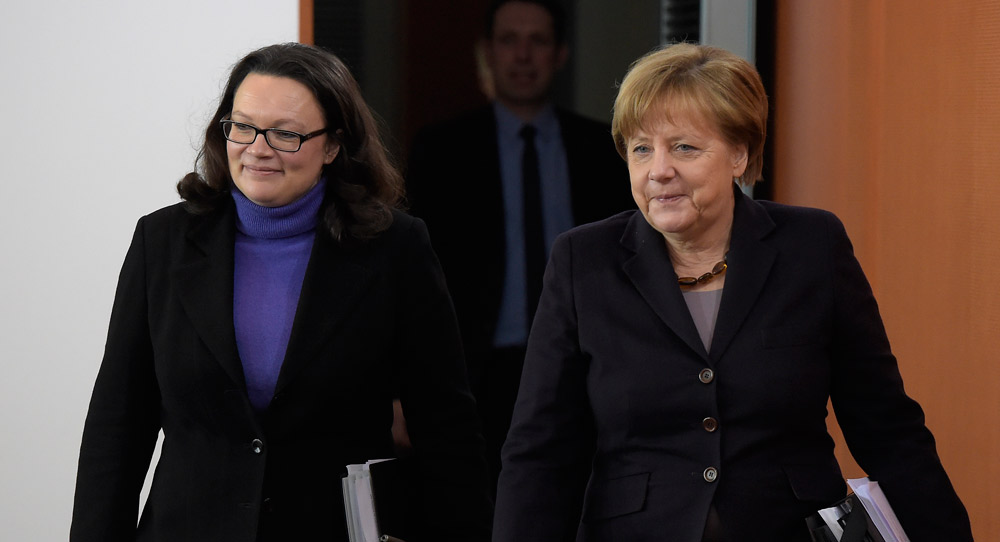
Germany’s new/old coalition is unstable, yet it has no option but to stick together.
As world leaders gather in Bavaria on February 16 for the annual Munich Security Conference, their German hosts will put on their best show of harmony, unity, and hospitality.
But behind the scenes, German politics has become poisonous to the extent that the next new/old grand coalition of conservatives and social democrats will only hold together because the alternative is so miserable. Stability and more attention to social issues will take precedence over ambition. That might not be a bad thing given the growing popularity of the far-right and anti-immigrant Alternative for Germany (AfD) party.
Yet it’s hard to know which of the two main established parties is in worse shape: Merkel’s Christian Democratic Union (CDU), along with its sister party, the Bavarian based Christian Social Union (CSU); or the Social Democrats (SPD).
Merkel’s conservative bloc is in near-rebellion against their chancellor. Over the past few days, the sniping about the coalition deal has increased with Merkel criticized for ceding too much to the Social Democrats.
In particular, party members wanted the Christian Democrats to at least hold onto the finance ministry—one of the most important cabinet posts. That was given to Olaf Scholz, the Social Democrat mayor of Hamburg. Scholz is no big spender when it comes to monetary and fiscal policy. Yet when it comes to reform of the eurozone, he is certain to be more flexible than his conservative predecessor, Wolfgang Schäuble.
Merkel conceded during a television interview on February 11 that giving the finance ministry to the SPD was the “price to pay for stability” of the coalition. And that is her leitmotiv: stability.
Cabinet posts aside, the other criticism that is taking place inside the CDU is about Merkel herself. There are calls for a “renewal” of the party. In plain speak, they are asking Merkel to prepare for the day after. “And now we need to show that we can start with a new team,” Merkel said in the interview. “We have six ministerial posts to fill and from my point of view we need to ensure that not only the over-60s are considered but also younger people,” she added—not entirely convincingly.
Merkel has never been willing to discuss the succession. Which leader would? And besides, during her dozen years in the chancellery, Merkel has seen off her critics and potential rivals. But as she prepares to lead for a fourth term, her authority can no longer be taken for granted. So much now depends not only on her own party, which she has been adept at keeping disciplined, but on her coalition partners, the Social Democrats. And what miserable shape they are in.
If you thought that the conservative bloc was sharpening the knives against its leadership, that’s nothing compared to what is happening in the Social Democratic camp. The degree of disdain for Martin Schulz, former president of the European Parliament who was catapulted into German politics in the hope of unseating Merkel, has been vicious.
Schulz has been blamed for the SPD’s dreadful showing in last September’s federal elections. And when he insisted that he be given the foreign ministry, the party almost erupted. The impression was that all Schulz wanted was power.
Once it was announced that he would get this job—which somehow has always made its holder shine in the eyes of the public—there was an outcry against Schulz, not least from the incumbent Sigmar Gabriel. Unable to withstand the criticism and knowing that the grand coalition might even fall apart because of the rebellion to the deal by the younger generation, Schulz gave up the job.
This incident showed a party in ferment and desperation. But it has nowhere to go. The new leader of the Social Democrats, Andrea Nahles, who took over from Schulz, is determined to make the grand coalition work despite the fierce opposition. Nahles is going to have to use all of her energy and strategic instincts to persuade the party membership to support the grand coalition. The outcome of that vote will be announced on March 4.
In the meantime, Merkel’s Christian Democrats will hold a special party congress on February 26. Sparks will fly. But like the Social Democrats, the conservatives have nowhere to go either.
So far, the big winner of the past few months of stalemate has been the far-right, euroskeptic, and anti-immigrant Alternative for Germany. The party keeps going up in the opinion polls, which is why neither Merkel nor Nahles can afford to allow the grand coalition to collapse.
A new election would play into the hands of the AfD. At the same time, despite all the infighting inside the coalition, Merkel and Nahles have to make it not only work; they have to make it stable. That also implies giving Europe that much-needed leadership required from Berlin. But don’t hold your breath. Europe, particularly France, is waiting for Germany to end the months of stalemate. Berlin is nearly there. But it will be a coalition that puts stability first. Ambition is for another day.

Nonresident Senior Fellow, Carnegie Europe
Judy Dempsey is a nonresident senior fellow at Carnegie Europe
Recent Work
Judy Dempsey
Judy Dempsey
Carnegie does not take institutional positions on public policy issues; the views represented herein are those of the author(s) and do not necessarily reflect the views of Carnegie, its staff, or its trustees.

While the EU and European governments are embracing the much-lauded middle-power moment, this entails three difficult conundrums.

Richard Youngs

Much has been said of the changes Brussels is trying to make to the EU enlargement process. Here’s why gradual integration might—or might not—be the answer.

Dimitar Bechev

The European Commissioner for Trade is headed to China. But after President Xi’s bridge-building visit to Washington, can a more isolated EU overcome Beijing’s stranglehold on critical raw materials? Who will blink first?

Rym Momtaz, ed.

The domestic impacts of how long it is taking to end the war in Ukraine have pushed the French electorate to the political extremes and compromised the country’s diplomatic capacity.
Rym Momtaz

Before the next wave of EU enlargement takes place, the union needs to grapple with thorny questions of how power is distributed among its members.


Emil Sondaj Hansen, Ditte Brasso Sørensen