

Commentary
Pierre Vimont
{
  "authors": [
    "Pierre Vimont"
  ],
  "type": "commentary",
  "blog": "Strategic Europe",
  "centerAffiliationAll": "",
  "centers": [
    "Carnegie Endowment for International Peace",
    "Carnegie Europe"
  ],
  "collections": [
    "Transatlantic Cooperation"
  ],
  "englishNewsletterAll": "",
  "nonEnglishNewsletterAll": "",
  "primaryCenter": "Carnegie Europe",
  "programAffiliation": "",
  "programs": [],
  "projects": [],
  "regions": [
    "Europe",
    "North America",
    "United States",
    "Western Europe",
    "France"
  ],
  "topics": [
    "Foreign Policy",
    "EU",
    "Security"
  ]
}
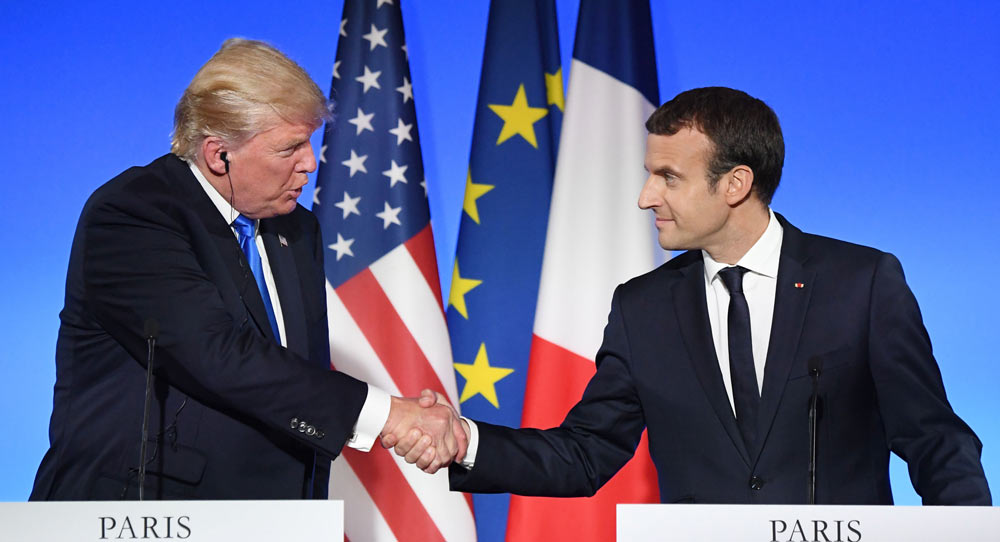
Source: Getty
The French president has his work cut out in persuading Trump to appreciate the benefits of multilateralism and the transatlantic relationship.
Emmanuel Macron’s U.S. state visit on April 23-25 will showcase the very personal relationship the French president has managed to establish with Donald Trump since both assumed power. This somewhat improbable rapport has to a large extent mystified other European leaders. It has also piqued the interest of the U.S. conservative media, which have no particular reason to be sympathetic to a French president with an ambitious vision for Europe.
Yet very little has been delivered out of this partnership so far. Macron’s visit to Washington—the first state visit by a foreign leader under the Trump administration—can thus be seen as a test for both men to produce tangible results on the most urgent challenges they face.Macron has been recognized as one of the few leaders who can reach out to the U.S. president. Despite quite different personal styles, both presidents have been portrayed as disrupters in their domestic political scenes. Both want to be perceived as men of action and, more importantly, as politicians who stick to their electoral promises. Enhanced by the invitation to attend Bastille Day ceremonies in Paris last year, which obviously pleased Donald Trump, the special chemistry between the two presidents has gradually developed into a genuine readiness for constructive dialogue, even when they disagree.
Amid a largely skeptical public, Macron has developed a leadership style that is distinct from his European counterparts. Positioned halfway between those who have reservations about current U.S. policies but prefer to keep them quiet and those who are more prepared to air their frustrations, Macron doesn’t hesitate to speak his mind—but he usually refrains from making critical public statements. He likely has no illusions about moving the Trump administration away from its current nationalist streak. Yet on points of disagreement with the American president, rather than voicing the traditional French independent stance, Macron actively smooths out differences with a sense of positive realism, indicating a more pragmatic and relaxed version of French diplomacy.
Instances of this attitude abound. On Trump’s decision to drop out of the Paris climate change agreement, on his threat to lift the presidential waiver concerning nuclear related sanctions against Iran, on the transfer of the U.S. embassy to Jerusalem, and on recent trade issues, Macron deliberately abstained from direct confrontation with the White House or from enlisting European nations to join an anti-American crusade.
Instead, Macron has opted for a quiet diplomacy with Washington while in parallel driving forward his unabated ambition for more Europe—a goal that is not one of Donald Trump’s favorites. Yet relations between both presidents have stood up to these headwinds, giving way to pragmatic conversations, as seen in the last few months on climate change or, more significantly, joining up air capacities for military operations in Syria to limit Russia expansion.
Macron is nonetheless well aware that his visit to Washington needs to deliver on the most urgent issues of the day—Iran, Syria, and trade. There is certainly no overexpectation from the French president on these matters. He knows that his U.S. counterpart shows no sign of moving away from his strong anti-Iranian stance or overcoming his profound discomfort with anything multilateral. So Macron could emphasize the risk for the American president of finding himself in contradiction with his stated intention to avoid repeating the previous mistakes of U.S. military interventions in the Middle East. He could add that reimposing nuclear-related sanctions against Tehran, thus opening the way to the dismantling of the Vienna agreement, could well drag the Trump administration into a major regional confrontation with Russia and Iran—and probably deep divisions with European allies.
Equally, sticking to an aggressive nationalist economic policy could well lead to a new multilateral order in which China might impose its own rules through its Belt and Road Initiative. The logic of a strategy that relies heavily on military options, narrowly defines coalitions, and bends its economic policy on “zero sum” tactics could lead to a rerun of the neoconservative agenda that Donald Trump has been so eager to discard.
With these political arguments, the French president will try to convince his interlocutor to be more patient on the Iranian nuclear issue and, in the meantime, to endorse the diplomatic roadmap agreed—after long working sessions among American and European officials—to restrict Iran’s ballistic missile program and its regional influence.
With regard to Syria, and in the aftermath of last week’s joint U.S., French, and British airstrikes, Macron will insist on going a step further with a common mobilization to eradicate chemical threats from the country and rebuild a multilateral consensus for this category of military weapons. In addition, he will plead for a more active engagement of Western nations to rebuild the future of Syria, which implies some form of dialogue with Russia, Iran, and Turkey. This would give a new political leadership role to the United States and its allies, and would provide a more suitable alternative to the elusive military withdrawal from Syria that Trump has been recently considering.
As for trade, Macron knows that overplaying the risk of a tariff escalation will not impress Donald Trump. The French president could instead insist on a more collaborative approach, with a call for Europe and America to join forces against unfair competition from China and fight for new multilateral rules on technology transfers, intellectual property, and foreign investments.
If some of these results can be delivered by the end of this visit, Macron will have been proven right in keeping his open dialogue with the U.S. president. Even more importantly, the French president will have rekindled a transatlantic partnership in desperate need of a new momentum. With Angela Merkel following in his footsteps, this could be an encouraging moment for Europe in Washington.

Senior Fellow, Carnegie Europe
Pierre Vimont is a senior fellow at Carnegie Europe. His research focuses on the European Neighborhood Policy, transatlantic relations, and French foreign policy.
Recent Work
Pierre Vimont
Pierre Vimont
Carnegie does not take institutional positions on public policy issues; the views represented herein are those of the author(s) and do not necessarily reflect the views of Carnegie, its staff, or its trustees.

Are Germany’s economic, industrial, and political struggles becoming a liability for the EU’s ability to rise to the geopolitical moment?

Rym Momtaz, ed.

European Commission President Ursula von der Leyen is about to give her annual address on the state of the EU. Here’s what she won’t—but should—say.
Rym Momtaz

The aftermath of the Ceuta crisis shows Europe has drawn the wrong lessons. Rather than doubling down on failed migration policies, the EU needs to address the underlying roots of such episodes.

Richard Youngs

An overwhelming victory by a far-right-wing party in a small state in eastern Germany will have major repercussions for Chancellor Friedrich Merz’s coalition.

Judy Dempsey

Canadian Prime Minister Mark Carney has twice inspired praise for standing up to U.S. President Donald Trump: at the 2026 World Economic Forum in Davos and on Canada-U.S. trade negotiations. Is Carney showing a third way better than the EU has in dealing with the Trump administration?
Rym Momtaz, ed.