

Paper
Erik Brattberg, Tomáš Valášek
{
  "authors": [
    "Tomáš Valášek"
  ],
  "type": "commentary",
  "blog": "Strategic Europe",
  "centerAffiliationAll": "",
  "centers": [
    "Carnegie Endowment for International Peace",
    "Carnegie Europe"
  ],
  "collections": [
    "Transatlantic Cooperation",
    "Iranian Proliferation"
  ],
  "englishNewsletterAll": "",
  "nonEnglishNewsletterAll": "",
  "primaryCenter": "Carnegie Europe",
  "programAffiliation": "",
  "programs": [],
  "projects": [],
  "regions": [
    "Middle East",
    "Europe",
    "North America",
    "United States",
    "Iran",
    "Western Europe"
  ],
  "topics": [
    "Foreign Policy",
    "EU",
    "Security",
    "Political Reform",
    "Nuclear Policy",
    "Arms Control",
    "Nuclear Energy"
  ]
}
Source: Getty
Washington underestimates the strength of attachment in Paris and Berlin to the current Iran deal, as well as the depth of differences between Europe and the United States on how to stabilize the Middle East.
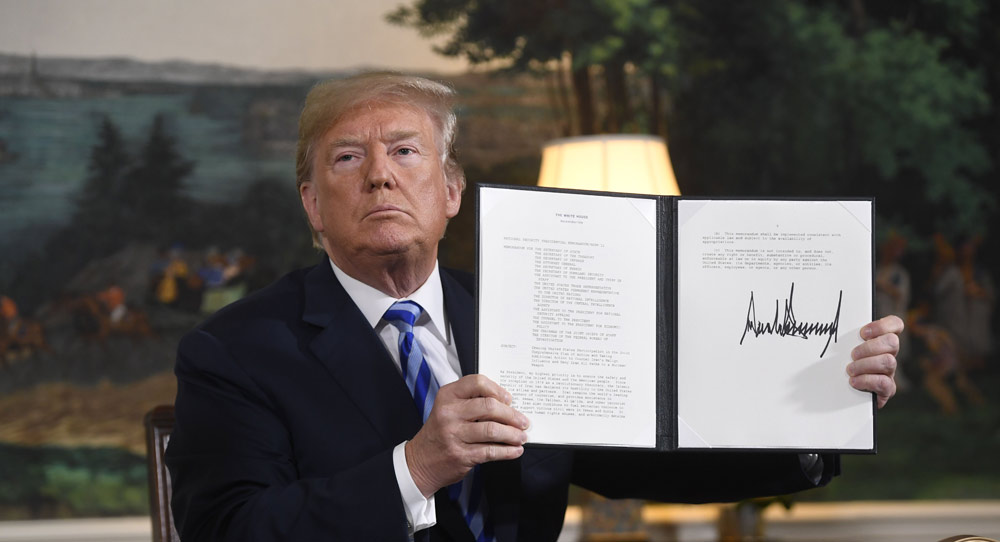
Conversations in Washington this week suggest that U.S. officials, currently fanning out across Europe soon, will bear three broad messages: First, Europeans, you have been forewarned about Donald Trump’s determination to end the nuclear agreement. Second, the United States will not countenance efforts to undermine upcoming U.S. sanctions. And third, the United States would like to work with you on a new, comprehensive deal along the lines of Secretary of State Mike Pompeo’s speech on Monday.
The first point is meant to frame European opposition to the United States’ withdrawal as wrongheaded and futile. But it misreads the nature and depth of European outrage, which goes well beyond substantive differences on how to best contain Iran’s nuclear ambitions. The current deal, known as the JCPOA, has a totemic value to many Europeans: it stands for a breakthrough for the EU, when the institution—which had long seen itself as rising global power—at last took on a vexing global problem and delivered a solution. Seen that way, the U.S. withdrawal does not just make the Middle East worse off; it also strips Europe of its crowning achievement. This is not widely understood in Washington, where officials profess surprise at the strength of Europe’s defense of the deal.
This opposition fuels rising anger on the U.S. side. One ominous line in Pompeo’s speech frames European efforts to keep Iran in compliance with the deal (by continuing to trade with Tehran) as profit driven. “These are markets our businesses would love to sell into as well,” he said. The implied charge of profiteering came up in a number of my discussions at the State Department. In fact, Iran represented a paltry 0.6 percent of the EU’s total exports in 2017. The importance of that business lies elsewhere: in keeping Iran in the nuclear agreement. Europe’s resolve to stick to these business ties, and the United States’ determination to confront Europe over them, suggests the transatlantic relationship will get worse, possibly much worse, in the short run. For the first time arguably since the Suez crisis, the United States and key European powers will be actively seeking to undermine each other in a region they consider central to their foreign policies.
We are in uncharted territory: we do not know what tools the United States could effectively use to respond to Europe. Talk in Washington about “nuclear” options—like sanctioning central banks—is actually a measure of how few palatable choices the United States has at its disposal. There is also a possibility that no matter what Washington throws at Tehran, Iran may opt to remain in the JCPOA—alongside China, Russia, and the EU—to portray the United States as the mistaken and isolated party. Ultimately though, if Washington follows through on the threat to impose economic hardship on Tehran, anti-American sentiments will probably force Iran out of the agreement.
The United States calculates that when the moment comes, Europe—rather than sulking—will see that it is in its interest to help land a new deal. I was told in Washington that Pompeo’s reference to current U.S. negotiations with North Korea was meant to reassure allies that Washington does not see regime change in Tehran as a precondition to talks. This is an issue where key European capitals would have been at odds with the United States, and the assurances on the point are meant to entice Europe’s support.
The United States is probably right in the long run about leaving Europe with only two choices, either no deal with Iran or help land a new one along current U.S. lines. But substantive differences on who is to blame for instability in the Middle East are bound to plague any future cooperation. Most European capitals see Russia, Saudi Arabia, the UAE, and Israel as partly culpable —not equivalent to Iran, which plays a particularly malign role, but not helpful, either. The United States believes that Europe’s fondness for the nuclear deal blinds key capitals to the true nature of Tehran’s regional roguery. Washington sees Iran as singularly responsible, and regards Israel and the Sunni powers as close allies. Notably, Pompeo laid a long list of demands at Tehran’s feet, whereas Paris and Berlin believe no progress can be made without a broader security conversation that involves concessions on the part of Israel and the Sunni powers. The United States does not seem open to policy adjustment; if anything, its parallel pursuit of the “ultimate deal” to end the Middle East conflict seems to be binding it closer and closer to Israel.
Given these differences, the outlook for transatlantic relations is stormy in the near future (which includes, crucially, a NATO summit in early July), with a wobbly and uncertain recovery. A breakthrough on North Korea would give Europeans reasons to question their skepticism of Donald Trump’s policy of maximalist pressure—though all Korea-watchers I spoke with in Washington believe that Pyongyang is seeking to extract economic benefits without actually denuclearizing. Should America’s diplomacy on North Korea fizzle, most Europeans will conclude that a hard-fought, functioning deal with Iran was thrown away for nothing.
Former Director, Carnegie Europe
Valášek was director of Carnegie Europe and a senior fellow, where his research focused on security and defense, transatlantic relations, and Europe’s Eastern neighborhood.
Recent Work

Erik Brattberg, Tomáš Valášek
Tomáš Valášek
Carnegie does not take institutional positions on public policy issues; the views represented herein are those of the author(s) and do not necessarily reflect the views of Carnegie, its staff, or its trustees.

With its public finances in shambles, the far right polling at 35 percent ahead of the 2027 presidential election, and a growing protest movement, is France’s crisis a threat to the EU’s geopolitical awakening?

Rym Momtaz, ed.

Ahead of a tough winter for Ukraine, Donald Trump’s swing back toward Russia bodes ill. But instead of panicking, Kyiv’s European allies are focusing on action.
Rym Momtaz

While the EU and European governments are embracing the much-lauded middle-power moment, this entails three difficult conundrums.

Richard Youngs

Much has been said of the changes Brussels is trying to make to the EU enlargement process. Here’s why gradual integration might—or might not—be the answer.

Dimitar Bechev

The European Commissioner for Trade is headed to China. But after President Xi’s bridge-building visit to Washington, can a more isolated EU overcome Beijing’s stranglehold on critical raw materials? Who will blink first?
Rym Momtaz, ed.