

Commentary
Gwendolyn Sasse
{
  "authors": [
    "Gwendolyn Sasse"
  ],
  "type": "commentary",
  "blog": "Strategic Europe",
  "centerAffiliationAll": "",
  "centers": [
    "Carnegie Endowment for International Peace",
    "Carnegie Europe"
  ],
  "collections": [
    "Europe’s Eastern Neighborhood"
  ],
  "englishNewsletterAll": "",
  "nonEnglishNewsletterAll": "",
  "primaryCenter": "Carnegie Europe",
  "programAffiliation": "",
  "programs": [],
  "projects": [],
  "regions": [
    "Europe",
    "Eastern Europe",
    "Ukraine"
  ],
  "topics": [
    "Security",
    "EU"
  ]
}
Source: Getty
The gap between U.S. and EU views on Ukraine is hindering an effective Western strategy to end the war in the country’s eastern region.
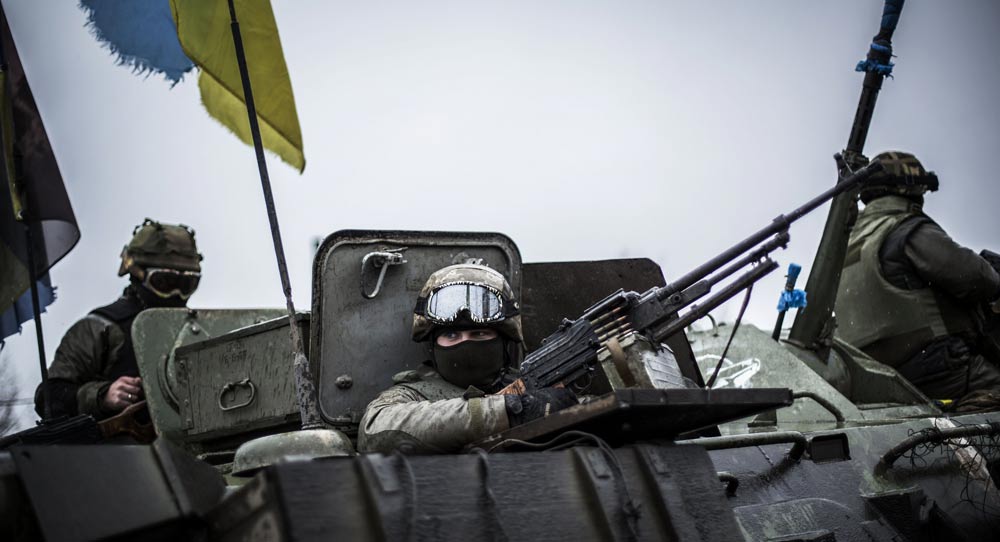
On April 30, Ukraine’s “antiterrorist operation” in the eastern region of Donbas officially ended. In its place, President Petro Poroshenko launched a “joint forces operation,” which was proposed by the National Security and Defence Council and mandated by a law passed earlier this year to reintegrate the Donbas.
The label “antiterrorist operation” (ATO), which was announced in April 2014, was a misnomer from the start, reflecting a global trend of extending the use of the term “terrorism” instead of the realities on the ground. The ATO was established under Poroshenko’s predecessor, Oleksandr Turchynov, in response to the growing unrest and the seizure of government buildings in Donetsk, Luhansk, and Kharkiv that preceded Russian military support for separatists in parts of the Donbas. It was originally conceived as a short-term measure. By comparison, the joint forces operation (JFO) has a longer-term perspective; that is, until the Donbas and Crimea are fully reintegrated into the Ukrainian state.The main practical difference between the two operations is that the control over the implementation of Ukrainian policy in the war zone switched from the security service (SBU) to Ukraine’s armed forces.
As president, Poroshenko is the commander in chief of the Ukrainian army. Lieutenant General Serhiy Nayev has been tasked with overseeing the joint forces operation (JFO), which combines all units of the Ukrainian army, the police, the security service (SBU), the National Guard, and the Border Guard Service deployed in the war zone. This reorganization of responsibilities underlines the prominent role that the army has come to play in Ukraine.
In a televised address marking the launch of the JFO, Poroshenko spoke of the beginning of a military operation “to ensure the protection of the territorial integrity, sovereignty, and independence of our state.” His wording suggests an upgrading of the war effort and a commitment to bringing the Donbas back under Kiev’s control. It also signals the president’s resolve and personal involvement in ensuring Ukraine’s security, an issue that is bound to play an important role during campaigning ahead of presidential and parliamentary elections in 2019. Poroshenko is hoping to regain ground; he is currently trailing in fourth place in the polls, with Yulia Tymoshenko being his main rival.
The restructuring of operations in the war zone in Donbas also coincided with the arrival of U.S. Javelin anti-tank missiles (defined as lethal but defensive) to Ukraine. This is not military aid in the direct sense of the word—Ukraine is meant to purchase the Javelin missiles and Javelin Command Launch Units, following the approval of the foreign military sale (for an estimated $47 million) by the U.S. State Department in March 2018. The official Ukrainian and U.S. positions are that the systems strengthen Ukraine’s long-term defensive capacity. In European political and military circles the delivery of lethal weapons to Ukraine is seen more critically, and fears of an unnecessary escalation of the conflict prevail.
The arrival of the Javelin systems can be expected to boost the morale of the armed forces engaged in the war zone, the current political leadership, and parts of the population across the country. Although the systems are likely to be positioned behind the frontline, it is possible that Ukraine will want to demonstrate their effectiveness.
The Russian reaction to even a small attack is hard to predict, and a temporary escalation cannot be ruled out. If Russian soldiers were to lose their lives in an attack that used Javelin missiles, the response would be stronger. The Russian media have been decrying U.S. military assistance to Ukraine as part of a buildup that confirms Ukraine’s intentions to launch a military campaign against Russia. Recent developments are therefore helping the Kremlin to shore up support for its position on Ukraine.
Despite verbal assurances that political dialogue remains the key mechanism to end the war, Kiev’s current emphasis on military command and capabilities and the supply of U.S. anti-tank missile systems will do little in the short term to bring Russia to the negotiation table and end the war in Donbas. This is bound to make the negotiations in the Normandy format—with Germany, France, Ukraine, and Russia—and in the Minsk Working Groups even more protracted. The scope to seriously discuss the mandate and conditions of a UN peace mission in the Donbas has also, at least temporarily, been reduced.
Moreover, the delivery of lethal weapons from the United States highlights the discrepancy between the U.S. and EU views on Ukraine—which ultimately hinders an effective Western strategy in the region.
Gwendolyn Sasse is a nonresident senior fellow at Carnegie Europe and Director of the Centre for East European and International Studies (ZOiS), Berlin.

Nonresident Senior Fellow, Carnegie Europe
Gwendolyn Sasse is a nonresident senior fellow at Carnegie Europe. Her research focuses on Eastern Europe, with a particular focus on Ukrainian politics and society, EU enlargement, and comparative democratization.
Recent Work
Gwendolyn Sasse
Gwendolyn Sasse
Carnegie does not take institutional positions on public policy issues; the views represented herein are those of the author(s) and do not necessarily reflect the views of Carnegie, its staff, or its trustees.

Before the next wave of EU enlargement takes place, the union needs to grapple with thorny questions of how power is distributed among its members.


Emil Sondaj Hansen, Ditte Brasso Sørensen

A summer of escalation in the Black Sea has hurt Ukraine economically and is exacerbating world food security. A truce is needed—as is a broader reframing of Europe’s Ukraine strategy.

Thomas de Waal

Are Germany’s economic, industrial, and political struggles becoming a liability for the EU’s ability to rise to the geopolitical moment?

Rym Momtaz, ed.

European Commission President Ursula von der Leyen is about to give her annual address on the state of the EU. Here’s what she won’t—but should—say.
Rym Momtaz

The aftermath of the Ceuta crisis shows Europe has drawn the wrong lessons. Rather than doubling down on failed migration policies, the EU needs to address the underlying roots of such episodes.

Richard Youngs