

Commentary
Judy Dempsey
{
  "authors": [
    "Judy Dempsey"
  ],
  "type": "commentary",
  "blog": "Strategic Europe",
  "centerAffiliationAll": "",
  "centers": [
    "Carnegie Endowment for International Peace",
    "Carnegie Europe"
  ],
  "collections": [],
  "englishNewsletterAll": "",
  "nonEnglishNewsletterAll": "",
  "primaryCenter": "Carnegie Europe",
  "programAffiliation": "",
  "programs": [],
  "projects": [],
  "regions": [
    "Middle East",
    "Europe",
    "Western Europe",
    "Germany"
  ],
  "topics": [
    "Foreign Policy",
    "EU",
    "Security"
  ]
}
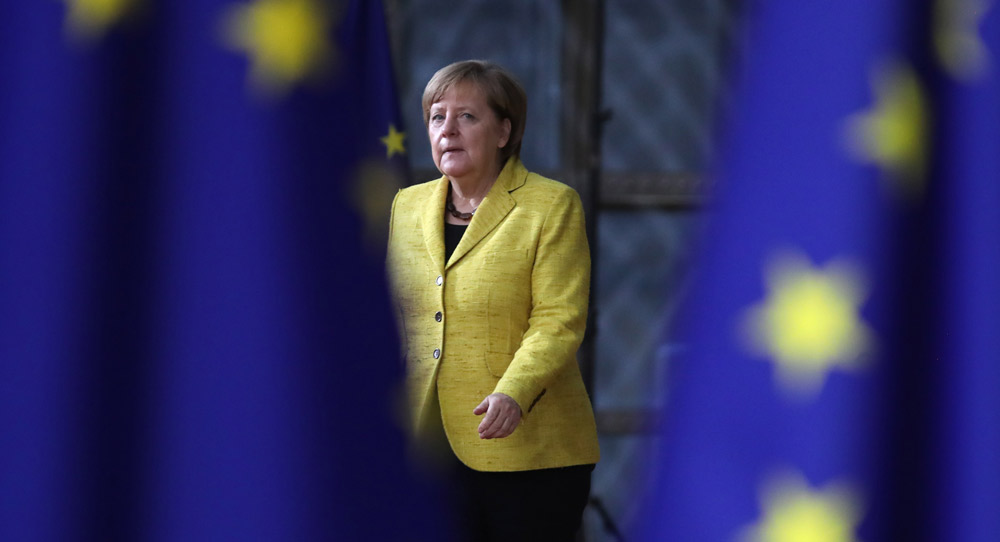
Source: Getty
Europe can abandon its ambitions as a global player until Germany breaks out of its comfort zone.
U.S. President Donald Trump’s decisions to pull out of the Iran nuclear deal and move the American embassy to Jerusalem has shaken his European allies.
It is not just because they mean more setbacks for the post-1945 multilateral order led by the United States. It is because Trump’s rejection of this order has left Europe highly vulnerable.Since the end of World War II, Europe was inextricably bound to the United States. The latter put a ravaged Western Europe back on its feet. The United States also provided a security umbrella. And it supported the establishment of what is today’s European Union. Above all, this special relationship was based on rules and shared values.
European leaders’ biggest fear is that the Trump administration has torn up the rule book. They now face a choice: continue muddling through—as they have repeatedly done, with mixed results during recent crises—or recognize that Trump’s policies should push Europe toward deeper political and economic integration. That path will require a strategic outlook that is sorely lacking in order to build a serious foreign, security, and defense policy. After decades of talking about one, little in substance has been achieved.
Muddling through is an option if the Europeans don’t want to be ambitious. That’s certainly clear in their absence of any strategy and influence in the Middle East—not to mention their careless policies in the Western Balkans, where they have so often turned a blind eye to corruption and miserable governance. That lack of ambition—and by implication, the lack of strategy—has brought danger and insecurity to Europe, as the war in Syria has shown.
The second option, deeper political and economic integration, is only possible if Germany emerges from its comfort zone. That would mean Chancellor Angela Merkel getting off the fence and acting strategically, not tactically, as has been her wont.
Now in her fourth term and heading yet another tired coalition of conservatives and Social Democrats, Merkel should have nothing to lose by showing some ambition and some gritty leadership.
She showed it when Russia annexed Crimea and lent military support to rebels in eastern Ukraine in 2014. Against all the odds, Merkel galvanized European leaders to impose sanctions on Moscow.
But Berlin didn’t use that opportunity to create a robust European foreign and security policy. Like its approach in dealing with indebted Eurozone countries, Berlin was more intent on sitting out the crisis rather than using it to inject some strategic thinking and planning at home, not to speak of the European level.
In contrast, French President Emmanuel Macron, in office for more than a year, has been waiting for Merkel to respond to his bold proposals for a reform of the EU that would lead to more economic and political integration.
Merkel’s caution, so often based on her intuition, her anti-risk approach, or on public opinion, is seen by some of her supporters as necessary given what is happening among EU member states. For them, Merkel represents stability and predictability at a time when Britain is preparing to leave the EU and while other member states, such as Hungary, are challenging some of the bloc’s core values.
But this predictability, once considered an asset, is becoming a liability. Trump’s transactional view of politics behooves Merkel to act with Macron and bring along the other member states.
The reason is that this time around, a Europe that muddles through could leave the bloc even more powerless than it is. It could give succor to those populist and nationalist movements that want a Europe less bound by the structures, values, and freedoms that that the EU was built on—and maybe even become transactional in nature.
Whether his own transactional policies will outlive his presidency or not, Trump’s America First doctrine could be exploited by Europe in several ways.
First, the EU should stick to multilateralism. This means capitalizing on the union’s trade accords with Canada, Japan, and South Korea and forging new ones with other countries in Southeast Asia and Latin America. And while at it, why not negotiate to join the Trans-Pacific Partnership agreement that Trump withdrew from?
It also means sticking to multilateral agreements. When it comes to saving the Iran nuclear deal, Berlin, Paris, and London are going to be in for a tough time by the Trump administration. They have already been threatened with sanctions if they don’t follow Washington’s decision to reimpose sanctions on Iran.
Macron and Merkel have no illusions about Iran’s geostrategic ambitions in the Middle East, or the influence of the Revolutionary Guard, or (for that matter) the growing politicization of the younger generation and its opposition to the regime. For economic and political reasons, Tehran needs this nuclear deal as much as the Europeans want it to curb Iran’s nuclear ambitions.
Second, Europe’s weakness outside the bloc is a result of the EU not taking security and defense seriously. It is divided over the nature of threats. It is divided over the use of hard power. It clings to the notion that soft power and diplomacy are the winning tickets to stability. They have repeatedly been proved wrong. Unless Germany, which dreads the idea of the rule book being torn up, gets serious about supporting a Europe that can defend itself and couples hard power with soft power, the EU can give up on being ambitious.

Nonresident Senior Fellow, Carnegie Europe
Judy Dempsey is a nonresident senior fellow at Carnegie Europe
Recent Work
Judy Dempsey
Judy Dempsey
Carnegie does not take institutional positions on public policy issues; the views represented herein are those of the author(s) and do not necessarily reflect the views of Carnegie, its staff, or its trustees.

Are Germany’s economic, industrial, and political struggles becoming a liability for the EU’s ability to rise to the geopolitical moment?

Rym Momtaz, ed.

European Commission President Ursula von der Leyen is about to give her annual address on the state of the EU. Here’s what she won’t—but should—say.
Rym Momtaz

The aftermath of the Ceuta crisis shows Europe has drawn the wrong lessons. Rather than doubling down on failed migration policies, the EU needs to address the underlying roots of such episodes.

Richard Youngs
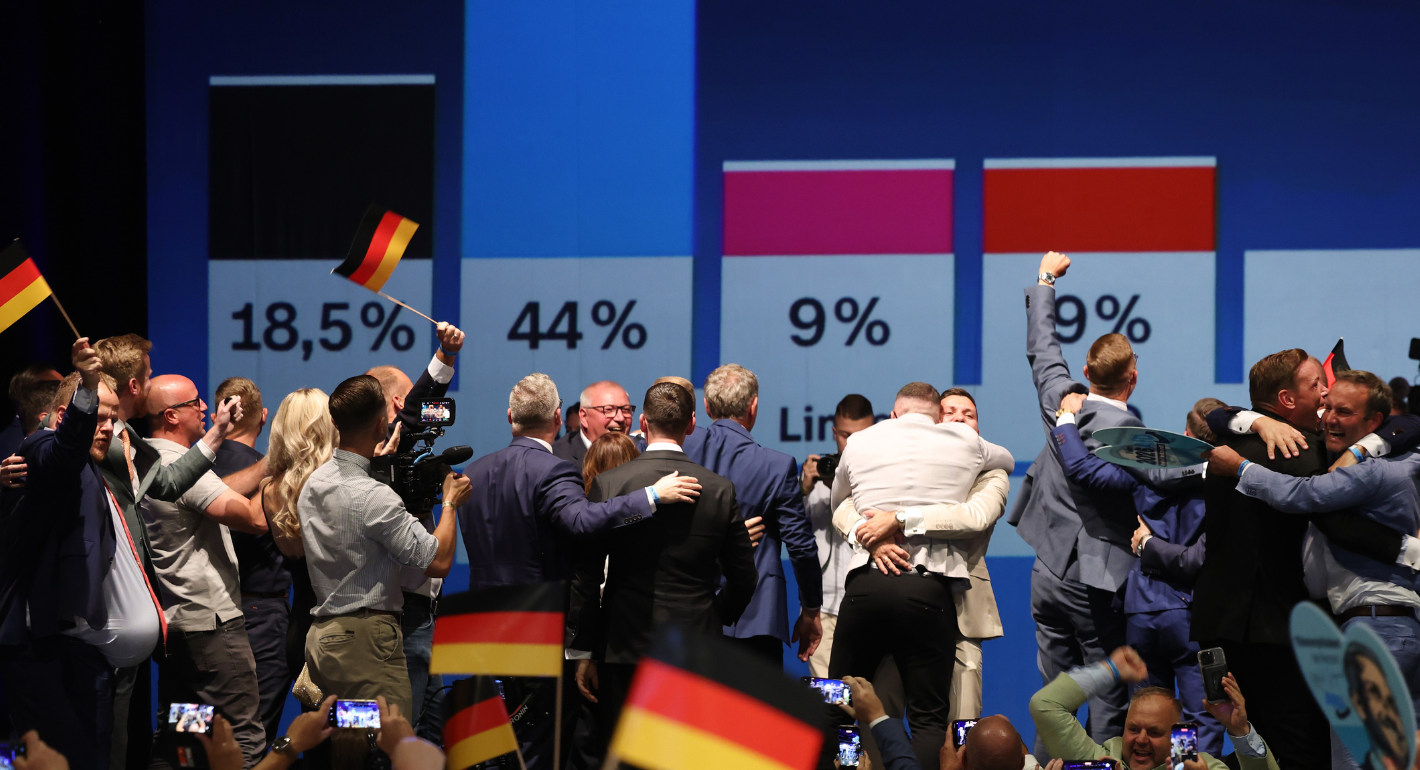
An overwhelming victory by a far-right-wing party in a small state in eastern Germany will have major repercussions for Chancellor Friedrich Merz’s coalition.
Judy Dempsey

Canadian Prime Minister Mark Carney has twice inspired praise for standing up to U.S. President Donald Trump: at the 2026 World Economic Forum in Davos and on Canada-U.S. trade negotiations. Is Carney showing a third way better than the EU has in dealing with the Trump administration?
Rym Momtaz, ed.