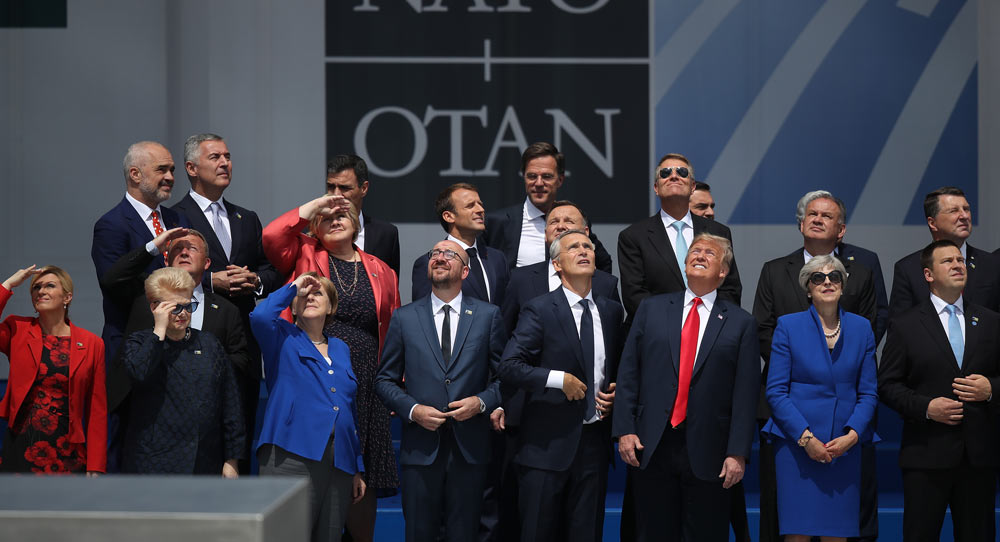
Carnegie Europe was on the ground at the 2018 NATO summit in Brussels, offering readers exclusive access to the high-level discussions as they unfold.
What drama! The second day of a NATO summit—at least over the past decade—is usually devoted to partner countries and Afghanistan. They tend to be calm, attract little attention, and allow leaders to stick to their scheduled scripts and departure timetables.
Not this time around. After the international press and most leaders (probably excluding
German Chancellor Angela Merkel) concluded that day one of the summit could have turned out much worse, they assumed that day two would be a shoo-in.
Forget it.
As soon as the meeting with Georgian and Ukrainian leaders began, Trump let rip. He singled out Germany, Spain, and the Benelux countries for falling way behind in meeting the NATO pledge to spend 2 percent of their gross domestic product on defense. The Georgian and Ukrainian delegations were asked to leave the conference room. An emergency meeting of leaders was called by NATO’s secretary general. There, Trump didn’t mince his words, as he told a packed press conference at the end of the summit.
He said the timetable to reach the 2 percent spending goal should be brought forward. But not content with that target, he said: “After 2 percent, we’ll start talking about going higher... I think 4 percent is the right number.”
There were rumors (incorrect, it turned out) flying around that Trump had either threatened to reduce U.S. spending in NATO by 20 percent—or even leave the European allies to defend themselves. The fact, Trump said, was that thanks to him the allies “stepped up liked they’ve never stepped up before,” adding that defense spending increased this year by some $33 billion (and by some $40 billion since he took office).
The promise of more money changed his mood—for now. “We have a very powerful NATO; much stronger than it was two days ago,” Trump said. “Now the United States is being treated fairly. I believe in NATO. NATO is now a fine-tuned machine.”
And so by the standards of this strange, new, Trumpian world, NATO has had a pretty good summit. The predictable drama, Twitter storms, and disagreements were all on display. But on issues of long-standing U.S. policy—including defense spending and opposition to the Nord Stream 2 pipeline—if the tone and delivery were changed, it could have been Barack Obama or George W. Bush speaking (though neither former president would have meted out such criticism, and so publicly, at Angela Merkel).
At the end of the day, Donald Trump, much to the relief of the rest of NATO, is not trying to covert his personal skepticism about alliances of any kind into U.S. policy.
In substance, NATO has just agreed new measures to reinforce eastern allies in a crisis. Against his own logic—a president who seems to believe America’s existing commitments in Europe as a step too far—Trump has just agreed to extend them to yet another country, North Macedonia.
A pattern has clearly emerged: the U.S. president uses these events to speak to home audiences. He’s permanently campaigning, and the low defense spending by Europeans does play well with the American public, which is understandably upset that the United States has come to carry such disproportionate share of the alliance’s defense burden.
What’s agreed to in meeting rooms makes little difference to voter intentions; the drama that Trump creates does, because it shows him as resolute. He’s causing crises for the sake of crises. Sometimes they change others’ behavior, sometimes they backfire. What matters is whether he is seen as getting things done.
The alliance remains a strange little oasis amidst the wreckage of what used to be transatlantic cooperation on Iran or global warming. What hangs over it is the question of whether Donald Trump would risk American lives if Europe were at risk. We do not know for sure, but he could. That boils down to deterrence—and that might continue to discourage Russia from doing anything foolish.
Yet there is another aspect to this summit. Yes, Trump has signed up to NATO. But he views the alliance much like the EU: a multilateral organization that in his view takes advantage of the United States. NATO may have disabused him of that notion by the promise to spend more. But he will be certain not to let them off the hook.
As for the EU in general and Germany in particular, the possibility of a trade war cannot be ruled out. As Trump mentioned, talks between Washington and Brussels will begin on July 25. In this context, the EU, unlike NATO’s European allies, is in a much stronger negotiating position—for now. In the meantime, Trump is off to Helsinki to meet Russian President Putin. “I’m going to a few hotspots—NATO, the UK, Putin. Putin may be the easiest of them all,” Trump quipped.