

Commentary
While the EU and European governments are embracing the much-lauded middle-power moment, this entails three difficult conundrums.
Richard Youngs
{
  "authors": [
    "Paul Taylor"
  ],
  "type": "commentary",
  "blog": "Strategic Europe",
  "centerAffiliationAll": "",
  "centers": [
    "Carnegie Endowment for International Peace",
    "Carnegie Europe"
  ],
  "collections": [
    "Transatlantic Cooperation"
  ],
  "englishNewsletterAll": "",
  "nonEnglishNewsletterAll": "",
  "primaryCenter": "Carnegie Europe",
  "programAffiliation": "",
  "programs": [],
  "projects": [],
  "regions": [
    "Europe",
    "North America",
    "Eastern Europe",
    "Western Europe"
  ],
  "topics": [
    "Security"
  ]
}
Source: Getty
It’s not too late for Poland to let go of the mirage of “Fort Trump” and pursue a more realistic security policy in collaboration with its European and NATO allies.
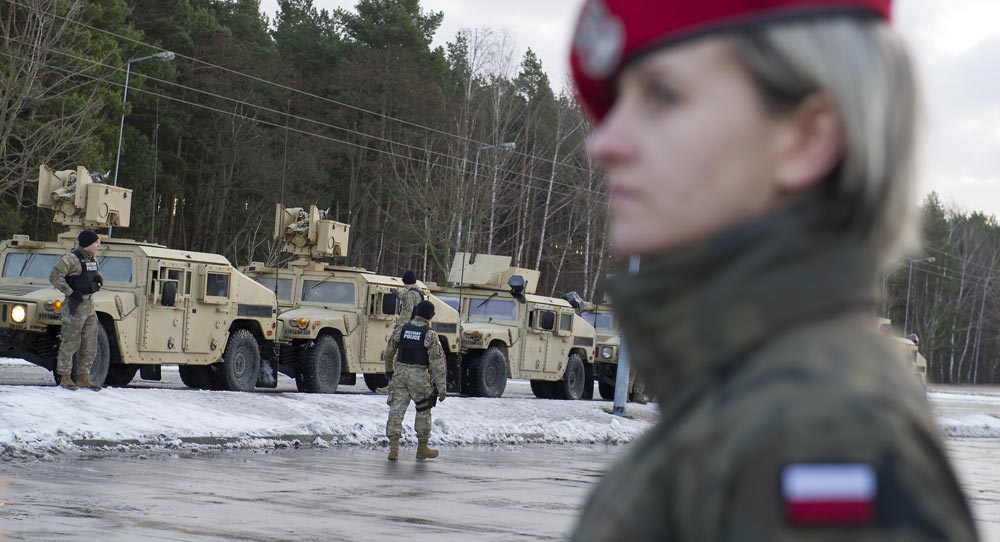
It’s time to get real. The United States is not pulling any of its troops out of foreign entanglements in Afghanistan or Syria so that it can put them in a big, fat “Fort Trump” in eastern Poland.
At the very least, when President Donald Trump tweeted it’s time to bring “our boys” home, the lightbulb should have gone on in Warsaw. America is disengaging from overseas commitments and focusing on growing rivalry with China. The U.S. army doesn’t have a spare combat brigade, let alone an armored division, to tie down in Central Europe waiting for the Russians to come.
For a Polish government to bet the store on securing a permanent U.S. army base to guard against Russian aggression is bound to lead to disappointment. All the more so if the quest is coupled with confrontation with the European Union over the rule of law; souring relations with the main Western European powers, Germany and France; a weakening of its armed forces and security services through repeated purges; and memory politics that upsets neighbors and allies.
Poland, the biggest Central European country with a strong military tradition, should be the sword and shield of NATO in the defense of northeastern Europe. Yet offering to pay for extra U.S. protection suggests that Warsaw regards NATO’s Enhanced Forward Presence (EFP)—rotating multinational frontline units in Poland and the Baltic States to ensure that any Russian incursion would immediately encounter allied forces—as inadequate.
NATO agreed on the reassurance plan at its 2016 Warsaw summit at Poland’s request, following Russia’s military action in Ukraine, to reinforce the principle that an attack on one ally is an attack on all. The EFP includes American boots on Polish soil, in addition to an existing air force presence and headquarters staff. On average, the United States has about 4,000 military personnel in the country.
Nevertheless, Warsaw is effectively signaling it doesn’t trust either NATO or the European Union to come to its aid in a crisis and putting all its eggs in the basket of its bilateral defense relationship with Washington. It is happy to overpay for Patriot air defense missiles as an extra insurance premium.
For sure, Poles have historical grounds rooted in 1795, 1939, and 1945 to fear being abandoned by Western powers. But those reasons should prompt Warsaw to seek to bind NATO and the EU more closely into its security rather than alienate European allies. As the EU is increasing its defense ambitions and capabilities, Poland should become more fully involved in the process. That way, the Common Security and Defense Policy, PESCO, and the European Defense Fund can reinforce collective defense in Eastern Europe, and not just be used for EU operations outside Europe.
There are other ways to strengthen NATO’s eastern defenses without a hulking permanent U.S. base. Use EU funds to expand dual-use road, rail, energy, and airport infrastructure to facilitate faster military mobility. Give NATO’s supreme commander pre-delegated authority to set in motion crisis response measures. Both the EU and NATO are investing in improved cyber defenses and better early warning of hybrid threats and disinformation. Poland lags in these areas. A joint U.S.-EU initiative would be more attractive to the United States.
It would make more sense to encourage the United States to build up enablers in Poland—such as pre-positioned equipment, pre-surveyed landing sites, and a bigger team of advance planners for rapid military reinforcements—rather than pressing for a base.
Of the threats to Polish national security, direct Russian military aggression is not the most likely. Warsaw needs to focus on a wider range of challenges, including the possibility of state failure in Ukraine, which could send refugees and possibly armed militias across its border, or of instability in Belarus, as well as cyberattacks or information warfare that could cripple key infrastructure and inflame its polarized domestic politics.
The biggest danger to Poland’s economic and political security in the long run is a deterioration of its relationship with the EU, the foundation of its post-Cold War prosperity, or a possible disintegration of the union. While public support for membership remains high and Poles are net beneficiaries of the EU budget, growing estrangement could eventually lead to a “Polexit,” as Britain’s experience shows.
To optimize its security policies, Poland should start by settling the dispute with the EU over judicial independence, repair ties with Berlin and Paris (notably by dropping the divisive campaign for war reparations from Germany), engage actively in European defense and industrial cooperation, and pursue additional ways of strengthening NATO’s eastern reinforcement strategy (short of a permanent U.S. base) in consultation with all allies.
In return, Berlin and Paris should look to boost political and industrial cooperation with Poland, reviving the Weimar Triangle formation that offered the promise of a seat in Europe’s inner leadership circle, and including Warsaw in future defense projects such as a next generation tank. Germany, as Poland’s neighbor, should be much more involved in Poland’s defense, as should France, which tends to focus more on Africa and is not leading any of the NATO forward deployed battalions in Eastern Europe.
It’s not too late for Poland to let go of the mirage of “Fort Trump” and pursue a more realistic security policy in collaboration with its European and NATO allies.
Paul Taylor is a contributing editor at POLITICO Europe and a senior fellow at Friends of Europe. He is the author of ‘Fort Trump’ or Bust, published by Friends of Europe in December 2018.

Paul Taylor
Senior Visiting Fellow, European Policy Centre
Paul Taylor is a senior visiting fellow at the European Policy Centre.
Carnegie does not take institutional positions on public policy issues; the views represented herein are those of the author(s) and do not necessarily reflect the views of Carnegie, its staff, or its trustees.

While the EU and European governments are embracing the much-lauded middle-power moment, this entails three difficult conundrums.

Richard Youngs

Much has been said of the changes Brussels is trying to make to the EU enlargement process. Here’s why gradual integration might—or might not—be the answer.

Dimitar Bechev

The European Commissioner for Trade is headed to China. But after President Xi’s bridge-building visit to Washington, can a more isolated EU overcome Beijing’s stranglehold on critical raw materials? Who will blink first?

Rym Momtaz, ed.

The domestic impacts of how long it is taking to end the war in Ukraine have pushed the French electorate to the political extremes and compromised the country’s diplomatic capacity.
Rym Momtaz

Before the next wave of EU enlargement takes place, the union needs to grapple with thorny questions of how power is distributed among its members.


Emil Sondaj Hansen, Ditte Brasso Sørensen