

Commentary
Judy Dempsey
{
  "authors": [
    "Judy Dempsey"
  ],
  "type": "commentary",
  "blog": "Strategic Europe",
  "centerAffiliationAll": "",
  "centers": [
    "Carnegie Endowment for International Peace",
    "Carnegie Europe"
  ],
  "collections": [
    "EU Integration and Enlargement",
    "Brexit and UK Politics"
  ],
  "englishNewsletterAll": "",
  "nonEnglishNewsletterAll": "",
  "primaryCenter": "Carnegie Europe",
  "programAffiliation": "",
  "programs": [],
  "projects": [],
  "regions": [
    "Europe",
    "Western Europe",
    "United Kingdom"
  ],
  "topics": [
    "EU"
  ]
}
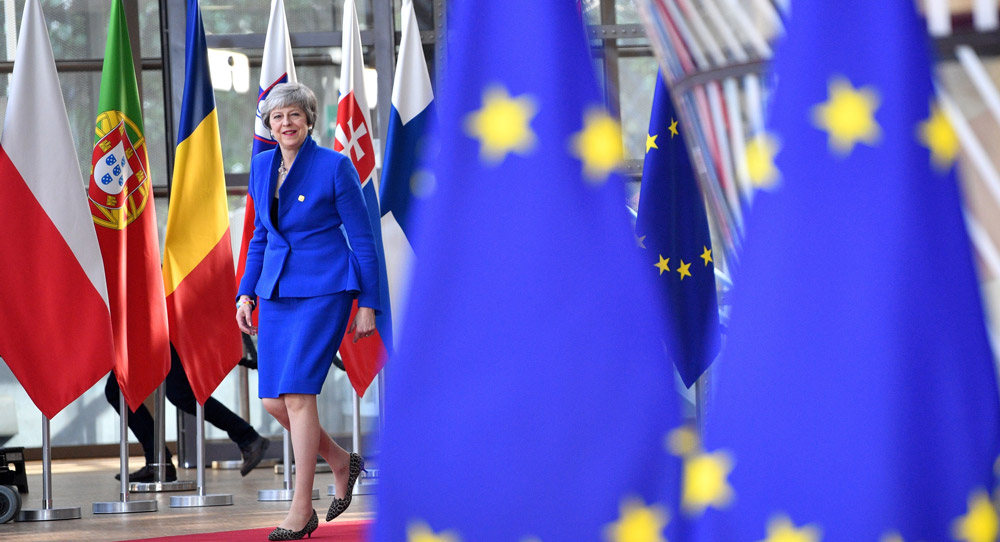
Source: Getty
A selection of experts answer a new question from Judy Dempsey on the foreign and security policy challenges shaping Europe’s role in the world.
Yes, Brexit is distinctly bad for Europe in every single way. Immediately, it takes away attention from numerous other urgent issues. Medium term, it will be a messy and difficult process to settle on the new relationship. Long term, a more fractured Europe is a weaker Europe. Don’t forget that the UK economy is still equal to eighteen EU member states and that the UK spends approximately 40 percent of all defense research and development in Europe.
Yes. With Brexit, Europe has less leadership internally and becomes less relevant globally. Plus, it’s a policy distraction for EU leaders. And yes, the Europeans will end up with some of the jobs that used to reside in the UK. But as costs of trade with the UK increases, they’ll lose some transactionally as well. Sorry.
While climate change threatens the future of our existence, and authoritarian regimes and movements continue to assault democracy and rule-based world order, the EU is undergoing yet another round of internal upheaval; this time because of Brexit. The process of leaving the EU—triggered by former prime minister David Cameron’s irresponsible plan to deal with the UK’s domestic political convulsions—has already harmed the British economy, polarized and alienated its citizenry, and depleted the country’s considerable soft power.
By contrast, the EU institutions have withstood the test of Brexit better than expected, maintaining unity and protecting the interests of the other member states, most significantly Ireland. These dual developments seem to have increased support and respect for the EU among the union’s wider publics. Yet this, in turn, has forced Euroskeptics in other countries to reevaluate their strategy and change their rhetoric. They no longer seem to want their country, be it Poland or Italy, to leave the EU. The Eurokeptics now want to reshape the block in a way that would undermine its basic values and principles, which is just as threatening to the European integration process.
The EU without the UK will be weaker both politically and economically. Brexit is bad for Europe, and it would be best if it doesn’t happen at all.
Yes, Brexit is bad for Europe, for ten reasons:
Yes—and that’s not just British hubris.
True, Britain has always been an awkward member of the EU, pushing back against continental hopes for a more federalist Union. But the UK’s veto power has been overstated—– it was sidestepped at crucial moments, such as with the fiscal compact in 2011. And British exceptionalism has masked competing French and German visions for Europe. It is this incoherence, not Britain, that obstructs further integration.
“We already miss you,” Donald Tusk commented in 2017. Indeed, Brexit will leave a significant gap in the EU budget—meaning the EU will have to do less, or ask other members to pay more. Britain’s exit means the EU also loses an advocate of free markets and overseas trade. And Britain’s absence will be keenly felt in foreign and security policy. The UK placed its faith in common EU action, participating in EU operations and driving European sanctions policy, notably against Russia. The UK has also been an important conduit between Europe and the United States. Without Britain, transatlantic policy may diverge further, weakening European security and influence.
Brexit will not resolve the EU’s existential dilemmas. More likely, this process will expend Europe’s energies for the next decade.
Whether Brexit is bad for Europe depends on the measures taken over the next few months in London, Berlin, Paris, and Brussels.
This is no time for European grandstanding. Europe is weaker than ever: the Yellow Vests have humbled President Emmanuel Macron in France; Italy’s government has succumbed to China’s
Belt and Road initiative; Central and Eastern Europe are witnessing the rise of authoritarian movements; Germany’s economy is stagnant; and the European Union has lost much of its magnetism.
Britain might be politically unstable at the moment, but it retains all the capabilities of a great power, including first-class armed forces, which have faithfully undergirded European security for seventy years. With the United States increasingly distracted in the Indo-Pacific, Europe is going to need the United Kingdom more than ever. Russia has not gone away; it looms ever-present to the East.
Is this the time to let Brexit fail? No. It is the time to build a better, stronger, and more durable relationship. Brexit is an opportunity for the EU, just as it is an opportunity for Britain to come to terms with its more “global” orientation. In short: Brexit will only be bad for Europe if we let it.
Yes, Brexit has been bad for Europe thus far.
The most immediate problem is bandwidth, particularly in London but also in EU-27 capitals, as endless Brexit debates distract attention from other challenges. For example, leaders scrapped a discussion on China at the March European Council to discuss Brexit deadlines. Even if a divorce is agreed, negotiations on the future relationship could take years.
Despite historic British resistance to deeper integration, the UK is a global player whose participation has benefitted EU policymaking. Although protracted Brexit arguments have strained relations, European diplomats lament the impending loss of regular contact with their British counterparts on a myriad of issues.
In economic terms, Brexit will affect the UK more than the EU. Yet the nature and extent of Brexit’s impact on all member states will depend on how Britain leaves the EU and the future degree of regulatory alignment. A no-deal departure would hinder continental supply chains and markets, whereas continued British participation in the Customs Union and/or Single Market would minimize disruption. Beyond quarrels about the backstop, Brexit has destabilized politics in Northern Ireland by resurfacing contentious identity and constitutional questions.
Yes. It would be wonderful if Britain’s departure from the EU unlocked integrationist energy in the rest of Europe. But I doubt it, given the nationalist forces in several key member states (like Germany or France) trying to tear the pragmatic and pro-European rationale of their governments apart. Not only will the EU budget take a big hit with the loss of its second biggest economy; Britain’s departure diminishes Europe’s weight in the balance of world powers.
The EU will also lose one of Europe’s usually pragmatic and oldest democracies. It might not look like it at the moment, as some members of the Tory party threaten to turn their parliament into the House of Clowns. But the EU should treat this as a national midlife crisis rather than a final state of insanity. Brussels is well advised to try everything to keep Britain in the EU. The UK might be a difficult member of the European family, but it’s a very important one.
Brexit is the ultimate lose-lose proposition. Even an orderly Brexit will be a long, divisive, energy-consuming process for both the UK and the EU. It will sap policymakers’ attention, weaken the economies of both the UK and the continent, add wasteful red tape and duplication, and diminish both sides’ global influence. The relationship could go from tense to openly hostile if a hardline Euroskeptic were to succeed Theresa May and team up with U.S. nationalists to divide and weaken the EU.
Brexit robs the EU of its second biggest economy and of one of its two nuclear powers, serious military players, and permanent UN Security Council members.
The EU already shows some signs of becoming more statist and protectionist since the Brits voted to leave. Anyone who hoped the removing of a British brake would free Europe to pursue deeper integration has been disabused. The Germans are the new British on some issues, the Italians, Poles, Hungarians, Dutch, or Finns on others.
Fears that other countries might follow Britain’s lead have faded. The Brexit shambles is a salutary lesson. Continental populists have muted or dropped talk of leaving the EU. But we will still have a weaker, poorer, less strategic Europe.

Nonresident Senior Fellow, Carnegie Europe
Judy Dempsey is a nonresident senior fellow at Carnegie Europe
Recent Work
Judy Dempsey
Judy Dempsey
Carnegie does not take institutional positions on public policy issues; the views represented herein are those of the author(s) and do not necessarily reflect the views of Carnegie, its staff, or its trustees.
The EU is putting together a new security strategy to meet today’s myriad challenges. But for any proposal to be effective, the union needs to grapple with its identity and ambitions.

Pierre Vimont

The EU’s new migration policy is not suited to today’s realities. With climate change increasingly becoming a driver of displacement, Europe needs to rethink its deterrence-focused approach.

Shana Tabak

The battle over free speech has taken center stage since U.S. Vice President JD Vance accused Europe of censorship. From travel bans to social media regulation, especially around the Israel-Palestine conflict, are liberal democratic governments weaponizing free speech?

Rym Momtaz, ed.
Europe seems to have accepted its sidelining in the Middle East. The EU must reassert its support for the international rules-based order and step up engagement.
Rym Momtaz
Amid uncertainty caused by the Iran war, the global drive for nonproliferation has stalled. With Europe diplomatically marginalized and countries reassessing their nuclear options, efforts to curb the spread of nuclear weapons risk becoming irrelevant.

Jane Darby Menton