

Commentary
Judy Dempsey
{
  "authors": [
    "Judy Dempsey"
  ],
  "type": "commentary",
  "blog": "Strategic Europe",
  "centerAffiliationAll": "",
  "centers": [
    "Carnegie Endowment for International Peace",
    "Carnegie Europe"
  ],
  "collections": [
    "EU Integration and Enlargement"
  ],
  "englishNewsletterAll": "",
  "nonEnglishNewsletterAll": "",
  "primaryCenter": "Carnegie Europe",
  "programAffiliation": "",
  "programs": [],
  "projects": [],
  "regions": [
    "Europe",
    "Western Europe"
  ],
  "topics": [
    "EU",
    "Democracy"
  ]
}
Source: Getty
Ahead of the general election in October, Poland’s support for the EU is as high as ever, but its influence in the bloc is at its weakest since it joined in 2004.
Thirty years ago this week, West Germany’s then foreign minister Hans-Dietrich Genscher stood on the balcony of his country’s elegant embassy in Prague.
It was an unforgettable moment.
The narrow cobblestone streets of the old city were jammed packed with those spluttering two-stroke Trabant cars that represented one of the questionable qualities of East German manufacturing. Outside and inside the grounds of the Lobkowicz Palace were thousands of East Germans.They were waiting for that special word.
Finally, Genscher spoke. "Dear fellow Germans, we have come to you in order to inform you that today, your departure…" The rest of his sentence was drowned out by cheers, clapping, roars of delight. The East Germans that had gathered or taken refuge at the West German embassy were free to leave for the West. Many rushed to the main railway station.
I stood watching the sheer outburst of joy, the sense of freedom. Over the following days, East Germans made their way over to West Germany. Another peaceful revolution was in train.
Such a revolution had already taken place a few months earlier in Poland.
There, the communist regime, which in December 1981 had imposed martial law on its people, had agreed to round talks with the opposition Solidarity movement. That paved the way for Poland’s semi-free elections that took place in June 1989. In the election, the communists were trounced. The transformation from one-party rule to democracy had begun.
Yet for Poland’s governing Law and Justice (PiS) party today, the transformation remains incomplete. Over the years, its leader, Jarosław Kaczyński, and his nationalist, conservative supporters have repeatedly criticized the liberal intellectuals of the Solidarity movement for failing to purge the country’s institutions of communists.
Indeed, PiS’s persistent assault on the judiciary is justified on the grounds that the system was never sufficiently cleansed of communists. Forget the fact that the transformation began three decades ago.
In reality, since coming to power in 2015, after a brief stint between 2005 and 2007, PiS has adopted and is implementing its own narrative for Poland. Since it cannot keep repeating its criticism that communists still influence the institutions, it has instead promoted a social, economic, and political program based on conservative and nationalist principles.
“For Kaczyński, not everything from the West should be imitated,” said Aleksander Smolar, president of the Stefan Batory Foundation in Warsaw. “His view is that Poland should be developed along its own lines.”
Those lines have three characteristics.
First is the socio-economic agenda. To increase the birth rate, the PiS government pays parents 500 zlotys per month for every child, an election promise that helped the party win power in 2015, and which it implemented shortly after.
Ahead of the parliamentary election scheduled for October 13, PiS has now promised to increase the minimum monthly pension by 100 zlotys to 1,200. Pensioners will also be given annual cash bonuses. In addition, the minimum wage will be almost doubled.
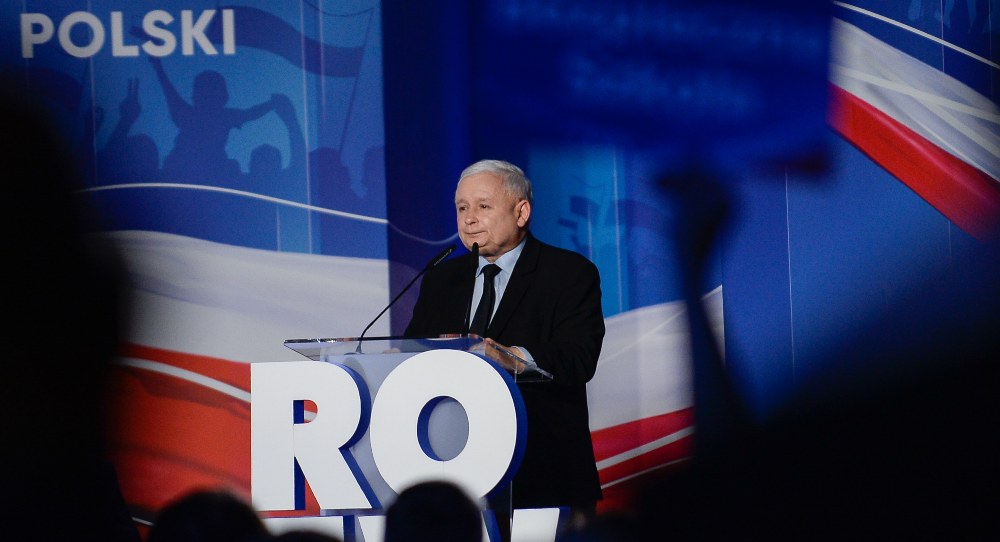
“At the end of 2020, the minimum wage will amount to 3,000 zlotys, at the end of 2023, it will be 4,000 zlotys,” Kaczyński told his party convention in Białystok, eastern Poland, in early September.
Second is PiS’s support for traditional values anchored in the Catholic Church, even though the church was involved in sexually abusing young people. Such values include opposition to LGBT+ rights and abortion. These issues have actually galvanized civil society movements into defending individual freedoms.
PiS’s assertion of traditional values is Kaczyński’s rejection of the West’s liberal values. “It’s as if PiS is saying: in 1989, we should imitate the West. Now, the West should imitate us,” said Smolar. “It’s a kind of Polish messianism,” he added.
Yet Poland wanted to join the EU not just because it would embed the country in Europe and the West. It was about making the transition to the rule of law, to an independent judiciary, to checks and balances, and to a free press. It was about completing the transition to democracy. Those very institutions are now been consistently undermined.
“If PiS wins the election, they will appoint one of their own as Ombudsman,” argued Professor Wojciech Sadurski, a constitutional expert.
“They will finish the capture of the courts and, most importantly, they will probably find some legal way to take over private media through ownership requirements. That will be pretty much the end of constitutional democracy,” he added.
Third is how Poland’s influence inside the EU has markedly waned since 2015. Even though support for the EU among Poles is remarkably high and Poland is the sixth-largest of the bloc’s members, neither has been translated into influence.
This is in stark contrast to the time when the center-right Civic Platform party was in power from 2007 to 2015. Then, the Polish government lobbied for strong European defense and security structures and a more integrated energy market. It was also very active in trying to strengthen the EU’s policies toward Ukraine and the other Eastern countries. It carried weight in Brussels.
That weight has diminished as the PiS government has sought like-minded allies in Central Europe.
The upshot is that if Warsaw accuses France or Germany for setting the agenda in the EU and fears that both will become even stronger after Brexit, it only has itself to blame for choosing to retreat.

Nonresident Senior Fellow, Carnegie Europe
Judy Dempsey is a nonresident senior fellow at Carnegie Europe
Recent Work
Judy Dempsey
Judy Dempsey
Carnegie does not take institutional positions on public policy issues; the views represented herein are those of the author(s) and do not necessarily reflect the views of Carnegie, its staff, or its trustees.

While the EU and European governments are embracing the much-lauded middle-power moment, this entails three difficult conundrums.

Richard Youngs

Much has been said of the changes Brussels is trying to make to the EU enlargement process. Here’s why gradual integration might—or might not—be the answer.

Dimitar Bechev

The European Commissioner for Trade is headed to China. But after President Xi’s bridge-building visit to Washington, can a more isolated EU overcome Beijing’s stranglehold on critical raw materials? Who will blink first?

Rym Momtaz, ed.

The domestic impacts of how long it is taking to end the war in Ukraine have pushed the French electorate to the political extremes and compromised the country’s diplomatic capacity.
Rym Momtaz

Before the next wave of EU enlargement takes place, the union needs to grapple with thorny questions of how power is distributed among its members.


Emil Sondaj Hansen, Ditte Brasso Sørensen