

Commentary
Judy Dempsey
{
  "authors": [
    "Judy Dempsey"
  ],
  "type": "commentary",
  "blog": "Strategic Europe",
  "centerAffiliationAll": "",
  "centers": [
    "Carnegie Endowment for International Peace",
    "Carnegie Europe"
  ],
  "collections": [
    "Transatlantic Cooperation"
  ],
  "englishNewsletterAll": "",
  "nonEnglishNewsletterAll": "",
  "primaryCenter": "Carnegie Europe",
  "programAffiliation": "",
  "programs": [],
  "projects": [],
  "regions": [
    "Europe",
    "North America",
    "United States",
    "Western Europe",
    "France",
    "Germany"
  ],
  "topics": [
    "Foreign Policy",
    "Security"
  ]
}
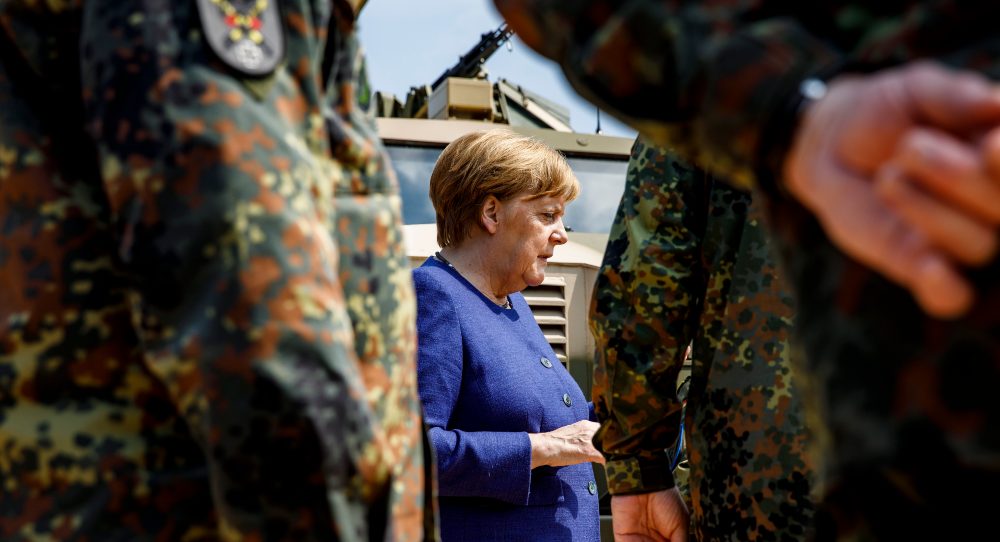
Source: Getty
Hold your breath! The American and French presidents’ provocative views on NATO are good for the alliance—provided Germany starts acting strategically.
Rarely has NATO not been under verbal siege over these past few months.
U.S. President Donald Trump continues to snipe at the alliance at any given opportunity. And on the other side of the Atlantic, French President Emmanuel Macron has gone so far as to call it brain-dead.
Leading officials, predictably, have rushed to defend the organization. Ahead of a meeting of alliance leaders near London on December 3–4, there will be even more praise and support showered on NATO.
Yet the fact that that this meeting will not be called a summit shows how NATO’s seventieth birthday is not being celebrated with great fanfare but instead with a degree of self-doubt, if not anxiety. In their different ways, Trump and Macron are good for NATO—provided alliance leaders can turn such criticism into an advantage.Trump’s tirades against NATO are about money. He wants the allies to pay more into the pot and stop taking the United States’ security umbrella for granted. The member states are now paying more for their defense.
And even if several governments have yet to meet the target of spending 2 percent of GDP on defense, the contributions have jumped. Yet it is debatable if the 2 percent goal makes sense if not coupled with an overhaul of what countries spend the money on.
And it’s an open question if Trump even believes that sum is enough anyway. For him, NATO is just another transactional instrument. The idea that it was founded to underpin the West carries little weight. That’s such a dangerous development for the transatlantic relationship. It represents another assault by Trump on one of the post-1945 multilateral organizations that were established to ensure a measure of predictability and stability for the West.
Macron has weighed in from a very different angle. It’s the intellectual and political aspects that he wants addressed. It’s not about getting rid of NATO or ganging up on the United States—which some countries such as Poland infer from Macron’s comments. Nor is it about Macron wanting France to become the leader of a European defense force that would eclipse NATO. Even if he wanted the latter, he would garner little support.
What Macron wants is for NATO to think and act politically and for Europe to consider the future of its security in case Trump wakes up one day and pulls America out of NATO. Many alliance leaders prefer to keep their heads in the sand rather than contemplate such a possibility.
Trump’s comments aside, the immense dangers the West is facing from Russia, China, and terrorism, not to mention the increasing vulnerability of democracies worldwide, cannot be played down. Macron wants NATO to talk about these issues.
The fact that the alliance has shied away from such discussions—even of the collapse of the Iran nuclear deal—or avoided preparing for scenarios such as a conflict breaking out in the South China Sea reveals a mindset and culture in fear of opening a Pandora’s box.
But it has to be opened. And Germany should do it.
The German defense minister, Annegret Kramp-Karrenbauer, says she wants the European allies to take on more responsibility. Not to be outdone, the minister of foreign affairs, Heiko Maas, who swings back and forth with regard to his views on NATO, wants an independent commission set up to undertake a forensic examination of the alliance. That committee should be chaired by NATO Secretary General Jens Stoltenberg.
But it will go nowhere unless Germany gets off the fence and decides once and for all to play a strategic role in Europe and in NATO.
This is not about Trump forever berating German Chancellor Angela Merkel for failing to spend enough on defense. As if money alone was a panacea to NATO’s ills.
It is about Germany replying to Macron by setting the agenda for Europe’s security and defense. This means asking hard questions about America’s security guarantee, about the role of Europe’s two nuclear powers, Britain and France, and about further enlargement of NATO.
Germany’s procrastination over security and defense should worry all NATO allies and all EU members.
As Merkel sees out her last term as chancellor, she has the chance to take advantage of the criticism coming from the White House and the Élysée Palace. Unless she grabs that chance, the advantage will pass to Russian President Vladimir Putin.

Nonresident Senior Fellow, Carnegie Europe
Judy Dempsey is a nonresident senior fellow at Carnegie Europe
Recent Work
Judy Dempsey
Judy Dempsey
Carnegie does not take institutional positions on public policy issues; the views represented herein are those of the author(s) and do not necessarily reflect the views of Carnegie, its staff, or its trustees.

Before the next wave of EU enlargement takes place, the union needs to grapple with thorny questions of how power is distributed among its members.


Emil Sondaj Hansen, Ditte Brasso Sørensen

A summer of escalation in the Black Sea has hurt Ukraine economically and is exacerbating world food security. A truce is needed—as is a broader reframing of Europe’s Ukraine strategy.

Thomas de Waal

Are Germany’s economic, industrial, and political struggles becoming a liability for the EU’s ability to rise to the geopolitical moment?

Rym Momtaz, ed.

European Commission President Ursula von der Leyen is about to give her annual address on the state of the EU. Here’s what she won’t—but should—say.
Rym Momtaz

The aftermath of the Ceuta crisis shows Europe has drawn the wrong lessons. Rather than doubling down on failed migration policies, the EU needs to address the underlying roots of such episodes.

Richard Youngs