

Commentary
Judy Dempsey
{
  "authors": [
    "Judy Dempsey"
  ],
  "type": "commentary",
  "blog": "Strategic Europe",
  "centerAffiliationAll": "",
  "centers": [
    "Carnegie Endowment for International Peace",
    "Carnegie Europe"
  ],
  "collections": [
    "EU Integration and Enlargement"
  ],
  "englishNewsletterAll": "",
  "nonEnglishNewsletterAll": "",
  "primaryCenter": "Carnegie Europe",
  "programAffiliation": "",
  "programs": [],
  "projects": [],
  "regions": [
    "Europe",
    "Western Europe"
  ],
  "topics": [
    "EU",
    "Democracy"
  ]
}
Source: Getty
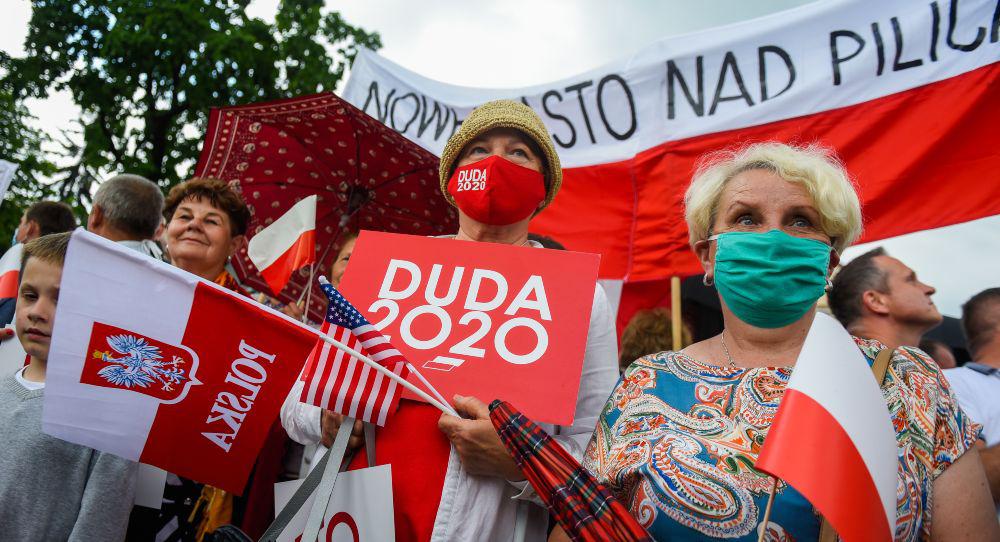
The inconclusive first round of Poland’s presidential election showed a Polish leader and government undoing the gains of joining the European Union. The EU can take some of the blame.
It was a small room. No windows. A simple table. Lots of chairs.
There, in a basement in the European Union’s Justus Lipsius building in the heart of Brussels, the Polish delegation negotiating to join the EU would give press briefings. And what briefings! The energy and enthusiasm were palpable. The negotiations were certainly highly technical and complex. But they were also emotional. Poland was about to return to Europe. Which it did on May 1, 2004. The euphoria was inspiring.
That’s all gone. So is the sense of purpose that motivated successive Polish governments since 1989, when the communist regime peacefully ceded power to the Solidarity trade union movement and the opposition.
As the EU’s sixth-largest economy, Poland was in a strong position to exert influence in the bloc. It played a substantial role when it came to energy policy and relations with Russia. It was even enthusiastic about strengthening the EU’s foreign, security, and defense policy. And it weathered the storm during the 2008 global financial crisis, becoming one of the few European countries to avoid a dip into recession.Despite such auspicious circumstances, Poland’s governing Law and Justice (PiS) party and President Andrzej Duda, who is backed by PiS, are reversing these gains. This was so clear during a nasty, polarizing presidential election campaign in which Duda was forced into a second round after winning almost 44 percent in the inconclusive first round of the vote on Sunday, June 28, 2020.
As if Duda hadn’t more pressing issues to deal with, such as the coronavirus pandemic or the need to continue the country’s modernization, he immediately pledged to protect traditional values against LGBT rights.
His rival, Rafał Trzaskowski, the Warsaw mayor and enthusiastic pro-European who won just over 30 percent of the vote, faces an uphill struggle in catching up on Duda. Not least because of the way PiS is in control of public television broadcasting.
This is how the OSCE’s Office for Democratic Institutions and Human Rights assessed the election: “The campaign was characterized by negative and intolerant rhetoric” and a “public broadcaster [that] failed to ensure balanced and impartial coverage,” the international observers monitoring the election said in a statement.
Not only that. “Inflammatory language by the incumbent and his campaign was at times xenophobic and homophobic . . . In the run-up to the election, the public broadcaster became a campaign tool for the incumbent, while some reporting had clear xenophobic and anti-Semitic undertones,” according to the accompanying press release. That’s quite an indictment.
But it will hardly cut ice with Duda’s supporters, especially in smaller towns and villages and in the eastern part of the country, which has consistently supported PiS. There, he and PiS have managed to chisel away at support for the rural Polish People’s Party, once an influential movement among small farmers and sometimes even a kingmaker in government coalitions.
Not anymore. Since winning power in 2015, PiS has moved to snuff out opposition not only through controlling the public broadcaster but by using taxpayers’ money to pay women to have more children and to increase pensions.
It has also used its power to erode the independence of the judiciary by interfering in the appointment of judges and forcing them into early retirement. PiS has long argued it was only ridding the system of the old guard. In practice, it was about placing their own supporters in the courts.
The EU should have stepped in a long time ago to defend the rule of law, one of the most basic principles of a democratic system. But PiS only had to look at how Hungarian Prime Minister Viktor Orbán used his majority in parliament to gain control over large parts of the media in addition to reining in NGOs.
Despite their criticism of the EU, especially of what they perceive as its liberal agenda, neither Duda nor PiS would dare contemplate leaving the bloc. For one thing, the EU is highly popular among the majority of Poles. For another, the EU allocated more than €16.3 billion to Poland in the way of various structural and development funds in 2018. That’s the equivalent of 3.4 percent of the Polish economy. Knowing the reluctance of EU member states to sanction their own kin, these funds will continue flowing to Warsaw.
And even if—and it’s a big if—Trzaskowski manages to win the second round of the presidential election on July 12, he will inherit a deeply polarized country and a highly politicized media and judiciary. The unity that catapulted Poland into the EU back in 2004 is a distant memory.

Nonresident Senior Fellow, Carnegie Europe
Dempsey is a nonresident senior fellow at Carnegie Europe
Recent Work
Judy Dempsey
Judy Dempsey
Carnegie does not take institutional positions on public policy issues; the views represented herein are those of the author(s) and do not necessarily reflect the views of Carnegie, its staff, or its trustees.
France and Germany’s failure to agree on the Future Combat Air System (FCAS) raises questions about European defense. Amid industrial rivalries and competing strategic cultures, what does the future of European military industrial projects look like?

Rym Momtaz, ed.
France has stopped clinging to notions of being a great power and is embracing the middle power moment. But Emmanuel Macron has his work cut out if he is to secure his country’s global standing before his term in office ends.
Rym Momtaz
Integrating AI into the workplace will increase job insecurity, fundamentally reshaping labor markets. To anticipate and manage this transition, the EU must build public trust, provide training infrastructures, and establish social protections.
Amanda Coakley
Europe’s interests in Syria extend beyond migration management, yet the EU trails behind other players in the country’s post-Assad reconstruction. To boost its influence in Damascus, the union must upgrade its commitment to ensuring regional stability.
Bianka Speidl, Hanga Horváth-Sántha
EU member states clash over how to boost the union’s competitiveness: Some want to favor European industries in public procurement, while others worry this could deter foreign investment. So, can the EU simultaneously attract global capital and reduce dependencies?
Rym Momtaz, ed.