

Commentary
Peter Kellner
{
  "authors": [
    "Peter Kellner"
  ],
  "type": "commentary",
  "blog": "Strategic Europe",
  "centerAffiliationAll": "",
  "centers": [
    "Carnegie Endowment for International Peace",
    "Carnegie Europe"
  ],
  "collections": [
    "EU Integration and Enlargement",
    "Brexit and UK Politics"
  ],
  "englishNewsletterAll": "",
  "nonEnglishNewsletterAll": "",
  "primaryCenter": "Carnegie Europe",
  "programAffiliation": "",
  "programs": [],
  "projects": [],
  "regions": [
    "Europe",
    "Western Europe",
    "United Kingdom"
  ],
  "topics": [
    "Political Reform"
  ]
}
Source: Getty
Brexit may well contribute to the breaking up of the United Kingdom. Only a brave gambler would bet on both Scotland and Northern Ireland still belonging to the UK in 2040.
UK Prime Minister Boris Johnson calls them the “awesome foursome.”
These days, two of the four nations that make up the United Kingdom are less keen on Britain’s prime minister than he is on them. The result could be a big threat to one of his objectives for Brexit: stronger internal relations within the UK.
Historically, the UK has never been a fixed entity. Relations between England, Ireland, Scotland, and Wales have fluctuated. Less than one hundred years ago, the UK comprised all of the British isles, before a bitter civil war led to the secession of twenty-six of Ireland’s thirty-two counties in 1922.Tensions have never disappeared. For three decades between the late 1960s and the late 1990s, Northern Ireland—and occasionally English cities—suffered from the Troubles, the Irish Republican Army’s (IRA’s) violent campaign to reunite Ireland by force. The IRA killed more than 2,000 people, their “loyalist,” pro-UK opponents more than 1,000, and the British army more than 300.
In Scotland and Wales, nationalist parties have made their mark more peacefully. Both countries now have their own national parliaments with substantial powers, but while the appetite for full independence is limited in Wales, it has grown in Scotland.
Brexit has now added a new dimension to these historical tensions. It may well contribute over time to the breaking up of the United Kingdom; only a brave gambler would bet on both Scotland and Northern Ireland still belonging to the UK in 2040.
Let us take the two in turn.
When Scotland’s new parliament first met in 1999, one of its members was applauded for declaring: “The Scottish Parliament, adjourned on March 25 in the year 1707, is hereby reconvened.”
That statement is long on nationalist nostalgia but short on accuracy. Scotland’s currency, and hence its overall economic powers, is controlled by London—as are its defense and foreign policy.
When the UK voted for Brexit in 2016, Scots divided by almost two to one in favor of staying in the EU. But Scotland was bound by the UK-wide result: it was forced to leave the EU along with England, Northern Ireland, and Wales.
This reopened a debate that seemed to have been settled in 2014, when a Scottish independence referendum resulted in Scots voting by 55 to 45 percent to remain in the UK. It was supposed to be a once-in-a-generation decision that offered Scots continuing membership of both the UK and the EU.
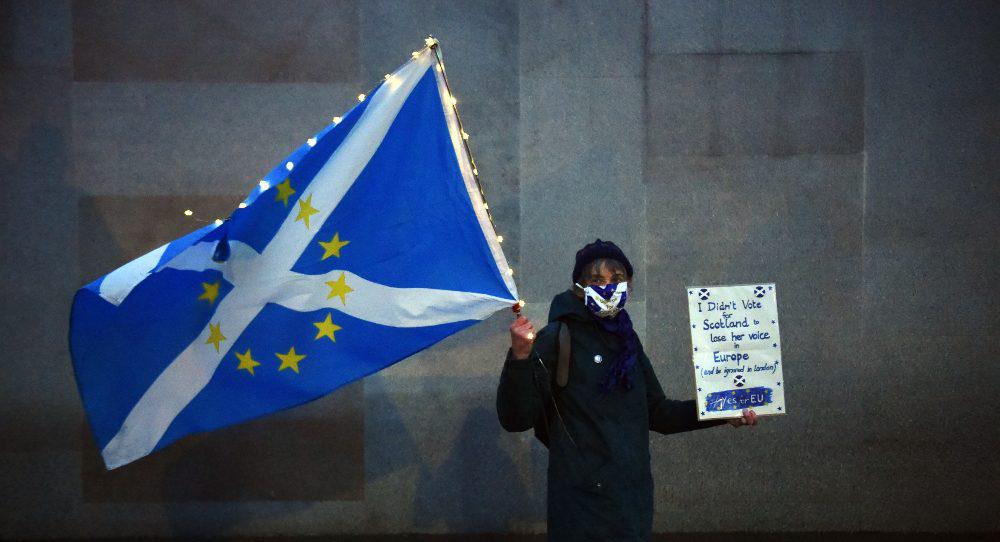
Many Scots now feel that their only way to rejoin the EU is to break away from the UK. More than ever before, the nationalist and European causes in Scotland have come together—and have been gaining support.
For the first time, polls conducted in 2020 report that a majority of Scots now favor independence from the UK. The rise in support is a direct response to Scotland being forced against its will to leave the EU.
In 2021, Scotland will elect a new parliament. The Scottish National Party (SNP) is set for its best-ever result and will remain in power in Edinburgh. Together with the Greens, also pro-independence and pro-EU, the SNP will be sure of a majority—and possibly a large majority—for a fresh referendum on independence.
Legally, however, Scotland’s politicians do not have the power to call a referendum. They can ask for one, but the decision rests with Westminster. Here, the Conservatives enjoy a large majority, and they oppose a fresh referendum. Johnson, the Conservative Party leader, says the Scots should wait forty years before another independence vote.
In the short run, London’s veto will prevail. The long run is another matter. If the Conservatives remain in power in Westminster, and the SNP in Edinburgh, the stage will be set for a constitutional crisis. Reluctantly, the Conservatives may have to give way.
Alternatively, the Conservatives may be voted out of office at the next UK general election. However, the main opposition party, Labour, will find it extremely hard to win outright. A far more likely outcome, if the Conservatives do lose, is a minority Labour government dependent on SNP support. And the price of that support will be agreement on a new vote on Scottish independence.
One way or another, a referendum is likely before 2030. Scotland’s departure from the UK is a distinct possibility.
Northern Ireland’s politics are very different; but its destination may be the same as Scotland’s. Its political tribes are driven by religion: the Protestant majority is overwhelmingly pro-British, while the Catholic minority wants a reunited Ireland. For the time being, therefore, most of Northern Ireland’s voters want to stay within the UK.
But three factors are changing that simple political arithmetic.
First, demographics—driven by birth rates and migration—are edging Northern Ireland slowly but remorselessly toward a Catholic majority.
Second, a small but growing minority of voters reject the sectarian divide and no longer vote according to their religion.
Third—and this is the one respect in which Northern Ireland resembles Scotland—Brexit is making a difference. Under the new UK-EU agreement on future relations, concluded on December 24, 2020, the island of Ireland remains politically divided but is economically more united than at any time since 1922.
There are no border posts, rules, or tariffs to impede trade across the 500-kilometer border between Northern Ireland and the Irish Republic; but trade between Northern Ireland and mainland Britain is now subject to significant checks, resulting in empty shelves in Northern Irish supermarkets.
The demographic and economic logic of Northern Ireland points to Irish reunification in the next 10–20 years.
Already, polls indicate a shift in views toward a 50-50 division on whether to leave the UK. Meanwhile, the prospect of rejoining the EU—which 56 percent of Northern Irish voters in 2016 did not want to leave—is attractive, not just to Catholic nationalists, but also to the growing minority of anti-sectarian Protestants.
Only in Wales do nationalists remain in a clear minority.
By 2040, Johnson’s “awesome foursome” may be a thing of the past. Brexit could end up dividing the United Kingdom more comprehensively than it divides Europe.

Former Nonresident Scholar, Carnegie Europe
Kellner was a nonresident scholar at Carnegie Europe, where his research focused on Brexit, populism, and electoral democracy.
Recent Work
Peter Kellner
Peter Kellner
Carnegie does not take institutional positions on public policy issues; the views represented herein are those of the author(s) and do not necessarily reflect the views of Carnegie, its staff, or its trustees.

Are Germany’s economic, industrial, and political struggles becoming a liability for the EU’s ability to rise to the geopolitical moment?

Rym Momtaz, ed.

European Commission President Ursula von der Leyen is about to give her annual address on the state of the EU. Here’s what she won’t—but should—say.
Rym Momtaz

The aftermath of the Ceuta crisis shows Europe has drawn the wrong lessons. Rather than doubling down on failed migration policies, the EU needs to address the underlying roots of such episodes.

Richard Youngs

An overwhelming victory by a far-right-wing party in a small state in eastern Germany will have major repercussions for Chancellor Friedrich Merz’s coalition.

Judy Dempsey

Canadian Prime Minister Mark Carney has twice inspired praise for standing up to U.S. President Donald Trump: at the 2026 World Economic Forum in Davos and on Canada-U.S. trade negotiations. Is Carney showing a third way better than the EU has in dealing with the Trump administration?
Rym Momtaz, ed.