

Commentary
Peter Kellner
{
  "authors": [
    "Peter Kellner"
  ],
  "type": "commentary",
  "blog": "Strategic Europe",
  "centerAffiliationAll": "",
  "centers": [
    "Carnegie Endowment for International Peace",
    "Carnegie Europe"
  ],
  "collections": [
    "Brexit and UK Politics"
  ],
  "englishNewsletterAll": "",
  "nonEnglishNewsletterAll": "",
  "primaryCenter": "Carnegie Europe",
  "programAffiliation": "",
  "programs": [],
  "projects": [],
  "regions": [
    "Europe",
    "Western Europe",
    "United Kingdom"
  ],
  "topics": [
    "Foreign Policy",
    "Economy",
    "Climate Change"
  ]
}
Source: Getty
Brexit Britain is discovering that its influence and ability to tackle global challenges have diminished. As reality sinks in, it could change the way Britain thinks and acts—very possibly for the better.
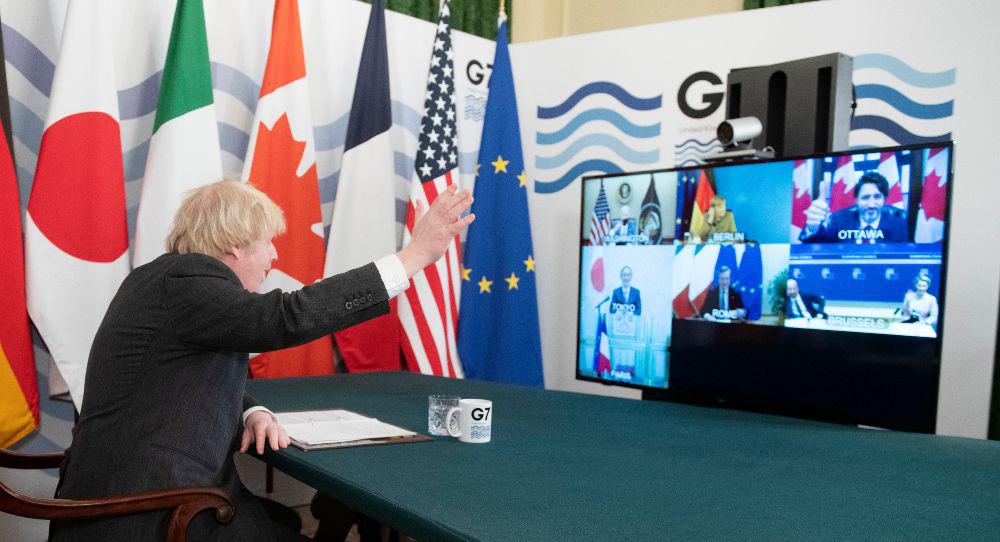
Boris Johnson talks frequently of his ambitions for “Global Britain.” He wants the United Kingdom, post-Brexit, to play a great role around the world.
In a government report published in March, he said that this is vital for the UK’s “safety and prosperity,” and definitely not a “vainglorious gesture.”
How seriously should we take Britain’s prime minister? Very, say his supporters. Here are some examples they cite. A new aircraft carrier has set off on its inaugural journey, to join Dutch and American ships patrolling the South China seas. In mid-June, the UK will host a G7 summit. In November, it will host another big gathering: the United Nations Climate Change Conference, known as COP26.
All the while, the UK is busy negotiating new trade deals with other countries, now that the EU no longer does so on Britain’s behalf. And the UK remains a nuclear power within NATO, with a permanent seat on the UN Security Council.
That’s one side of the ledger. But it’s not the whole story. Here are some things that Johnson’s critics put on the other side:
To these examples we should add a larger point about Britain’s place in the world. Six decades ago, Dean Acheson, who had helped to create the postwar world as U.S. secretary of state, famously said: “Great Britain has lost an empire and has not yet found a role.” By joining the European Community in 1973, Britain found a role. It became a bridge between the United States and Europe.
The bridge is not as big or strong as British leaders would like; but it has made a difference. Sharing a language, history, and culture with one, and a continent with the other, Britain was able to develop close bonds with both and help to develop common approaches to global issues.
Brexit has blown up that bridge. The UK’s relations with the EU are now cold and awkward. Britain remains friendly toward the United States, but is far less useful to Washington.
If Washington wants to deal with Europe, it now bypasses London and deals directly with Brussels, Paris, and Berlin. What’s more, U.S. President Joe Biden feels strongly about his Irish roots. He will not be impressed by Johnson’s attempts to rewrite the UK-EU Northern Ireland Protocol, which the prime minister signed less than six months ago. Anything with even the faintest whiff of British bad faith will go down badly in the White House.
Recently the prestigious U.S. Council on Foreign Relations proposed a “Concert of Powers for a Global Era.” The Council suggested that its members should be the United States, China, the EU, Russia, Japan, and India. By its absence from that list, Britain has been relegated to the second division of world powers, despite having nuclear weapons and its UN Security Council seat.
The big question is: does that matter? One of the UK’s problems is that nostalgia for past glories tends to swamp its present identity. Brexit Britain is discovering that it has little influence and less power to solve the world’s big problems—such as tackling climate change, fighting terrorism, preventing future pandemics, standing up to China, and taxing big, footloose technology companies.
All in all, the days of exaggerated self-importance are finally over. A more modest Britain is on its way. Gradually, that reality is likely to sink in. It could change the way Britain, as a nation, thinks and acts; and very possibly for the better. This was not what Johnson and his fellow Brexiters intended, but it could be their most valuable legacy.

Former Nonresident Scholar, Carnegie Europe
Kellner was a nonresident scholar at Carnegie Europe, where his research focused on Brexit, populism, and electoral democracy.
Recent Work
Peter Kellner
Peter Kellner
Carnegie does not take institutional positions on public policy issues; the views represented herein are those of the author(s) and do not necessarily reflect the views of Carnegie, its staff, or its trustees.

Before the next wave of EU enlargement takes place, the union needs to grapple with thorny questions of how power is distributed among its members.


Emil Sondaj Hansen, Ditte Brasso Sørensen

A summer of escalation in the Black Sea has hurt Ukraine economically and is exacerbating world food security. A truce is needed—as is a broader reframing of Europe’s Ukraine strategy.

Thomas de Waal

Are Germany’s economic, industrial, and political struggles becoming a liability for the EU’s ability to rise to the geopolitical moment?

Rym Momtaz, ed.

European Commission President Ursula von der Leyen is about to give her annual address on the state of the EU. Here’s what she won’t—but should—say.
Rym Momtaz

The aftermath of the Ceuta crisis shows Europe has drawn the wrong lessons. Rather than doubling down on failed migration policies, the EU needs to address the underlying roots of such episodes.

Richard Youngs