

Commentary
Judy Dempsey
{
  "authors": [
    "Judy Dempsey"
  ],
  "type": "commentary",
  "blog": "Strategic Europe",
  "centerAffiliationAll": "",
  "centers": [
    "Carnegie Endowment for International Peace",
    "Carnegie Europe"
  ],
  "collections": [
    "Europe’s Eastern Neighborhood"
  ],
  "englishNewsletterAll": "",
  "nonEnglishNewsletterAll": "",
  "primaryCenter": "Carnegie Europe",
  "programAffiliation": "",
  "programs": [],
  "projects": [],
  "regions": [
    "Europe",
    "Eastern Europe",
    "Belarus"
  ],
  "topics": [
    "Foreign Policy",
    "Security",
    "Democracy",
    "EU"
  ]
}
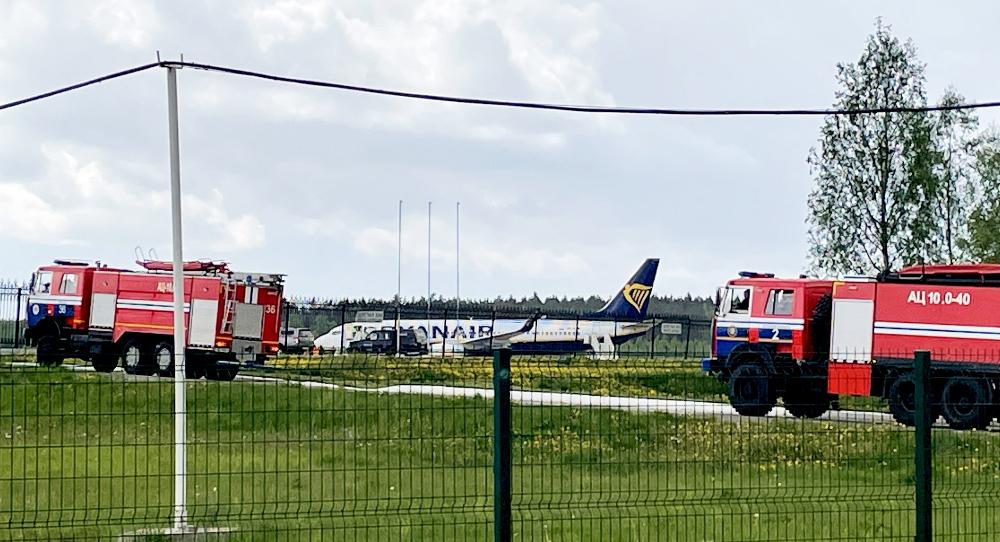
Source: Getty
It took the hijacking of a plane and the kidnapping of a journalist to shake Europe out of its complacency over Belarus. Beyond sanctions, the EU’s response should include supporting Belarusian society and reconsidering Nord Stream 2.
The time for bland statements from EU officials is over.
A Ryanair commercial flight traveling from Athens to Vilnius on May 23 was forced to land in Minsk, the capital of Belarus. The crew was told there was a bomb on board. There wasn’t.
Instead, on board was Raman Protasevich, a leading independent journalist, activist, and editor of opposition Telegram channel Nexta.
As soon as the aircraft doors were opened, Protasevich was taken away by security officials. Later, he appeared in a video on state television, bruised. He had been clearly forced to make a confession about damaging the interests of Belarus.
This is what some dissidents and those considered troublemakers were pressured into doing during the communist era. But this is 2021. These things are happening in a country that borders the European Union. It is a country of 9.5 million people, of whom so many have been protesting peacefully since last August against rigged presidential elections.
Since then, Alexander Lukashenko, in power in Belarus since 1994, has cracked down. Thousands of young and old, men and women, students, workers, artists are in prison. The independent media is almost destroyed.
Until Protasevich’s kidnapping, the EU’s reaction to what was taking place in Belarus was tepid. A few economic sanctions were imposed on high-ranking officials, including Lukashenko himself, as well as some enterprises and their managers. But that was all.
That reinforced the perception that the EU was powerless. No matter what measures European leaders took, despite the extraordinary courage of Belarusian citizens, the country’s future was in the hands of a discredited regime backed by Moscow.
But the illegal diversion of the Ryanair plane, the kidnapping of Protasevich, and the presence of four Russians on the plane—allegedly operatives who remained in Minsk after the crew was allowed to depart for Vilnius—have finally forced the EU’s hand. The safety and security of its airspace and passengers—and the EU’s reaction—were being tested by Lukashenko.
At the European Council on May 24, EU leaders agreed a list of actions in response to the hijacking. They demanded the immediate release of Protasevich and his girlfriend Sofia Sapega. They also agreed to ban Belarusian airlines from EU airspace and European airports. There will be a new batch of targeted sanctions introduced as well. They are all about isolating Lukashenko.
Were it as easy as that.
Lukashenko can always rely on Russian President Vladimir Putin to come to his aid. In reality, the EU’s measures could play into the hands of Russia, which has no intention of letting Belarus move toward democracy. This is why the EU has to take bolder steps and avoid isolating ordinary Belarusians who want fair and free elections and the end of the Lukashenko regime. No matter what Putin’s intentions are with regard to Belarus, there is no return to the status quo ante of last August.
Beyond the new round of sanctions, the EU, with support from the United States, should adopt a two-pronged strategy.
The first element is supporting the Belarusian citizens.
Sanctions are never clear-cut. In the case of Belarus, they could make a major difference if the intention to isolate Lukashenko was coupled with helping the country’s citizens and opposition.
Lithuania and Poland are already lending much support. Warsaw has become a hub for broadcasting news into Belarus via the Belsat network which was established several years ago. Lithuania has set up educational facilities for students. Much more could be done.
The EU could provide visas for those facing persecution or risk of arrest. It could finance schools and universities for Belarusians wanting to study in Europe. It could provide legal assistance to those in prison. It could openly declare support for all the political prisoners behind bars. To keep Belarusians informed, it could make better use of social media, a tool Lukashenko is dismantling by the day.
As for the trade unions whose leaders have bravely held strikes, knowing the reprisals they faced, the EU could set up a fund to support those who have been sacked. This is important. A recent survey conducted by the Centre for East European and International Studies (ZOiS) showed that an increasing number of Belarusians are worried about their financial situation.
This is an opportunity for the EU to support Belarusian society as a whole. As a start, European Commission president Ursula von der Leyen promised on May 24 a €3 billion ($3.7 billion) economic and investment package “ready to go for Belarus, when it becomes democratic.”
The EU’s policy toward Belarus inevitably has a Russian component. If Russia continues to back Lukashenko, particularly by providing intelligence and security assistance, the EU, and the United States—and Putin—need to recognize that the Lukashenko regime’s days are over.
If the EU, the United States, and especially Germany have any leverage over Putin, it is the Nord Stream 2 gas pipeline. Postponing this controversial project should be the second element of the EU’s strategy.
The pipeline is almost complete. Although U.S. President Joe Biden's administration has lifted the threat of sanctions on those companies involved in the project—for the sake of relations with Germany—this is the time to revisit that decision.
If anything, the Protasevich case shows that the EU today has to prepare for the day after. Waiting is not an option.

Nonresident Senior Fellow, Carnegie Europe
Judy Dempsey is a nonresident senior fellow at Carnegie Europe
Recent Work
Judy Dempsey
Judy Dempsey
Carnegie does not take institutional positions on public policy issues; the views represented herein are those of the author(s) and do not necessarily reflect the views of Carnegie, its staff, or its trustees.

Ahead of a tough winter for Ukraine, Donald Trump’s swing back toward Russia bodes ill. But instead of panicking, Kyiv’s European allies are focusing on action.

Rym Momtaz

While the EU and European governments are embracing the much-lauded middle-power moment, this entails three difficult conundrums.

Richard Youngs

Much has been said of the changes Brussels is trying to make to the EU enlargement process. Here’s why gradual integration might—or might not—be the answer.

Dimitar Bechev

The European Commissioner for Trade is headed to China. But after President Xi’s bridge-building visit to Washington, can a more isolated EU overcome Beijing’s stranglehold on critical raw materials? Who will blink first?
Rym Momtaz, ed.

The domestic impacts of how long it is taking to end the war in Ukraine have pushed the French electorate to the political extremes and compromised the country’s diplomatic capacity.
Rym Momtaz