

Commentary
Judy Dempsey
{
  "authors": [
    "Judy Dempsey"
  ],
  "type": "commentary",
  "blog": "Strategic Europe",
  "centerAffiliationAll": "",
  "centers": [
    "Carnegie Endowment for International Peace",
    "Carnegie Europe"
  ],
  "collections": [
    "EU Integration and Enlargement"
  ],
  "englishNewsletterAll": "",
  "nonEnglishNewsletterAll": "",
  "primaryCenter": "Carnegie Europe",
  "programAffiliation": "",
  "programs": [],
  "projects": [],
  "regions": [
    "Europe",
    "Western Europe"
  ],
  "topics": [
    "Foreign Policy",
    "Economy",
    "Democracy",
    "Political Reform",
    "EU"
  ]
}
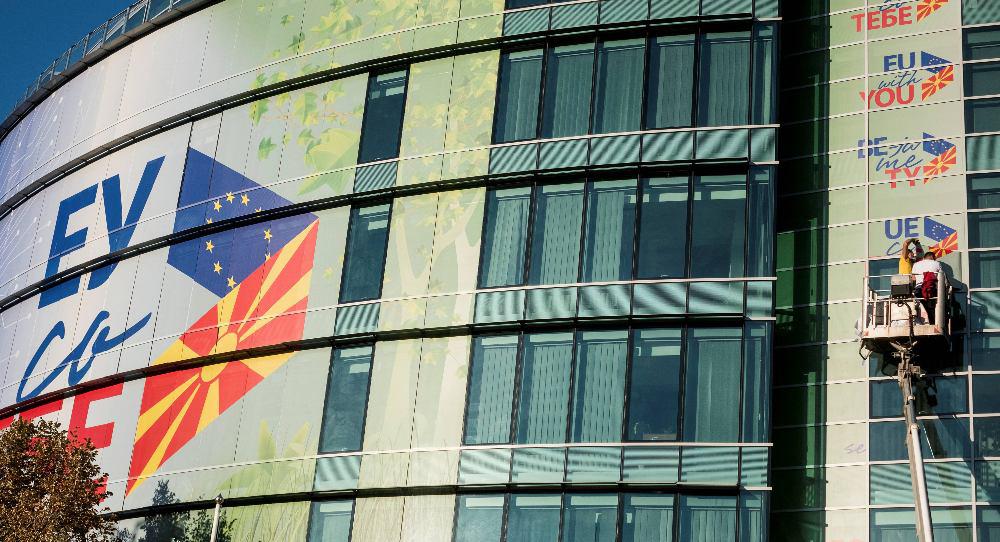
Source: Getty
The EU remains the Western Balkans’ primary trading partner and investor. But failing to step up engagement and deliver on enlargement promises will come at a high cost and benefit the likes of Russia and China.
The EU has not lost the Western Balkans.
It remains the principal economic player in the region and wields considerable diplomatic clout. The hype about China and Russia aside, it is the EU which provided the bulk of coronavirus assistance and is now funding the post-pandemic recovery.
The union has largely itself to blame for coming across as lacking influence. Its greatest asset—the promise of membership—is also its Achilles’ heel.
If accession is no longer a credible prospect, Balkan power players are likely to shun Brussels’ demands, look elsewhere for political support and economic rewards, and take the European Union for granted.
Worse still, local leaders casually bash the EU to score domestic political points while benefitting from the perks European integration offers to populations—including trade access, investment, and visa-free travel.
The Western Balkans remain firmly in the EU’s sphere but this does not mean that Brussels, Berlin, or Paris are calling the shots.
If the question is whether the people of the Western Balkans have stopped believing they’ll join the EU soon, then yes.
Despite reassurances proffered by European Commission President Ursula von der Leyen following the EU-Western Balkans summit, Charles Michel’s words were more telling. Namely, the president of the European Council finally acknowledged out loud what we’ve all known for a while: “there is an ongoing debate between the 27 on the Union’s capacity to integrate new member states.” In other words, short of overhauling the unanimity system of voting, don’t expect enlargement any time soon.
This does not, however, mean the Western Balkans are “lost.” It means we need to stop viewing the EU-Western Balkans’ relationship exclusively through the lens of enlargement. The prospect of EU membership can be a powerful motivator for reform, but it is not a prerequisite for engagement. The United States promotes policy changes worldwide without dangling the possibility of statehood.
Instead of breaking promises on accession, the EU should focus on promises it can keep. It is the key investor in the region and EU ideals are still of interest to the Western Balkan citizenry. As long as the people of the Western Balkans still desire representative and non-corrupt governments, cleaner air, and freedom of movement, the EU will not lose the Western Balkans to anyone else.
EU policy in the Western Balkans recalls the classic Communist joke: “The EU pretends to offer membership and we pretend to be interested in joining.” EU members never had any intention of enlarging the union and as their behavior has demonstrated for years, neither Bosnia and Herzegovina nor Serbia ever had any interest in joining.
As the person who designed the Dayton Agreement, I know what it was supposed to do and what it could likely not do. Its primary goal was to stop the war. A secondary goal was to restore relatively normal economic and social life. A long-term goal was to build the foundations of a three-community government. Always in the back of our minds was Kosovo.
Goals one and two seem to be have been achieved. Probably only the return of former Yugoslav president Josep Broz Tito’s secret police could make goal three achievable. Kosovo remains a major problem. Time has come to abandon illusions and focus on the doable.
With a new EU high representative on board and a new German government on the horizon, it will be important to explore all “non-membership” options that could help both solidify the peace and improve the civil societies of Bosnia, Kosovo, and Serbia. Continued foreign subsidies are likely to be essential. Engaging the United States and Russia more actively in these efforts will be critical.
Yes. The Western Balkans expose the pointlessness of talking about an EU foreign policy. In 1999, a combined European and American, NATO-EU operation brought an end to a decade of Serb-initiated conflict in the Western Balkans, including attacks on Sarajevo or the slaughter of 8,000 men, women and children at Srebrenica. Europe acted.
In the last twenty years, Europe has talked. First Greece and now Bulgaria created fake identity issues to deny the existence of the Skopje-Macedonian entity (today’s North Macedonia). Then Spain, Greece, Romania, Slovakia, and Cyprus pretended Kosovo didn’t exist.
French President Emmanuel Macron in 2017 said Europe must enlarge to include the small nations of the West Balkans. Then he flip-flopped as his opponents accused him of opening Europe to Muslim states. In fact, the number of Muslims in France and Germany alone far outnumber the total Muslim population of the entire Western Balkans.
But no national leader in the EU has faced down the clerical demagogues in their countries who oppose Western Balkan enlargement. EU foreign policy chiefs have come and gone and made no difference.
The winners are Russia’s President Vladimir Putin, Turkey’s President Recep Tayyip Erdoğan, and China’s President Xi Jinping, who have infiltrated and gained influence in the Western Balkans to undermine EU cohesion and coherence.
The answer is both yes and no. The Western Balkan countries still hope for integration and the citizens of the region overwhelmingly support membership in the EU. As long as this is the case, there will be a rhetorical commitment to integration and democratization on both sides. No one can afford the luxury of giving it up.
In practice, the countries of the Western Balkans are progressing slowly, and there are no guarantees as to what European integration will lead to, or at least there is no clear accession dynamic. This means that the EU’s transformative power is no longer yielding results, which is devastating for both the EU and the Western Balkans.
Non-Western actors have been showing interest in the Western Balkans for a long time. But since they do not offer a framework for democratization, they cannot assume the primary role and become more interesting than the EU, given the union’s economic clout in the region.
Yet, the very presence of non-Western actors may have consequences not only in terms of strengthening their influence but also in terms of who the Western Balkan countries see as mentors.
For now, the EU remains the most desirable partner and destination, but this will not last if the union doesn’t change its approach toward the region soon and start to engage more actively on the ground.
Lost to whom? Citizens from the Western Balkans are migrating to Germany, Austria, and Sweden, not to China, Russia, or Turkey.
If I were a cynic, I would say this is what the EU wants—a workforce that is easily integrated, diligent, and modest. However, not everybody will leave.
With depopulation, immigrants from outside Europe may settle, purchasing empty houses. That is not to say that this is wrong. Migration is a constant in our civilization.
However, with the European hysteria about immigration, new actors in the already destabilized Western Balkans may complicate existing regional dynamics and further estrange this region from the EU.
Thus, the question is: does the EU care who governs territories and states in the Western Balkans? The short answer is it cannot afford not to care. Losing the Western Balkans is hurting the EU itself. The union has a hole in its body and it is the Western Balkans.
EU officials demonstrate little imagination and willpower to engage with progressive forces. Instead, they put chips on authoritarian leaders who have no intention of reforming their countries and risk losing office.
As long as the EU is catering for the wellbeing of corrupt politicians in the Western Balkans, it is betraying pro-European citizens in this region. And most importantly, it is wasting EU taxpayers’ money and damaging its own credibility on the global stage.
The European Union has not conquered the hearts and minds in the Western Balkans, although the EU remains the main destination for migration.
The EU’s method of communication and the local media are part of the problem. Brussels is portrayed as distant and eager to impose its values and policies, all while tolerating local autocrats. Most citizens in the Western Balkans ignore what the EU stands for. Their information sources are local media and politicians.
Furthermore, EU-promoted themes are perceived as imported, especially LGBTQ rights, gender politics, and environmental policies, to mention a few. Local authorities pretend to implement some of those policies without conviction. Serbia’s President Aleksandar Vučić recently declared: “Climate change, just like the rule of law, is used as a jihad against those countries which are disobedient.”
Brussels is not viewed as the only representative of EU policies. Budapest, Ljubljana, and Berlin are also influential, albeit for different reasons. Yet the local media does not reflect such nuances.
The absence of independent media has opened space for Russia’s Sputnik-generated media content, and China-friendly, sponsored supplements. The former spreads conspiracies and sows doubts about the EU. Doom scenarios about EU disintegration are frequent.
Formally, the European Union has not lost the Western Balkans. But n the ground, both sides must make efforts to build trust and improve perceptions.
I’d say the EU should work harder in order not to lose the Western Balkans.
Enlargement has been the best tool in the past. From the Iberian Peninsula to post-Soviet Eastern Europe, the EU has extended its sphere of influence.
However, this is not the case today. Not only because the union of twenty-seven has lost its appetite for enlargement, or presumably has no capacity to absorb more, but also because its transformative power ended up being very much questioned when looking at the cases of Poland or Hungary.
This does not change the fact that the most concrete step toward what some call strategic autonomy and others European sovereignty is collaborating effectively with the countries in the neighborhood.
The United Kingdom, Turkey, and the Western Balkans, are there on that list.
Being aware of this is even more important now that the United States is re-directing its energy and resources to countering the rise of China.
So, the EU should look for alternative ways of establishing a strategic partnership with the Western Balkans. The enlargement perspective could be kept for the future. The frustration it creates is just counterproductive. What is needed is a well-functioning relationship to tackle common challenges today.
Not yet. Both the aspiring six countries of the region and the EU need to do much more to not lose each other. The candidate countries have to seriously engage in rule of law and democratic institution strengthening and ensure true pluralism and media freedoms.
The EU needs to be even more present in supporting these wholesome processes of democratization.
These are certainly challenging years and the proclaimed “geopolitical” European Commission is not living up to its promise of engaging more strategically with the world, let alone with the Western Balkans.
There has recently been somewhat of a wake-up in Brussels caused by the growing activities of Russia, China, and others, which indicated that the EU sensed it was losing ground.
The recent EU-Western Balkans summit in Slovenia rightly underscored the continuing commitment to bringing the region into the EU’s fold.
Blocking North Macedonia’s—and thus Albania’s—accession and not giving Kosovo a visa-free regime is not helping the EU’s image.
The commitment of the Western Balkan countries to join the EU is unwavering whatever opinion polls say and in spite of nay-sayers.
Were we have to referenda in all six countries this coming Sunday asking whether these countries wanted to become EU members, convincing majorities would vote for joining. Common sense in public opinion says it is better to be part of the big EU family that surrounds the Western Balkans geographically and in every other way, than to stay outside in the cold.
This is not a story about the EU losing the region, as it geographically encircles it, and remains its primary trading partner and investor.
This is the story about the EU losing its leverage to dictate the reform agenda of the Western Balkan nations and to shape their foreign policy agenda.
“The EU has the power of attraction, but its transformative powers are more limited,” said Bulgarian political scientist Ivan Krastev in Belgrade in 2014.
Seven years later, these words perfectly capture the geopolitical reality of the EU and the Balkans. It would appear that to break the current deadlock, three highly unlikely things need to happen. First, the EU has to get its own house in order. Second, the Western Balkans must do the same. And third, local disputes, like Kosovo’s status, need to be resolved.
The problem is that neither the reforms in the Balkans nor the resolution of political disputes will happen unless local capitals have the positive incentive of a realistic prospect of joining the EU.
Moreover, countries like Serbia feel vindicated in hedging their bets with Russia, China, and others. The EU’s lack of strategic thinking and bureaucratic mindset results in Europe squandering its geopolitical capital in the region.

Nonresident Senior Fellow, Carnegie Europe
Judy Dempsey is a nonresident senior fellow at Carnegie Europe
Recent Work
Judy Dempsey
Judy Dempsey
Carnegie does not take institutional positions on public policy issues; the views represented herein are those of the author(s) and do not necessarily reflect the views of Carnegie, its staff, or its trustees.

A summer of escalation in the Black Sea has hurt Ukraine economically and is exacerbating world food security. A truce is needed—as is a broader reframing of Europe’s Ukraine strategy.

Thomas de Waal

Are Germany’s economic, industrial, and political struggles becoming a liability for the EU’s ability to rise to the geopolitical moment?

Rym Momtaz, ed.

European Commission President Ursula von der Leyen is about to give her annual address on the state of the EU. Here’s what she won’t—but should—say.
Rym Momtaz

The aftermath of the Ceuta crisis shows Europe has drawn the wrong lessons. Rather than doubling down on failed migration policies, the EU needs to address the underlying roots of such episodes.

Richard Youngs

An overwhelming victory by a far-right-wing party in a small state in eastern Germany will have major repercussions for Chancellor Friedrich Merz’s coalition.
Judy Dempsey