

Report
- +9
Richard Youngs, Erik Jones, Dan Baer, …
{
  "authors": [
    "Rosa Balfour"
  ],
  "type": "commentary",
  "blog": "Strategic Europe",
  "centerAffiliationAll": "",
  "centers": [
    "Carnegie Endowment for International Peace",
    "Carnegie Europe"
  ],
  "collections": [
    "Europe’s Eastern Neighborhood",
    "EU Integration and Enlargement"
  ],
  "englishNewsletterAll": "",
  "nonEnglishNewsletterAll": "",
  "primaryCenter": "Carnegie Europe",
  "programAffiliation": "",
  "programs": [],
  "projects": [],
  "regions": [
    "Europe",
    "Eastern Europe",
    "Western Europe",
    "Russia"
  ],
  "topics": [
    "Security",
    "Democracy",
    "EU"
  ]
}
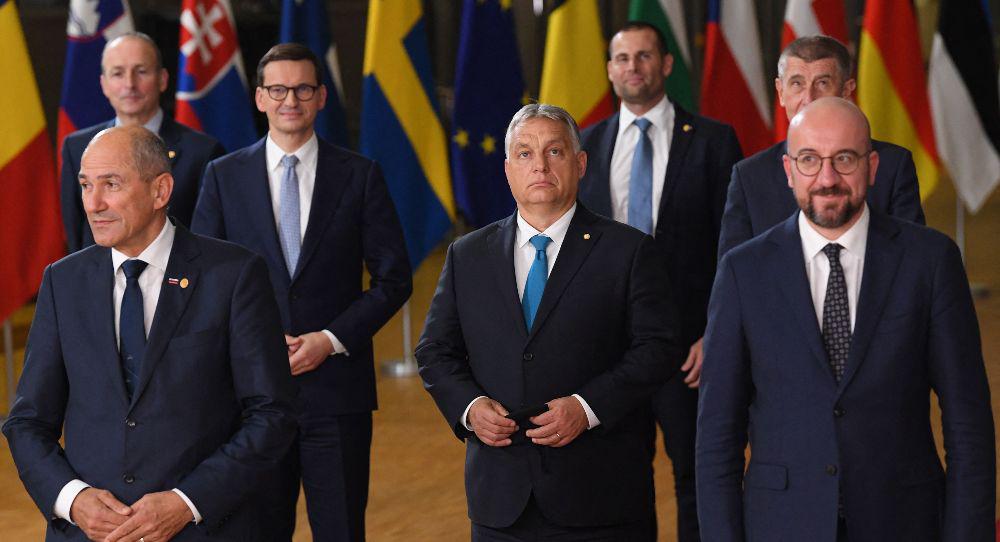
Source: Getty
Differing threat perceptions in Western and Central Europe combined with democratic backsliding risk creating dangerous fractures within the EU. Building a shared understanding of today’s security challenges must go hand in hand with strengthening democracy in the bloc.
Back in 2014, following Russia’s annexation of Crimea, the EU overcame its own historical divisions over relations with Moscow and agreed a set of sanctions that have since remarkably held. The EU has also supported Ukraine economically and in its political reform. As Russia has grown more unabashed in its intention to undermine the EU, European leaders have become less naive about the possibility of dialogue with Moscow.
Yet divisions continue to haunt Europe because they are rooted in different world views, not just in policy preferences. Of these, the cleavages on security and democracy stand out because they have come to overlap in dangerous ways. Security perceptions, especially of Russia, cut across the deepening division between European democracies, and these wedges create an unhealthy fracture between Western and Central Europe.
As Russia threatens Ukraine by amassing troops on its borders and Belarus opposition leader Sergei Tikhanovsky is sentenced to eighteen years of prison, these tensions are undercurrents in the string of meetings taking place in Brussels. EU foreign ministers met on Monday, December 13; two days later, the new German Chancellor Olaf Scholz and French President Emmanuel Macron met the president of Ukraine Volodymyr Zelensky and EU leaders welcomed their counterparts flying in from Eastern Europe for the Eastern Partnership summit.
Today, on December 16, EU leaders gather for the end of the year European Council meeting to decide, among many things, how to meaningfully deter Russia from destabilizing or invading Ukraine. The United States has been asking Europe for a robust response: the onus to support Ukraine is clearly on this side of the Atlantic.
How is Europe responding? EU foreign ministers agreed on a package of sanctions against the Wagner Group—a Russia-based mercenary group responsible for military operations and gross human rights violations in several conflicts and countries. This is an important step but is unlikely to deter Russia.
At the time of writing, the reported European Council draft conclusions will warn Moscow, in coordination with Washington and London, of “massive consequences and considerable costs” without hinting at the nature of the consequences. Extra sanctions toward Belarusian authorities are not expected.
Similarly vague, the Eastern Partnership summit joint declaration stated “we remain deeply concerned about the continuous destabilisation and violations of the principles of international law in many parts of the Eastern Partnership region.” Even if the Eastern Partnership is a dense initiative connecting the EU to six partner countries, the most pro-EU members—Ukraine, Moldova, and Georgia—have long been demanding a clearer perspective of their “European future.”
These muffled responses are the result of a compromise between those who do not want to provoke Russian President Vladimir Putin by crossing his new red lines and those who hope for a more assertive EU in pushing back on Russian encroachments on the bloc’s partners. Behind the compromise are different and deeply felt cognitive perspectives that shape tactical responses.
Simply put, the perception of Russia varies widely across Europe between those historically and geographically closer, who see Russia as a security threat, and those, mostly in Western Europe, who no longer trust Moscow but seek dialogue by virtue of the economic and energy ties and a recognition of Russia’s historical role in Europe. The latter approach has nurtured distrust in Central Europe and the Baltic states over strengthening the EU’s role in Europe’s security: these countries would like to see their analysis of the Russian threat better reflected in EU decisions, not just in NATO.
In Western Europe, Hungary and Poland’s democratic backsliding also fuels distrust. To be fair, the democratic recession is not limited to these two countries but embraces the older Western democracies too. But it is the governments of Hungary and Poland that are systematically undermining the rule of law. The stand-off between the EU institutions and Warsaw is showing no signs of abating, with Warsaw threatening to block all other decisions. Hungary frequently vetoes foreign policy decisions, though has cunningly avoided to do so on important issues such as sanctions towards Russia.
The complaint about democratic backsliding runs deeper than vetoes; the fear is that the principles upon which the entire European integration project was built are being undone, eroding the rule of law—an essential ingredient of the EU’s single market, even for the most pragmatic EU supporters.
The insistence on a more substantive adherence to the democratic rules that hold the bloc together has also been used by some EU governments to block further progress on the accession path of the Western Balkans. The geopolitical and societal costs are huge: democrats in the Western Balkans do not have the anchorage to carry out political reform; a vibrant pro-democracy civil society is increasingly disillusioned (as in Eastern Europe); the region becomes a proxy for the geopolitical games of other powers; and the settlement following the wars of the 1990s is increasingly at risk of collapse in Bosnia and Herzegovina. This is in stark contrast with the experience of the 2000s, when the EU’s enlargement to Central Europe was heralded as its greatest foreign policy success.
The intimate connection between security and democracy has featured in the history of European integration from the beginning. As European security becomes a pressing existential challenge, it requires more than a trade-off between hawks and doves. A reckoning on security and democracy needs to acknowledge the security threat perception of Central Europe and the Baltic states. This was one of the reasons these countries turned West once the Iron Curtain fell.
At the same time, the democratic quality of all EU member states is the basis for their solidarity. Straying from that path risks pulling the EU apart. This would be a sad and dark shadow to the EU’s enlightened handling of the end of the Cold War in Europe.

Director, Carnegie Europe
Rosa Balfour is the director of Carnegie Europe. Her fields of expertise include European politics, institutions, and foreign and security policy.
Recent Work



Richard Youngs, Erik Jones, Dan Baer, …
Rosa Balfour
Carnegie does not take institutional positions on public policy issues; the views represented herein are those of the author(s) and do not necessarily reflect the views of Carnegie, its staff, or its trustees.
An overwhelming victory by a far-right-wing party in a small state in eastern Germany will have major repercussions for Chancellor Friedrich Merz’s coalition.

Judy Dempsey

Canadian Prime Minister Mark Carney has twice inspired praise for standing up to U.S. President Donald Trump: at the 2026 World Economic Forum in Davos and on Canada-U.S. trade negotiations. Is Carney showing a third way better than the EU has in dealing with the Trump administration?

Rym Momtaz, ed.

The EU’s responses to two recent incidents expose the gulf between European perceptions and capabilities. Unless the union can bridge that gap, it will never become a real geostrategic power.
Rym Momtaz

In supporting Europe’s far-right, MAGA and Russia both want the same thing: a weaker EU. Europe must defend itself without abandoning the openness these forces exploit.

Armida van Rij
As we close out another season of Strategic Europe, it is worth taking stock of the deep shifts underway.
Rym Momtaz