

Commentary
Ahead of a tough winter for Ukraine, Donald Trump’s swing back toward Russia bodes ill. But instead of panicking, Kyiv’s European allies are focusing on action.
Rym Momtaz
{
  "authors": [
    "Zsuzsanna Szelényi"
  ],
  "type": "commentary",
  "blog": "Strategic Europe",
  "centerAffiliationAll": "",
  "centers": [
    "Carnegie Endowment for International Peace",
    "Carnegie Europe"
  ],
  "collections": [],
  "englishNewsletterAll": "",
  "nonEnglishNewsletterAll": "",
  "primaryCenter": "Carnegie Europe",
  "programAffiliation": "",
  "programs": [],
  "projects": [],
  "regions": [
    "Europe",
    "Western Europe"
  ],
  "topics": [
    "EU",
    "Economy",
    "Democracy",
    "Climate Change"
  ]
}
Source: Getty
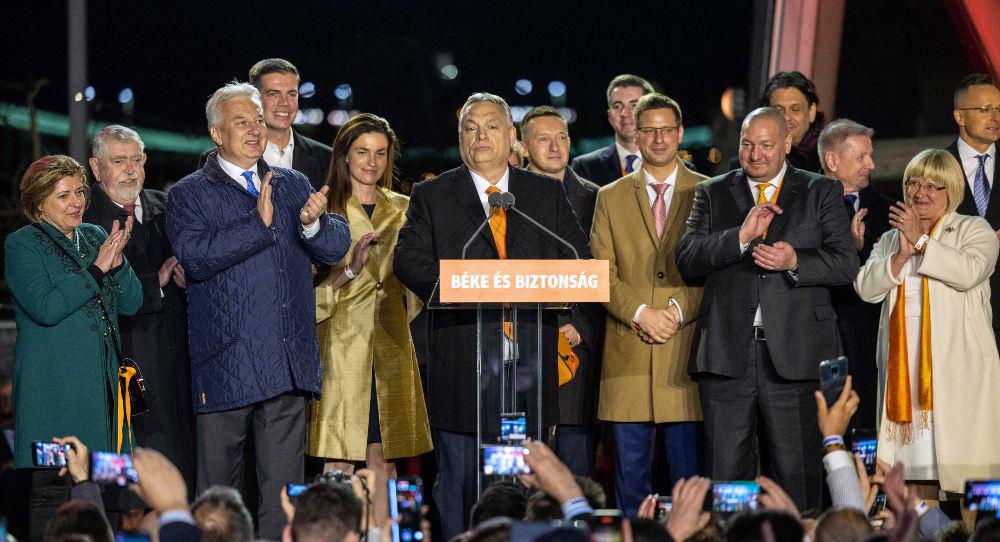
After Viktor Orbán’s landslide victory, the illiberal Hungary experiment will continue. Brussels must respond decisively to the erosion of democracy and media freedom.
The morning of April 3 was unseasonably cold in Hungary. Trees in bloom were covered with snow when Hungarians arrived at the polling stations to vote in the parliamentary election.
The stakes were high: could the united opposition defeat Viktor Orbán’s Fidesz party after twelve years of his “illiberal state?” While outright opposition victory was a faint prospect, there was a realistic hope that Fidesz’s constitutional majority would be finally ended, and that the opposition could act as a check on the ruling party’s unscrupulous activities.
When, two hours after the polls had closed, I arrived at the headquarters of the united opposition, 25–30 percent of the votes were already counted. The mood was gloomy. It was already clear that Fidesz had won. The ruling party gained two-thirds of the seats for the fourth time. The opposition coalition performed much worse than forecasted in all the polls. Almost all their victories were confined to Budapest’s constituencies.
Disturbingly, Our Homeland, a far-right fringe party which had split from Jobbik three years ago, made it into parliament. This election outcome will reverberate in Hungary and Europe.
What lies behind this result?
First, Fidesz were exceptionally good at mobilizing their vote in rural areas. In the poorest Eastern region, Fidesz gained 93 percent of the vote. Typically, these people tend to consume most of their politics from government-dominated public media. In these poor villages, home to many Roma voters, much of the population work in the state’s welfare programmes and are highly dependent for income on local mayors who rallied behind Fidesz.
Second, the overwhelming power of Fidesz in rural areas and small towns underlines the haemorrhaging of the right-wing Jobbik party in these places. Jobbik had allied with the left-liberal and green parties as part of the united opposition in these elections. It seems that a large part of their one million voters, instead of following them, turned to Fidesz or the Our Homeland party.
Finally, Russia’s war in Ukraine had a decisive impact on the election campaign. Since the invasion began in February, the united opposition demanded that Orbán, after years of close relations with Russian President Vladimir Putin, join his European allies and support Ukraine with every means. They presented the elections as nothing less than a choice between Europe and the authoritarian East. Orbán, however, did not let himself be cornered.
The ruling party’s communications team came up with the message that by supporting Ukraine, the opposition were dangerous warmongers and would involve Hungary in the conflict.
The billions of forints spent on negative adverts on billboards, films on Meta and YouTube—together with the output of the hundreds of other media outlets in the hands of Fidesz-related oligarchs—meant these attacks on the opposition worked.
As the result shows, hundreds of thousands of undecided voters were persuaded by Orbán’s simple message: do you want blood (the opposition) or oil (Fidesz)? And they voted for the ruling party en masse.
Fidesz used every means an autocratic government has in its armory, spending the resources of state and party interchangeably to fund political campaigns and creating a rigged media environment where, in addition to the entire public media, even 50 percent of commercial media is controlled by the governing party and financed by government sources.
Since 2010 Orbán has become more repressive with his critics—whether civil society organizations, journalists, or politicians. That is likely to continue. Those municipalities led by opposition parties will need to prepare to face financial punishments that will hollow out their powers. Teachers who were on strike several weeks in February and March 2022 may face retaliation as all of them are employed by the state. Media companies, such as Central Media Group, which still has a significant portfolio independent of the government party’s oligarchs, could be pressured out of the market.
The Hungarian opposition faces a huge dilemma: now that the united platform has failed so badly, what next? It will take several months or years until they recover and are able to answer this question.
As for Hungary’s European partners, they will meet a more hostile Orbán, who, despite a growing isolation within the EU and the Visegrad group, will be emboldened to dig in and demand his due share of financial transfers and decisions.
Orbán will continue building the alliance of far-right parties in Europe. His big hope is that Donald Trump’s Republican supporters will soon return to power and strengthen him from the other side of the Atlantic. We will see how this effort plays out within a few short weeks, when Fidesz hosts the American Conservative Political Action Conference (CPAC), the first ever in Europe, which will bring its radical right-wing activists to Budapest.
The illiberal Hungary experiment will continue. The political language will become more radicalized. The elite polarization will be even more toxic. The distribution of state resources will be more selective. The democratic institutions will be further subverted.
The EU must be decisive: is it prepared to accept an autocratic state among its members?
Zsuzsanna Szelényi is a visiting fellow at the CEU Democracy Institute and former member of parliament in Hungary.

Zsuzsanna Szelényi
Research Fellow, Central European University Democracy Institute
Zsuzsanna Szelényi is the research fellow at the Central European University Democracy Institute.
Carnegie does not take institutional positions on public policy issues; the views represented herein are those of the author(s) and do not necessarily reflect the views of Carnegie, its staff, or its trustees.

Ahead of a tough winter for Ukraine, Donald Trump’s swing back toward Russia bodes ill. But instead of panicking, Kyiv’s European allies are focusing on action.

Rym Momtaz

While the EU and European governments are embracing the much-lauded middle-power moment, this entails three difficult conundrums.

Richard Youngs

Much has been said of the changes Brussels is trying to make to the EU enlargement process. Here’s why gradual integration might—or might not—be the answer.

Dimitar Bechev

The European Commissioner for Trade is headed to China. But after President Xi’s bridge-building visit to Washington, can a more isolated EU overcome Beijing’s stranglehold on critical raw materials? Who will blink first?
Rym Momtaz, ed.

The domestic impacts of how long it is taking to end the war in Ukraine have pushed the French electorate to the political extremes and compromised the country’s diplomatic capacity.
Rym Momtaz