

Commentary
Judy Dempsey
{
  "authors": [
    "Judy Dempsey"
  ],
  "type": "commentary",
  "blog": "Strategic Europe",
  "centerAffiliationAll": "",
  "centers": [
    "Carnegie Endowment for International Peace",
    "Carnegie Europe"
  ],
  "collections": [
    "Europe’s Eastern Neighborhood",
    "EU Integration and Enlargement"
  ],
  "englishNewsletterAll": "",
  "nonEnglishNewsletterAll": "",
  "primaryCenter": "Carnegie Europe",
  "programAffiliation": "",
  "programs": [],
  "projects": [],
  "regions": [
    "Russia",
    "Europe",
    "Eastern Europe",
    "Ukraine"
  ],
  "topics": [
    "Foreign Policy",
    "Security",
    "EU",
    "Democracy"
  ]
}
Source: Getty
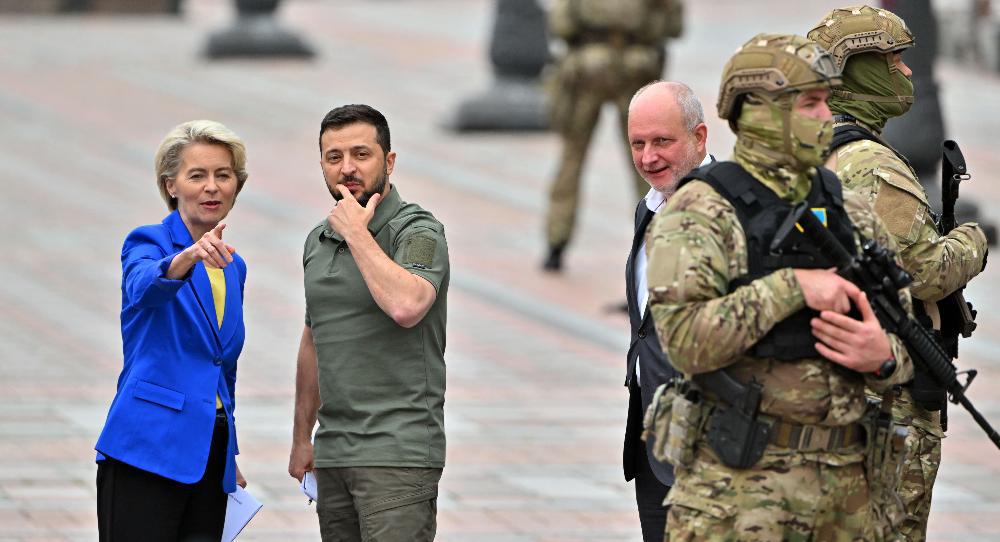
A Russian victory against Ukraine would be devastating for Europe’s security and stability. European governments have no excuse for not realizing what is at stake.
A war is taking place in Europe. Again.
In the 1990s, the former Yugoslavia plunged into a bloody civil conflict. The scale of the violence and the depth of the hatred was frightening. All this was happening a few hours’ drive from Vienna.
The scars are still present.
There is a fragile peace between Serbia and Kosovo. NATO troops are still maintaining stability in the latter. There are ethnic divisions in Bosnia and Herzegovina. Russia and China are meddling there and in the rest of the Western Balkans.
Meanwhile, the EU is still trying to forge a coherent, strategic policy toward the Western Balkans, which it should have done immediately after the Kosovo War in 1999. It didn’t. It had neither a foreign nor a security policy to deal with its own backyard.
There is a connection between the Western Balkans and Russia’s invasion of Ukraine that started nearly seven months ago. If Russia defeats Ukraine or manages to establish a frozen conflict in parts of the country, such a victory of sorts will have devastating consequences for Eastern Europe, for the Western Balkans, and for the EU as a whole.
As a new paper by the European Council for Foreign Relations argues: “Unfortunately, the war shows little prospect of ending. The violence may subside at times, but the absence of any sort of resolution will mean that it could reignite at any moment.”
If that would be the case, the prospects for change in Belarus would disappear. President Alexander Lukashenko would see no reason to loosen his grip over a country in which he has suppressed the opposition, imprisoned thousands, and forced many into exile.
Pro-Russian movements in Georgia and Moldova and in the Caucasus would be encouraged by a Ukrainian defeat or a negotiated settlement that would leave Kyiv with a compromised territorial integrity and independence.
Leaving aside the immense political and economic costs, the Kremlin could use a victory in Ukraine to try and reassert its influence in the post-Soviet sphere. And other authoritarian leaders could be emboldened by Russia’s so-called achievements. In Russia itself, a victory would deal a devastating blow to the pockets of civil society and small opposition to the war. Russia’s authoritarianism could gain further momentum.
As a result, the specter of instability in Eastern Europe could not be ruled out as reformers and pro-Russian movements struggle to shape the direction of their societies. Such instability would have repercussions for the rest of Europe.
Some EU leaders might be persuaded to renew ties with Russia. The long-held unity of the sanctions regime the EU imposed on Russia could falter. Were that to happen, it could mean a return to recent times when several EU capitals, notably Berlin and Paris, viewed Eastern Europe through the prism of Russia.
Not only that; the EU would become more divided and weaker, a development long pursued by Moscow. Recriminations would run deep, with Poland and the Baltic states blaming big EU member states, such as Germany, France, and Italy for not doing enough to provide Ukraine with the military means to win. And political parties sympathetic to Russia would revel in a victory that could give a fillip to populist movements throughout the EU.
In contrast, Ukraine’s victory—and a situation in which Ukraine could enter negotiations from a position of strength—would have immense significance for the rest of Europe. It could trigger a domino effect.
Lukashenko would certainly be weakened. The young pro-European government in Moldova would be strengthened. The infighting in Georgia just might give way to a chance to restart the reforms with the aim of being granted EU candidate status. Pro-Russian movements in parts of the Western Balkans, particularly in Serbia would be weakened. If that were the case, this could be the chance for the EU to assert its influence in the region.
In short, the outcome of Russia’s war in Ukraine, with its shocking scale of brutality, torture, and destruction, is about Europe’s stability, freedom, and democracy. It is about the credibility of Europe and the West.
The EU was not prepared for the war in the former Yugoslavia. It has been pitifully slow in picking up the pieces in the region. European governments now have no excuses not to understand what is at stake in Ukraine.

Nonresident Senior Fellow, Carnegie Europe
Judy Dempsey is a nonresident senior fellow at Carnegie Europe
Recent Work
Judy Dempsey
Judy Dempsey
Carnegie does not take institutional positions on public policy issues; the views represented herein are those of the author(s) and do not necessarily reflect the views of Carnegie, its staff, or its trustees.
Europe has an interest in supporting Armenian leader Nikol Pashinyan as he tries to make peace with neighbors and loosen ties with Russia. But it is depersonalized support in the long term, not quickfire flash, that will win the day.

Thomas de Waal
Following Ursula von der Leyen’s gaffe equating Turkey to Russia and China, relations with Ankara risk deteriorating even further. Without better, more consistent diplomatic messaging, how can the EU pretend to be a geopolitical power?

Sinan Ülgen
Closer EU-UK ties could help address urgent European concerns. But is the EU ready for rapprochement with the United Kingdom?

Rym Momtaz, ed.
Europe has been standing by while its Southern neighborhood is being redrawn by force. To establish a path to peace between Israel and Lebanon, it’s time for Europeans to get involved with hard power.
Rym Momtaz
In Ukraine, Gaza, and Iran, AI warfare has come to dominate, with barely any oversight or accountability. Europe must lead the charge on the responsible use of new military technologies.

Raluca Csernatoni