

Commentary
Before the next wave of EU enlargement takes place, the union needs to grapple with thorny questions of how power is distributed among its members.
Emil Sondaj Hansen, Ditte Brasso Sørensen
{
  "authors": [
    "Bastian Giegerich",
    "Ester Sabatino"
  ],
  "type": "commentary",
  "blog": "Strategic Europe",
  "centerAffiliationAll": "",
  "centers": [
    "Carnegie Endowment for International Peace",
    "Carnegie Europe"
  ],
  "collections": [],
  "englishNewsletterAll": "",
  "nonEnglishNewsletterAll": "",
  "primaryCenter": "Carnegie Europe",
  "programAffiliation": "",
  "programs": [],
  "projects": [],
  "regions": [
    "Europe",
    "Western Europe",
    "Eastern Europe"
  ],
  "topics": [
    "Foreign Policy",
    "EU",
    "Security"
  ]
}
Source: Getty
The need to militarily assist Ukraine is another incentive for better coordinating defense investment at European level. The EU’s initiatives will only deliver if member states are guided by shared considerations.
This blog is part of ENGAGE, a project that examines challenges to global governance and EU external action. A consortium of thirteen academic institutions and think tanks seeks to assess the EU’s ability to harness all its foreign policy tools and identify ways to strengthen the EU as a global actor.
***
When Russia attacked Ukraine in February 2022, defense budgets started rising across EU member states.
Some of these new defense Euros will be eaten up by spiraling inflation rates—high in the general economy, even higher in the defense sector.
Others will be spent inefficiently on longstanding national priorities without much consideration for possible collaboration with other Europeans or shifting requirements in light of the return of conventional war to Europe.
While EU member states donated military assistance and equipment to Kyiv, Russia’s invasion provided yet another pressure point for more and better coordinated defense investment. It is not a given that this will happen.
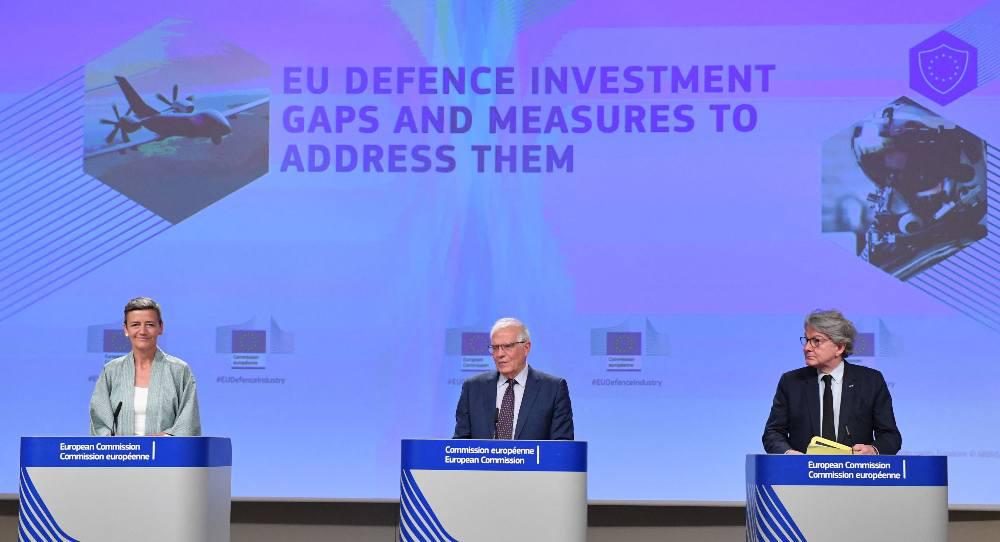
As highlighted in the defense investment gap analysis published in May 2022 by the European Commission in coordination with the European Defense Agency, stockpiles, hardly adequate before the war, need to be replenished urgently. For some EU member states this is an opportunity to flush out Soviet-era equipment from their inventories.
As part of the modernization push, volumes—the sheer size of inventories—and technological advancement will be on the minds of decisionmakers. Generating a European defense industrial capacity to deliver at acceptable speed and in required volumes necessitates a structured dialogue among member states. That includes European defense industries and EU agencies.
There is no shortage of EU plans and instruments, such as the Capability Development Plan (CDP), Permanent Structured Cooperation (PESCO), and the European Defense Fund (EDF).
Yet, defense acquisitions still mainly occur at the national level and in 2020, joint procurement represented only 11 percent of the total armament acquisition of EU member states.
Why such a low percentage? For several reasons. There are differences in EU member states’ strategic cultures. There is the desire to protect national defense industries and champions. There is the temptation to spend money on off-the-shelf products that are at the cutting-edge of technology. And there is the impulse to cement defense partnerships beyond the EU. These factors contribute to the current situation.
The upshot is that progress and more cooperation in this field will require significant investment and incentives that stretch across financial, industrial, and political arenas.
To reduce barriers to cooperation, in July the Commission announced the European Defence Industry Reinforcement through common Procurement Act (EDIPRA). The aim is to provide incentives for joint procurement through cost saving and financial support.
The €500 million ($500 million) fund for 2022–24 may be used for technical and administrative costs and should include an “appropriate amount to create the incentive effect necessary to induce cooperation” among at least three member states.
The mechanism, accessible also to Norway, follows the regulatory logics of the EDF and PESCO. It will take into account the Defence Joint Procurement Task Force’s work—the latter being a recent initiative to help speed up the replenishment effort resulting from armament transfers to Ukraine.
By the end of 2022, the Commission will also present the EU Defence Investment Programme (EDIP) regulation that should further reduce barriers to joint procurement through a VAT exemption. The exemption should be granted only to those procurement programs presented by a European Defence Capability Consortium of at least three member states to procure capabilities developed collaboratively within the EU.
Through these initiatives, the European Commission is expanding its responsibilities in relation to defense industrial policy in Europe. Joint procurements are meant to lead to a higher volume of orders for the selected industry, or consortium of industries, thus potentially reducing the unit costs companies have and customers pay. If there is more than one European producer, selecting who to effectively subsidize with EU money might be tricky.
Although the inclination of EU industrial policy has been to go with the most competitive option, this solution does not necessarily lead to a consolidation of the market unless governments reduce their preference for products that also sustain the national industrial base.
Particularly in areas a government considers to be of key strategic importance, this will be difficult to do, and some observers have suggested a permanent agency for joint procurement may be necessary to effectively deal with different national priorities.
The opportunity for better EU-NATO alignment presented by the upcoming CDP revision in 2023 and the start of a new NATO Defence Planning Process (NDPP) could help as well.
Beyond planning, the EU Defence Innovation Scheme and the Hub for European Defence Innovation are suitable mechanisms for improving research and development, technology, and skills in defense.
The plethora of new initiatives has the potential to change the current European defense industrial landscape. But they are unlikely to succeed unless member states commit to being guided by shared considerations regarding defense industrial strategy. A long string of exceptions and case-by-case decisions is likely to undermine their intended effects.
Governments and companies would have to consider the trade-offs of technology and product specialization to generate savings. Such savings would need to be reinvested in technology and skills, to further improve competitiveness.
This theoretical promise of European defense cooperation is not new. What is new are some of the EU-level incentives and the size of the challenge. Will that be enough?
Bastian Giegerich is director of Defence and Military Analysis at the International Institute for Strategic Studies (IISS) and is based in London.
Ester Sabatino is research analyst for Defence and Military Analysis at the International Institute for Strategic Studies (IISS)-Europe and is based in Berlin.


Bastian Giegerich
Director General and Chief Executive, International Institute for Strategic Studies
Bastian Giegerich is the director general and chief executive of the International Institute for Strategic Studies.

Ester Sabatino
IISS
Ester Sabatino is research analyst for Defence and Military Analysis at the International Institute for Strategic Studies (IISS)-Europe and is based in Berlin.
Carnegie does not take institutional positions on public policy issues; the views represented herein are those of the author(s) and do not necessarily reflect the views of Carnegie, its staff, or its trustees.

Before the next wave of EU enlargement takes place, the union needs to grapple with thorny questions of how power is distributed among its members.


Emil Sondaj Hansen, Ditte Brasso Sørensen

A summer of escalation in the Black Sea has hurt Ukraine economically and is exacerbating world food security. A truce is needed—as is a broader reframing of Europe’s Ukraine strategy.

Thomas de Waal

Are Germany’s economic, industrial, and political struggles becoming a liability for the EU’s ability to rise to the geopolitical moment?

Rym Momtaz, ed.

European Commission President Ursula von der Leyen is about to give her annual address on the state of the EU. Here’s what she won’t—but should—say.
Rym Momtaz

The aftermath of the Ceuta crisis shows Europe has drawn the wrong lessons. Rather than doubling down on failed migration policies, the EU needs to address the underlying roots of such episodes.

Richard Youngs