

Commentary
With its public finances in shambles, the far right polling at 35 percent ahead of the 2027 presidential election, and a growing protest movement, is France’s crisis a threat to the EU’s geopolitical awakening?
Rym Momtaz, ed.
{
  "authors": [
    "Lizza Bomassi"
  ],
  "type": "commentary",
  "blog": "Strategic Europe",
  "centerAffiliationAll": "",
  "centers": [
    "Carnegie Endowment for International Peace",
    "Carnegie Europe"
  ],
  "collections": [],
  "englishNewsletterAll": "",
  "nonEnglishNewsletterAll": "",
  "primaryCenter": "Carnegie Europe",
  "programAffiliation": "",
  "programs": [],
  "projects": [],
  "regions": [
    "Asia",
    "Europe",
    "Southeast Asia",
    "Western Europe"
  ],
  "topics": [
    "Foreign Policy",
    "Economy",
    "EU",
    "Climate Change"
  ]
}
Source: Getty
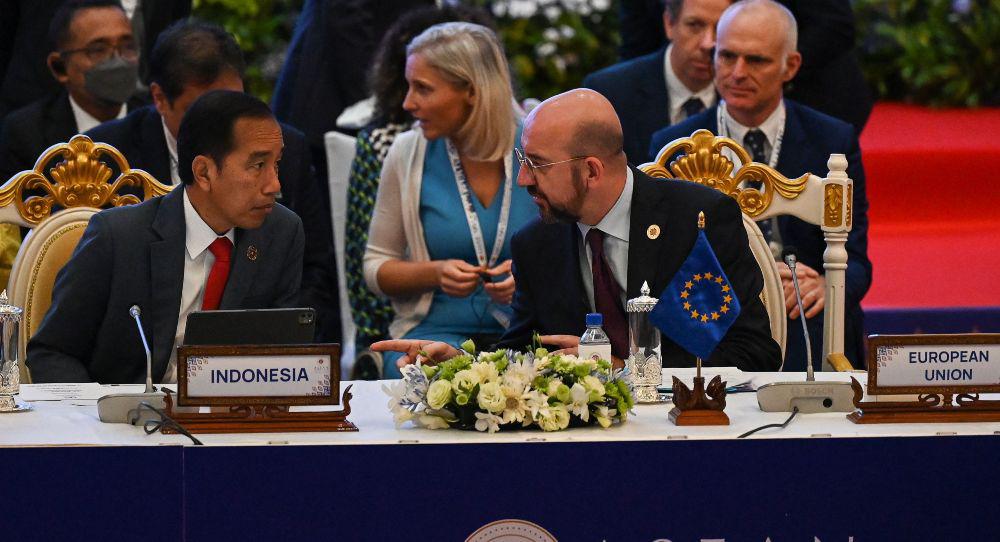
The EU and ASEAN need each other to counterbalance the geopolitical rivalry playing out between China and the United States. A strong partnership requires better communication by Brussels.
In 2020, the European Union and the Association of Southeast Asian Nations (ASEAN) upgraded their longstanding relationship to a strategic partnership.
At the time, it sent a strong signal of both regions’ intent to strengthen their commitment to one another in what was a prescient move by the EU.
Prescient because within months, the EU was going to need partners and champions outside the West to reaffirm its standing in the world. From the Covid-19 pandemic and the coup in Myanmar to Russia’s invasion of Ukraine, a series of external and internal shocks have forced both regions to focus on the acute challenges of the day and their relationship has been consigned to the margins once again.
Indeed, on the eve of what is supposed to be a very important EU-ASEAN summit—what was initially rumored to be a leaders’ meeting to address the many crises and uncertainties unleashed in recent years—the event has been relegated to an opportunity to commemorate forty-five years of diplomatic relations. Even the unofficial side events seem to be tackling more consequential issues than the official summit itself.
As for the outcome, if there is a joint statement, it will likely lack substance. There will be a reaffirmation of both regions’ commitment to one another followed by support for ASEAN centrality and a nod to the need for respecting the international rules-based order.
In principle, this should not be an issue. The relationship—as established as it is—can weather distractions. And there is certainly a strong case for thornier issues being best left addressed outside the spotlight.
The problem is, left unaddressed at the highest levels, these distractions become systemic and do not reflect the reality of current global circumstances. It smacks of indifference and does not do justice to the countless hours spent by EU and ASEAN civil servants, diplomats, and civil society actors who have tried to address these challenges—be they military, supply chain geopolitics, or human rights—in other fora. Just going through the motions, because it is more convenient and less problematic is not a solution and can lead to misunderstanding, even contempt.
Details matter. So does signaling.
History is littered with examples of how miscommunication can turn into conflict, even between longstanding allies. Just look at the recent tumult caused by U.S. President Joe Biden’s Inflation Reduction Act, which, because it was badly communicated to global allies in Europe, Asia, and elsewhere before and after its signing, caused no small amount of consternation.
The EU is in danger of making a similar blunder, within the context of the EU-ASEAN relationship, with a little known (outside of industry circles) but potentially explosive issue: the EU’s forthcoming directive on corporate sustainability due diligence.
Due to go under the European Parliament and Council’s microscope in 2023, the directive, once transposed into national law, will impose obligations on EU and non-EU companies to check supply chains for environmental and human rights issues and respond to findings. This may not appear problematic to ASEAN at first glance, given that this directive is primarily targeted at large multinationals, but even the European Commission itself recognizes that small and medium-sized enterprises (SMEs) will be indirectly affected. A reminder: in ASEAN’s ecosystem, micro, small, and medium enterprises make up a whopping 97.2 percent of economic power.
The directive covers a host of difficult and sensitive issues. If the EU does not proactively reach out to ASEAN and consult with them what the implications will be for a region whose economic bedrock is so reliant on its SME sector, the directive is unlikely to go down well.
The dangers of unintended consequences may be amplified by the fact that the EU-ASEAN playing field is so nuanced right now that it’s difficult to see who will have the upper hand in any potential negotiations. ASEAN is on the rise with annual growth in many of its member countries projected at 4-5 percent in the coming decade; Europe on the other hand has entered a period of critical vulnerability as it tries to diversify its energy reliance, tackle raging inflation, and contend with a serious security situation on its Eastern flank. Yet ASEAN also needs the EU to act as a legitimate and viable counterbalance to the geopolitical rivalry playing out between China and the United States in its own backyard.
This is why signaling is so important from the outset. The external perception of the relationship needs to be accorded the same amount of importance it has in reality.
The EU has never been good at advertising itself—it suffers from an overly long list of priority areas, national distractions, and technicalities. But there are things it is good at, from taking the lead on issues of global importance, such as the fight against climate change, to reigning in unwieldy industries by subjecting them to the EU’s regulatory machinery.
If it does not apply the lessons learnt from these experiences to improve its own public relations, the EU risks losing out on the very champions and partners it needs the most.

Lizza Bomassi
Former Deputy Directory, Carnegie Europe
Lizza Bomassi was the deputy director of Carnegie Europe.
Carnegie does not take institutional positions on public policy issues; the views represented herein are those of the author(s) and do not necessarily reflect the views of Carnegie, its staff, or its trustees.

With its public finances in shambles, the far right polling at 35 percent ahead of the 2027 presidential election, and a growing protest movement, is France’s crisis a threat to the EU’s geopolitical awakening?

Rym Momtaz, ed.

Ahead of a tough winter for Ukraine, Donald Trump’s swing back toward Russia bodes ill. But instead of panicking, Kyiv’s European allies are focusing on action.
Rym Momtaz

While the EU and European governments are embracing the much-lauded middle-power moment, this entails three difficult conundrums.

Richard Youngs

Much has been said of the changes Brussels is trying to make to the EU enlargement process. Here’s why gradual integration might—or might not—be the answer.

Dimitar Bechev

The European Commissioner for Trade is headed to China. But after President Xi’s bridge-building visit to Washington, can a more isolated EU overcome Beijing’s stranglehold on critical raw materials? Who will blink first?
Rym Momtaz, ed.