

Commentary
Dimitar Bechev
{
  "authors": [
    "Dimitar Bechev"
  ],
  "type": "commentary",
  "blog": "Strategic Europe",
  "centerAffiliationAll": "",
  "centers": [
    "Carnegie Endowment for International Peace",
    "Carnegie Europe"
  ],
  "collections": [
    "Europe’s Eastern Neighborhood",
    "EU Integration and Enlargement"
  ],
  "englishNewsletterAll": "",
  "nonEnglishNewsletterAll": "",
  "primaryCenter": "Carnegie Europe",
  "programAffiliation": "",
  "programs": [],
  "projects": [],
  "regions": [
    "Europe",
    "Eastern Europe",
    "Western Europe",
    "Western Balkans"
  ],
  "topics": [
    "Foreign Policy",
    "EU",
    "Democracy"
  ]
}
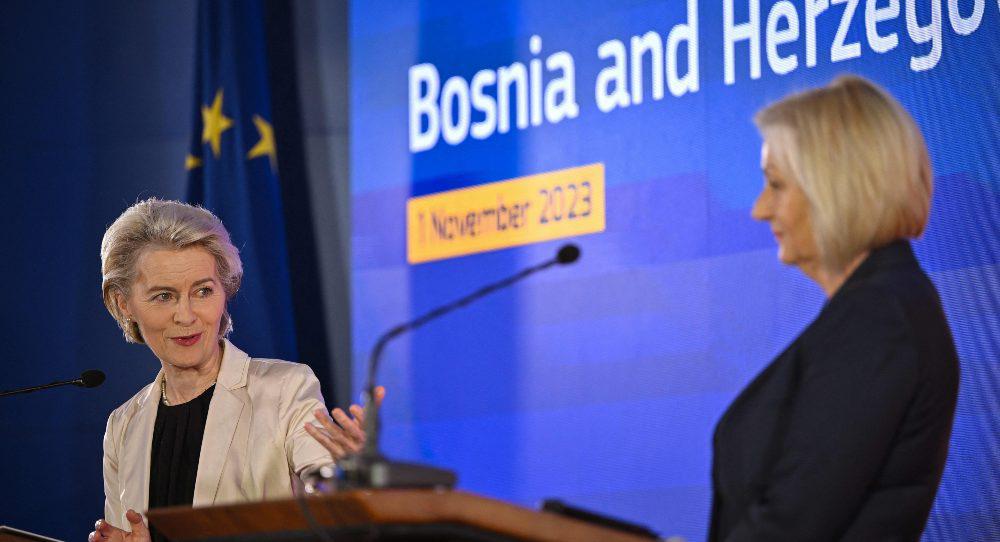
Source: Getty
Enlargement remains the most powerful foreign policy tool at the EU’s disposal. But it is likely to remain dysfunctional irrespective of what European leaders decide next week.
EU enlargement is en vogue again.
Days away from the December 14–15 European Council, suspense is building up over whether the EU’s top brass will give a go-ahead to starting EU membership talks with Ukraine. Moldova, which, like its eastern neighbor received candidate status in June 2022, is similarly hopeful that negotiations are within reach.
In the Balkans, Bosnia and Herzegovina hopes to jump on this bandwagon, too—and some member states are arguing its case. Speaking to the FT in November, Austrian Foreign Minister Alexander Schallenberg warned the EU not to forget the Western Balkans, while looking at the region “with a magnifying glass” and at Ukraine with “rose-tinted glasses.”
To be fair, there are reasons to worry that the EU has not overcome its proverbial myopia when it comes to geopolitics. Yes, Russia’s aggression against Ukraine has awakened policymakers in Brussels, Berlin, and Paris, reminding them of the strategic value of enlargement. After all, the union has few other political tools at its disposal to respond to security challenges on its periphery. It possesses no standing army or intelligence capability. Member states have been providing military assistance to Ukraine, but collectively they have not done a stellar job, to put it mildly, in scaling up ammunition production to supply the frontlines and refill national stocks.
Enlargement—or member-state building, to use a fashionable term from the mid-2000s—remains the most potent instrument the twenty-seven-strong bloc has at its disposal. However, enlargement policy is also dysfunctional and is likely to remain so irrespective of what the European Council decides next week.
As I have argued in the past, enlargement suffers from both a supply and a demand deficit. On the supply side, member states and their governments have not been keen to pursue it for fear that it will generate costs in addition to benefits—be that domestic pushback, diminished influence over Brussels institutions, less money from the EU budget, or other drawbacks.
Arguably, Russia’s aggression has changed the calculus and these days, even enlargement-skeptics like France are more favorably disposed to the idea of opening the union’s door. Yet there are the blockers, too.
Hungary’s Viktor Orbán, for instance, will condition his endorsement of Ukraine’s accession talks on unblocking the frozen transfers from the EU budget, including the post-Covid Next Generation EU instrument. Moving forward, the Netherlands under the likely premiership of Geert Wilders could easily turn into a naysayer too, linking enlargement with increased migration. The list goes on. And even if the EU introduces qualified majority voting on enlargement to rein in the spoilers, it remains the case that a future accession treaty for Montenegro, Ukraine, or any other country has to be signed and duly ratified by all twenty-seven member states.
That, in turn, exacerbates enlargement’s demand-side problem. If membership is at best a long-term prospect, why conform with EU demands to tackle corruption in the higher echelons of power, reform the judiciary, or implement—in good faith—Brussels’ rules on the economy or public policy?
The Western Balkans is a stark example of leaders talking the talk of Europe but walking the walk only when it suits them. There is a reason to believe that, should they ever join the EU, countries like Serbia, Albania, and North Macedonia would emulate Hungary or Bulgaria—not Sweden, or even Slovenia or Croatia.
The Balkan populations have meanwhile grown cynical. With the possible exception of Serbia, support for membership remains high across the region. However, people are aware that the most sure way of joining is doing so individually, by simply moving to Vienna, Munich, or Milan rather than waiting another decade or two before their home country makes it through Brussels’ golden gates. That is why the predominant reaction in the Western Balkans to the fact that Ukraine and Moldova are now also part of the enlargement pack is indifference rather than anger that those two have jumped the queue. “We were promised EU membership some twenty years ago,” the response goes, “and look where we are—stuck in a limbo. You will learn your lesson too.”
That, however, does not change the fact that the EU will continue to have a magnetic pull to neighbors. With or without formal membership, both the Western Balkans as well as Ukraine and Moldova will become more and more integrated into the EU-sphere in the years to come. Ukrainians are likely to retain access to EU labor markets, for instance, as a consolation prize for non-accession. The Western Balkans will be enmeshed even more deeply into the EU’s single market, a policy priority under a Franco-German paper from last September which looks at ways on how to overhaul the union ahead of its expansion.
All EU neighbors will come under pressure to get onboard the European Green Deal, or else pay extra for the right to export their carbon-intensive products to the bloc. Candidate countries may become eligible for additional financing to comply with EU policies and legislation. Europeanization will march forward, even if Brussels may struggle to turn this into a lever for influencing politics and security choices on the European periphery.
When Ursula von der Leyen took office as head of the European Commission in 2019, she pitched the notion of a “geopolitical Commission.” There is a case to be made that the EU has gone in that direction since February 24, 2022. However, we have to be realistic as to what enlargement can and cannot achieve.

Senior Fellow, Carnegie Europe
Dimitar Bechev is a senior fellow at Carnegie Europe, where he focuses on EU enlargement, the Western Balkans, and Eastern Europe.
Recent Work
Dimitar Bechev


Miloš Pavković, Fitim Gashi, Iliriana Gjoni, …
Carnegie does not take institutional positions on public policy issues; the views represented herein are those of the author(s) and do not necessarily reflect the views of Carnegie, its staff, or its trustees.

Are Germany’s economic, industrial, and political struggles becoming a liability for the EU’s ability to rise to the geopolitical moment?

Rym Momtaz, ed.

European Commission President Ursula von der Leyen is about to give her annual address on the state of the EU. Here’s what she won’t—but should—say.
Rym Momtaz

The aftermath of the Ceuta crisis shows Europe has drawn the wrong lessons. Rather than doubling down on failed migration policies, the EU needs to address the underlying roots of such episodes.

Richard Youngs

An overwhelming victory by a far-right-wing party in a small state in eastern Germany will have major repercussions for Chancellor Friedrich Merz’s coalition.

Judy Dempsey

Canadian Prime Minister Mark Carney has twice inspired praise for standing up to U.S. President Donald Trump: at the 2026 World Economic Forum in Davos and on Canada-U.S. trade negotiations. Is Carney showing a third way better than the EU has in dealing with the Trump administration?
Rym Momtaz, ed.